हिंदी में पढ़ें —JantaScope हिंदी
Politics

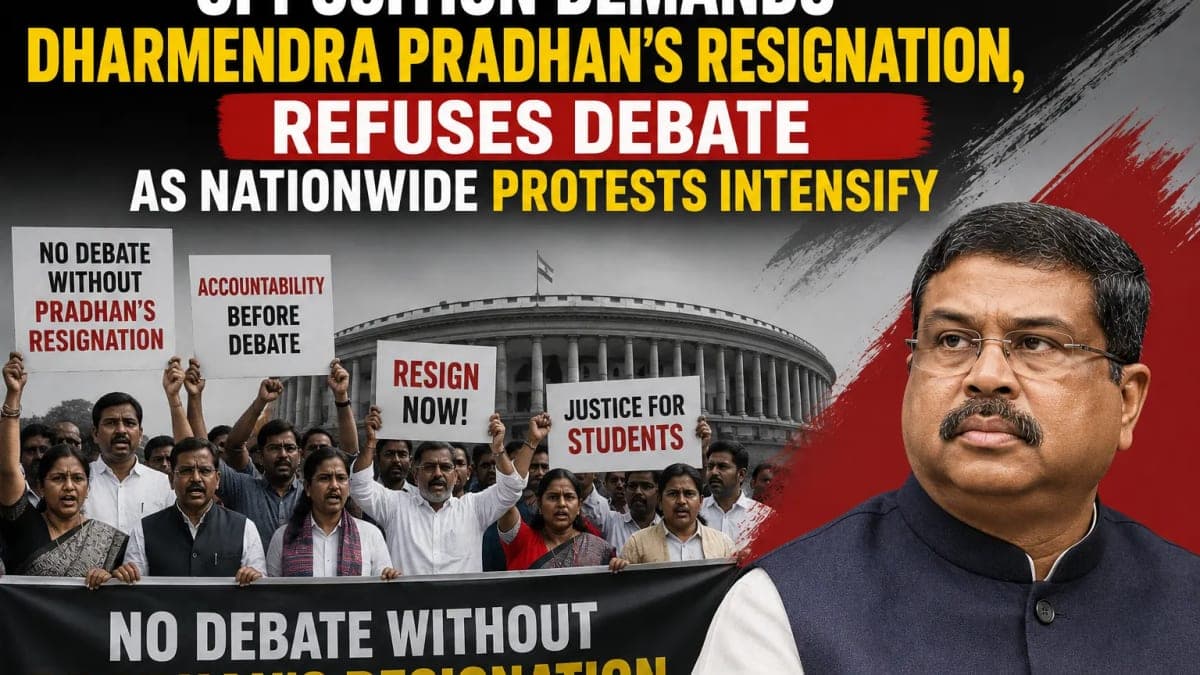
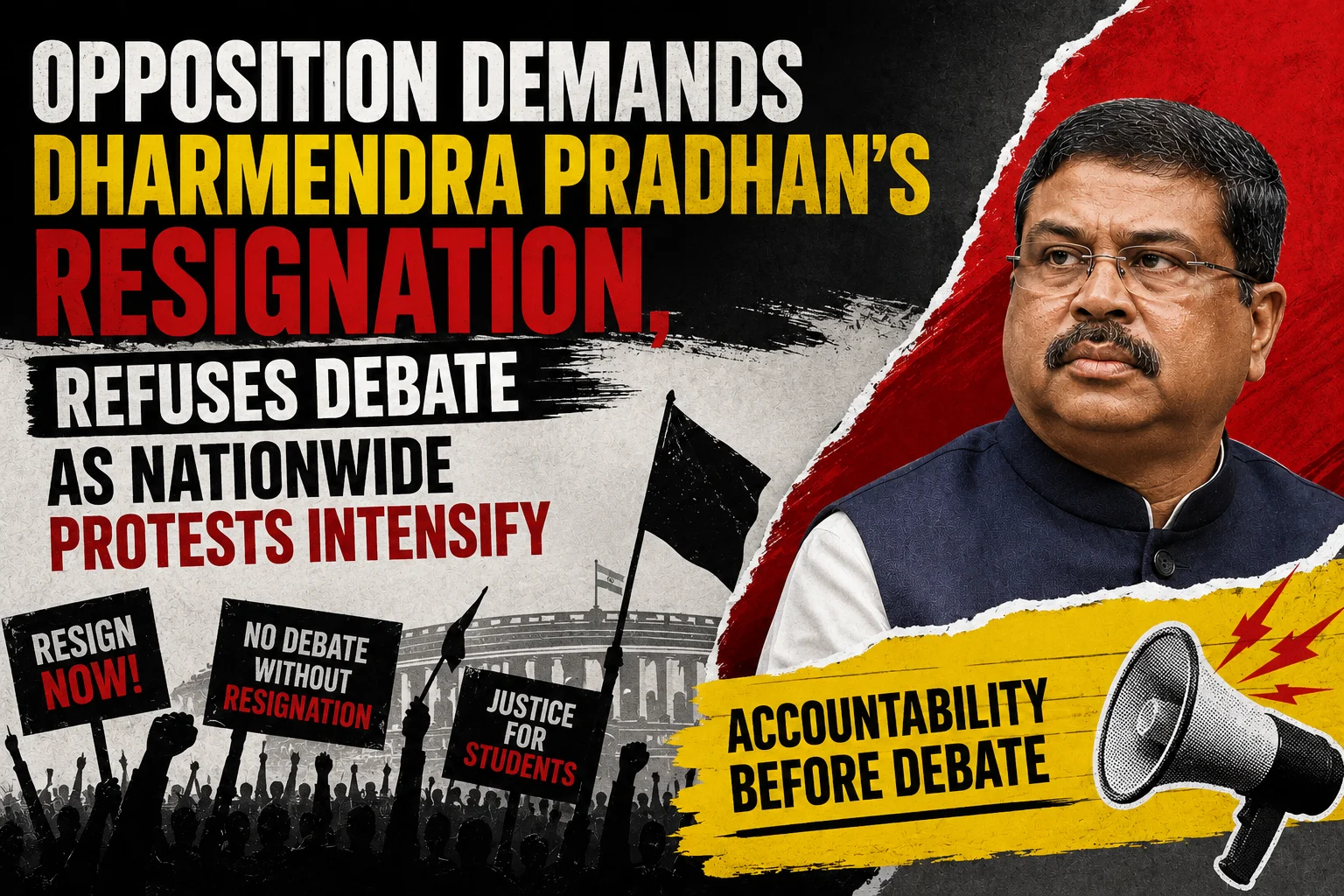
Opposition Demands Dharmendra Pradhan’s Resignation, Refuses Debate as Nationwide Protests Intensify

A fresh political confrontation has unfolded after opposition parties declared they would not participate in parliamentary discussions unless Union Education Minister Dharmendra Pradhan resigns. The standoff has extended beyond Parliament, with opposition leaders taking to the streets to press their demand and intensify pressure on the government.

Opposition Demands Dharmendra Pradhan’s Resignation, Refuses Debate as Nationwide Protests Intensify

By Jeet Nirmal

Source: Janta Scope

Opposition Demands Dharmendra Pradhan’s Resignation, Refuses Debate as Protests Escalate

Opposition Hardens Stand in Parliament

Opposition parties have intensified their campaign against the government by insisting that Union Education Minister Dharmendra Pradhan step down before any substantive discussion takes place in Parliament.

Leaders from several opposition parties argued that accountability should precede debate, maintaining that the minister's resignation is necessary to ensure an impartial discussion on issues related to the education sector and recent controversies.

The demand has resulted in a political deadlock, with parliamentary proceedings facing continued disruptions.

Protest Moves Beyond Parliament

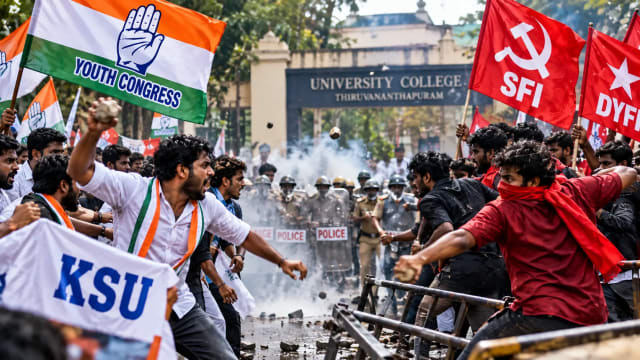
Alongside their parliamentary strategy, opposition leaders and party workers staged demonstrations outside the legislature and in other public spaces, seeking to amplify their message.

The protests featured slogans, placards, and coordinated demonstrations aimed at highlighting their demand for ministerial accountability. The street protests underscored the opposition's attempt to combine legislative pressure with public mobilisation.

Government Maintains Its Position

The government has maintained that Parliament remains the appropriate forum for addressing national issues and has urged opposition members to participate in discussions rather than disrupt proceedings.

Government representatives have argued that debate and accountability can coexist within the parliamentary process and have defended the minister against demands for resignation.

Officials have continued to stress the importance of allowing Parliament to function normally while political differences are discussed through established democratic mechanisms.
Education Issues at the Centre of the Dispute

The political confrontation is closely linked to continuing concerns surrounding examination management and education governance. Opposition parties have argued that recent developments have raised serious questions about administrative oversight and public confidence in competitive examinations.

The government, meanwhile, has reiterated its commitment to strengthening examination systems and ensuring transparency through institutional reforms and ongoing investigations where necessary.

Political Stakes Continue to Rise

The issue has become one of the most prominent flashpoints of the current parliamentary session, reflecting broader disagreements between the ruling coalition and the opposition over accountability and governance.

By demanding a resignation before any debate, opposition parties have adopted a strategy intended to increase political pressure, while the government continues to reject what it views as preconditions for parliamentary discussion.

Parliamentary Deadlock Continues

Repeated adjournments and interruptions have affected legislative business, delaying debates on several important issues. Parliamentary observers note that prolonged disruptions often reduce the time available for legislative scrutiny and policy discussions.

Both sides continue to defend their positions, making an immediate resolution uncertain.

Why This Development Matters

The dispute extends beyond a single political demand. It reflects broader questions about ministerial responsibility, parliamentary functioning, and how democratic institutions address public concerns during periods of political disagreement.

The manner in which the government and opposition resolve the current impasse may influence not only the remainder of the parliamentary session but also the wider public debate on accountability, education governance, and legislative cooperation.

Related

More stories

Xi Jinping Likely to Visit India After 7 Years for BRICS Summit in Major Diplomatic Development

Chinese President Xi Jinping is likely to travel to New Delhi for the BRICS Summit on September 12–13, 2026, in what would be his first visit to India in seven years. Reports indicate he could arrive with a delegation of about 400 officials, while his final travel plans have not yet been officially confirmed.

Politics

Xi Jinping Likely to Visit India After 7 Years for BRICS Summit in Major Diplomatic Development

Tension at Vidhana Soudha as Karnataka BJP Protest Over Valmiki Corporation Case Escalates

Political tensions intensified around Bengaluru's Vidhana Soudha as Karnataka BJP leaders and workers protested demanding the removal of minister B Nagendra over alleged financial irregularities involving the Maharshi Valmiki Scheduled Tribes Development Corporation. Police blocked protesters attempting to move toward the legislature, leading to scuffles and the detention of several BJP leaders.

Politics

Tension at Vidhana Soudha as Karnataka BJP Protest Over Valmiki Corporation Case Escalates

Women’s Reservation Back in Spotlight: BJP and Congress Clash as Rahul Gandhi Becomes Centre of Political Battle

The debate over women’s political representation has returned to the centre of national politics, with the BJP and Congress trading sharp accusations over the implementation of the 33% reservation for women in the Lok Sabha and state assemblies. Rahul Gandhi has emerged as a key figure in the confrontation as both sides challenge each other’s record on women’s empowerment.

Politics

Women’s Reservation Back in Spotlight: BJP and Congress Clash as Rahul Gandhi Becomes Centre of Political Battle

Parliament Session Ended 10 Days Ago — So Why Has It Still Not Been Formally Closed? Congress Raises Questions

A procedural delay after Parliament’s Monsoon Session has turned into a fresh political controversy. Both the Lok Sabha and Rajya Sabha were adjourned sine die on August 13, 2026, but the session had still not been formally prorogued more than a week later. Congress has questioned the gap and sought clarity from the government, while political speculation has grown over whether Parliament could be recalled to consider important legislation.

Politics

Parliament Session Ended 10 Days Ago — So Why Has It Still Not Been Formally Closed? Congress Raises Questions

PM Modi’s Marathon BJP Meeting Signals Early Push for 2027 State Elections — Here’s What Was Discussed

Prime Minister Narendra Modi held an extended meeting with the BJP’s newly appointed national office-bearers in New Delhi as the party begins sharpening its organisational and political strategy for the next round of Assembly elections. The discussions put emphasis on strengthening the party organisation, connecting with younger voters, improving coordination and preparing state units for upcoming electoral contests.

Politics

PM Modi’s Marathon BJP Meeting Signals Early Push for 2027 State Elections — Here’s What Was Discussed

Rahul Gandhi–BJP Political Battle Escalates After Pune Student Outreach

A student-focused outreach programme led by Congress leader Rahul Gandhi in Pune has triggered a fresh political confrontation between the Congress and the BJP. While Gandhi used the platform to raise questions around women’s rights, gender equality and concerns affecting students, BJP leaders accused the Congress of converting a youth interaction into a political event. The Congress, in turn, has argued that the sharp BJP response shows the ruling party is uncomfortable with Gandhi’s growing.

Politics

Rahul Gandhi–BJP Political Battle Escalates After Pune Student Outreach