Parliament Adjourned, But Session Remains Formally Open
New Delhi: The conclusion of Parliament’s Monsoon Session has produced an unusual political debate after Congress questioned why the session had not yet been formally prorogued.
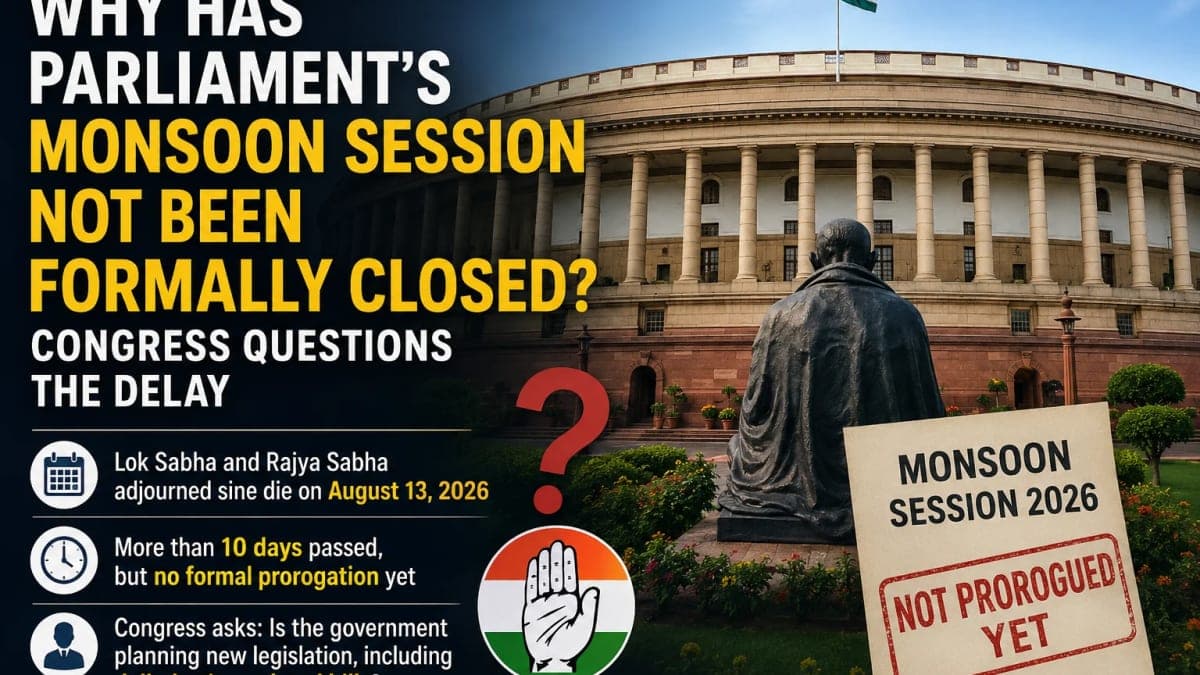
The Lok Sabha and Rajya Sabha were adjourned sine die on August 13, marking the end of their scheduled sittings. However, adjournment sine die and prorogation are not the same parliamentary procedure. While adjournment ends the sittings of a House without announcing another sitting date, prorogation formally terminates the session.
As of August 23, no formal prorogation notification had been issued, according to reports. The extended gap has prompted Congress to publicly question the government's intentions.
Jairam Ramesh Questions the Delay
Congress general secretary in charge of communications Jairam Ramesh highlighted the length of time between the adjournment and expected prorogation.
Ramesh said the gap is generally around two to four days and noted that there have also been occasions when prorogation followed on the same day. He questioned why no information had emerged even 10 days after the Lok Sabha was adjourned sine die.
The Congress leader also linked his questions to speculation surrounding possible delimitation-related legislation and asked whether Union Home Minister Amit Shah was attempting to secure the numbers necessary for a constitutional amendment.
That suggestion remains a political allegation rather than an established explanation for the delay.
Why Does Prorogation Matter?
Under India’s constitutional framework, the President prorogues Parliament on the advice of the government. The distinction is important because adjournment sine die stops the current sittings, whereas prorogation formally brings the parliamentary session itself to an end.
The delay therefore does not mean that MPs have continued meeting since August 13. Parliamentary proceedings have stopped, but the formal constitutional step closing the session had not been completed as of the latest reports.
The timing has attracted additional attention because Parliament can potentially be brought back before prorogation without beginning an entirely new session, contributing to speculation that the government may want to retain procedural flexibility.
Delimitation and Women’s Reservation Enter the Political Debate
Much of the political speculation surrounding the delay has focused on delimitation and the implementation of women’s reservation in legislatures.
The women’s reservation framework is linked to a future delimitation exercise, making questions about constituency boundaries and parliamentary representation politically significant ahead of the 2029 Lok Sabha election.
Reports have suggested that political parties are increasingly focused on the numbers required for constitutional changes, particularly because constitutional amendments can require a special majority in Parliament.
Congress has used the prorogation delay to question whether the government is considering another legislative move. However, the absence of prorogation by itself does not establish that a special sitting or a particular Bill is imminent.
Why the Delay Has Become Politically Significant
The controversy matters for two reasons.
First, parliamentary procedure is not merely ceremonial. Formal steps such as summoning and proroguing sessions establish clear boundaries between different periods of legislative business.
Second, the political environment has made an otherwise technical procedure more closely watched. The Monsoon Session was marked by confrontation between the government and Opposition, including disruptions and disputes over several national issues. Parliamentary Affairs Minister Kiren Rijiju blamed Opposition parties for disrupting proceedings, while the Opposition repeatedly accused the government of avoiding adequate discussion on issues it wanted raised.
Against that backdrop, an extended gap before prorogation has inevitably generated political questions.
Is the Delay Unprecedented?
The gap appears unusual compared with recent practice, but that does not automatically make it unconstitutional.
Congress has pointed to the more common two-to-four-day interval between adjournment and prorogation. As one recent comparison, the 2026 Budget Session ended on April 18 and was formally prorogued two days later.
The present delay is therefore notable primarily because it differs from the recent pattern and because it comes at a politically sensitive moment.
Balanced Analysis: Procedure or Political Strategy?
There are two separate issues that should not be conflated.
The first is factual: Parliament's two Houses were adjourned sine die on August 13, and formal prorogation had not occurred by August 23. That extended interval is what Congress has challenged.
The second is political interpretation. Congress has suggested that the government could be keeping its legislative options open, particularly in relation to delimitation-linked measures. That remains speculation unless the government announces such a plan or provides another explanation.
For the government, keeping a session technically open may provide procedural flexibility. For the Opposition, however, the absence of a clear explanation creates room to question whether an important legislative move is being prepared.
The controversy may therefore continue until Parliament is formally prorogued or the government clearly explains why the process has taken longer than usual.
This article is based on reporting published by TOI.