Modi Steps Up Engagement With BJP’s New Leadership Team
Prime Minister Narendra Modi has intensified his engagement with the Bharatiya Janata Party’s organisational leadership as the ruling party begins looking ahead to another important cycle of state elections.
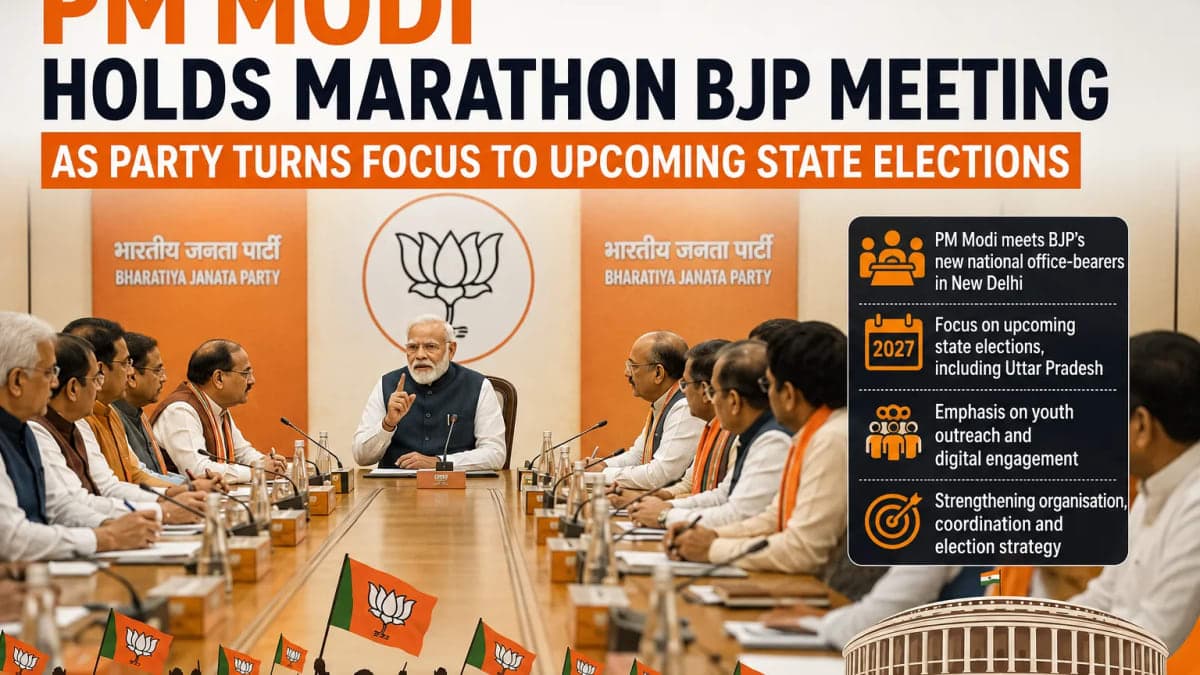
Modi participated in an extended interaction with the BJP’s newly appointed national office-bearers at the party headquarters in New Delhi. The meeting reportedly continued for around four-and-a-half hours, making it a substantial organisational exercise rather than a brief introductory gathering.
The discussions came shortly after BJP president Nitin Nabin chaired the first meeting of the party’s new national office-bearers. State unit presidents and party leaders responsible for different states have also been involved in the wider organisational discussions.
The timing is politically significant. Although several major Assembly elections of 2026 are now over, the BJP is already turning its attention towards the contests due in 2027 and the organisational groundwork required before campaigning formally gathers pace.
Upcoming State Elections Move Onto BJP’s Agenda
The BJP leadership is preparing for Assembly elections expected in several states in 2027. Uttar Pradesh will inevitably attract particular attention because of its political weight and its 403-member Assembly, but the wider election cycle also includes other states where the party will have to defend existing positions or attempt to expand its presence.
Reports on the BJP's latest organisational meetings indicate that preparations for the 2027 Assembly elections have become an important part of the party's agenda.
Rather than waiting for election notifications or campaign season, the BJP appears to be placing emphasis on early organisation-building.
That approach could involve strengthening state and district structures, assessing local political conditions, improving communication between the national and state leadership and preparing workers well before candidates enter the field.
Digital Outreach and Younger Voters in Focus
Another important theme emerging from Modi’s interaction was the need to strengthen engagement with younger Indians and improve the party’s digital connection with voters.
Digital communication has become an increasingly important part of Indian election campaigns. Political parties now compete not only through rallies, door-to-door campaigns and traditional media but also through short-form videos, social platforms and direct online engagement.
Reports from the meeting indicate that Modi emphasised digital outreach and engagement with younger voters as the BJP considers how its organisation should evolve for future political contests.
For the BJP, this means its electoral preparation is likely to combine its established booth-level organisation with a stronger technology-driven communication strategy.
Modi Calls for Fresh Ideas and Perspectives
The meeting was also notable because it brought Modi together with the BJP's newly constituted national team.
After the interaction, Modi described the engagement as being centred around new ideas and perspectives, suggesting that the exercise was also intended to establish coordination between the Prime Minister and the party's recently appointed organisational leadership.
That coordination could become increasingly important as the BJP moves from organisational restructuring toward election-specific planning.
The Prime Minister's close involvement also sends a message internally: preparations for future elections are likely to remain closely connected to the party's national leadership even when campaigns are shaped around state-specific political conditions.
Why the Meeting Matters
The significance of the meeting goes beyond its duration.
For any national political party, state elections are tests not only of public support but also of organisational strength. Candidate selection, booth management, alliances, local leadership disputes, campaign messaging and voter mobilisation can all influence the outcome.
Beginning preparations early gives the BJP time to identify organisational weaknesses before they become campaign problems.
It can also allow the leadership to balance national themes with local issues. Strategies that work in one state may not automatically translate to another because voter priorities, opposition alliances, caste equations, economic concerns and regional identities differ considerably across India.
BJP Faces Different Challenges Across States
The BJP enters the next election cycle with significant organisational resources, but that does not guarantee uniform results.
In states where it is already in power, the party will have to defend its record and manage the anti-incumbency pressures that often accumulate around governments.
Elsewhere, it may need to build stronger regional leadership, expand its social coalition or counter established state-level rivals.
This makes local adaptation particularly important. A national campaign centred heavily on Modi can provide visibility and a common political message, but Assembly elections frequently depend on state leadership, candidate choices and constituency-level dynamics.
Balanced Analysis: Organisation Could Be BJP’s Biggest Advantage — But Local Politics Will Matter
The marathon meeting suggests the BJP does not intend to treat the next election cycle as a distant challenge.
Its established organisational network and ability to mobilise workers across multiple levels remain important advantages. Starting preparations months before campaigning intensifies could further strengthen that machinery.
At the same time, early planning cannot eliminate political uncertainty.
Opposition parties will develop their own alliances and campaign strategies, while economic concerns, employment, welfare programmes, governance records and regional issues could reshape voter sentiment before polling begins.
The larger test for the BJP will therefore be whether it can combine a centrally coordinated election machine with strategies flexible enough to address very different political environments across individual states.
Modi's lengthy interaction with the new party leadership is an early indication that the BJP wants that process to begin well before the next major campaign season arrives.
This article is based on reporting published by TOI.