CPI(M) Calls Rahul Gandhi’s 2029 PM Projection ‘Premature’, Says INDIA Bloc Has Taken No Decision
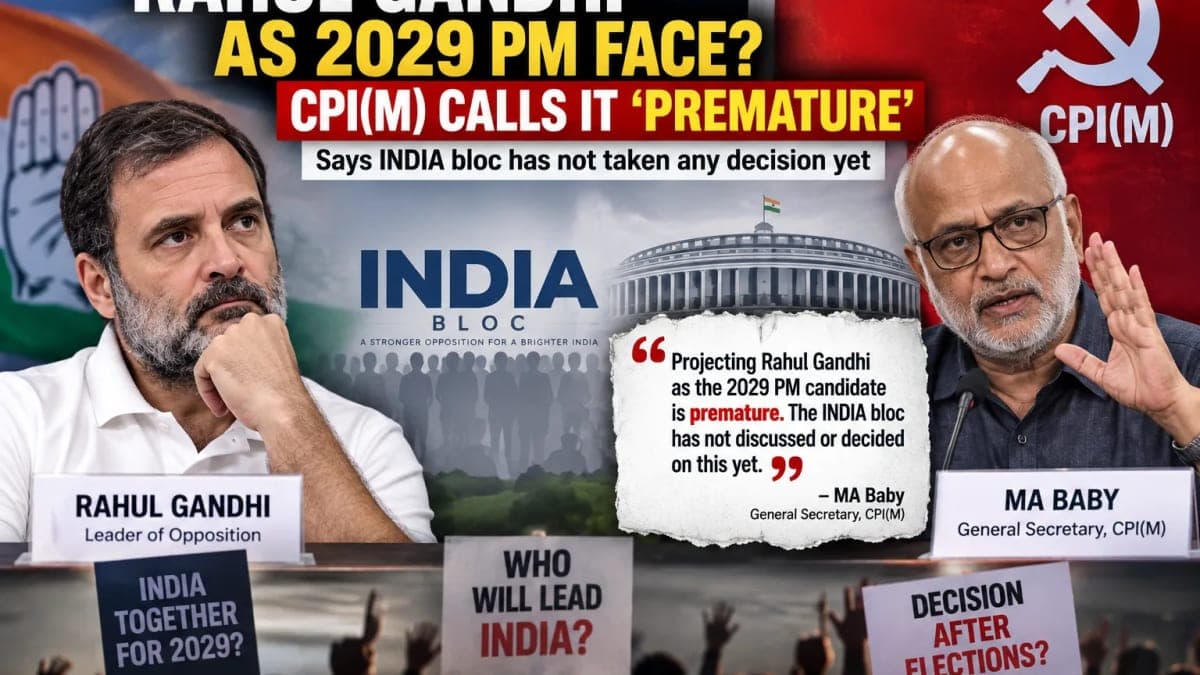
The debate over who should lead the Opposition into the 2029 Lok Sabha election has exposed an early difference within the INDIA bloc, with CPI(M) general secretary MA Baby cautioning against projecting Congress leader Rahul Gandhi as the alliance’s prime ministerial candidate years before the vote.
Baby said the INDIA bloc has neither discussed nor decided who should be its candidate for Prime Minister. Against that backdrop, he described statements by Congress leaders presenting Gandhi as the alliance’s 2029 PM face as “premature and unwarranted.”
His intervention does not amount to a rejection of Gandhi’s potential claim to the top job. Instead, the CPI(M) leader argued that the Opposition should first concentrate on strengthening its alliance and winning the election, leaving the leadership question to be resolved afterwards.
INDIA Bloc Has Not Discussed PM Candidate, Says MA Baby
Baby said the INDIA bloc was created to bring Opposition parties together against the Modi government and argued that preserving that unity should remain the immediate priority.
According to him, there has been no alliance-level discussion on selecting a prime ministerial candidate for 2029.
“Many Opposition parties have come together and formed the INDIA bloc in order to defeat the Modi government. We are confident of achieving that goal,” Baby said.
He added that the alliance had not taken a decision on projecting anyone as its prime ministerial candidate and had not even discussed the question.
That makes Congress leaders’ attempts to identify Gandhi as the bloc’s candidate ahead of the election “premature and unwarranted,” according to Baby.
Congress Has Publicly Projected Rahul Gandhi as INDIA Bloc’s Leading Face
The CPI(M)’s caution comes after senior Congress leader K C Venugopal publicly backed Gandhi’s leadership for the 2029 contest.
Responding to questions surrounding suggestions that Tamil Nadu Chief Minister C Joseph Vijay could emerge as a future prime ministerial contender, Venugopal said, “Nobody should create any such confusion. Rahul Gandhi will be the face of the INDIA alliance.”
Asked whether Gandhi would lead the alliance in the next Lok Sabha election, Venugopal responded: “Definitely.”
The Congress general secretary argued that Gandhi’s campaigns involving students, farmers and young people had strengthened his national political profile.
The remarks effectively placed Gandhi at the centre of Congress’s 2029 leadership pitch. They did not, however, represent a formally announced consensus among all INDIA bloc constituents.
CPI(M) Is Not Ruling Out Rahul Gandhi
Baby’s position contains an important qualification.
He has separately said that Gandhi, as Leader of Opposition in the Lok Sabha, would have a legitimate right to stake a claim to become Prime Minister if the Opposition wins the election.
“Normally, the Leader of the Opposition generally has a right. Who should be the PM is something we should discuss after elections,” Baby said.
He also made clear that the CPI(M), given its own parliamentary strength, would not expect to make a claim for the prime ministership.
The distinction is politically significant: the Left party is questioning the timing and process of naming a candidate, rather than declaring Gandhi unacceptable for the position.
Why CPI(M) Wants the Decision After the Election
Baby pointed to the history of Opposition coalition governments to support his argument.
He cited the 1977 election, when Opposition parties concentrated on fielding joint candidates before settling the question of who would become Prime Minister after the result.
He also referred to governments led by H D Deve Gowda and I K Gujral, as well as the selection of Manmohan Singh as Prime Minister, to argue that coalition leadership has often been decided after elections rather than through an advance declaration.
For CPI(M), that precedent offers a practical reason to avoid a leadership contest before the Opposition knows the balance of power among its constituent parties after the 2029 result.
Vijay Factor Adds Another Layer to the Leadership Debate
The discussion has gained momentum amid political chatter in Tamil Nadu over C Joseph Vijay’s future national role.
Venugopal’s comments came amid a “Vijay for PM” pitch from sections associated with the Tamilaga Vettri Kazhagam. He said the TVK itself had made no formal demand to project Vijay as the alliance’s prime ministerial candidate.
Baby has also acknowledged that Vijay’s name has been discussed in Tamil Nadu as a possible future Prime Minister but declined to enter that debate.
“I know in Tamil Nadu, even Joseph Vijay’s name has been discussed as a possible future PM after the defeat of BJP. That’s a different discussion and I don’t want to get into that controversy,” he said.
What the Disagreement Means for the INDIA Bloc
The exchange highlights a strategic question that Opposition parties will eventually have to settle: whether entering the 2029 campaign with an identified national leader would strengthen their challenge or whether doing so too early could create competition among alliance partners.
Congress has a clear political incentive to place Gandhi at the centre of the Opposition’s national campaign. He is the Leader of Opposition in the Lok Sabha and the party’s most prominent national campaigner.
The CPI(M)’s position reflects a different coalition calculation. Baby indicated that multiple parties could have claims if the alliance wins, meaning the eventual choice could depend on electoral strength and post-poll negotiations.
For now, there is no formally agreed INDIA-bloc candidate for Prime Minister in 2029.
That distinction is essential: Congress leaders may advocate Rahul Gandhi’s leadership, but CPI(M) says the alliance as a whole has yet to make that decision.