Rahul Gandhi’s Pune Outreach Sparks Fresh BJP-Congress Clash
The political battle over India’s younger voters intensified after Rahul Gandhi’s “Chhatron Ki Goonj” programme in Pune on August 22, 2026.
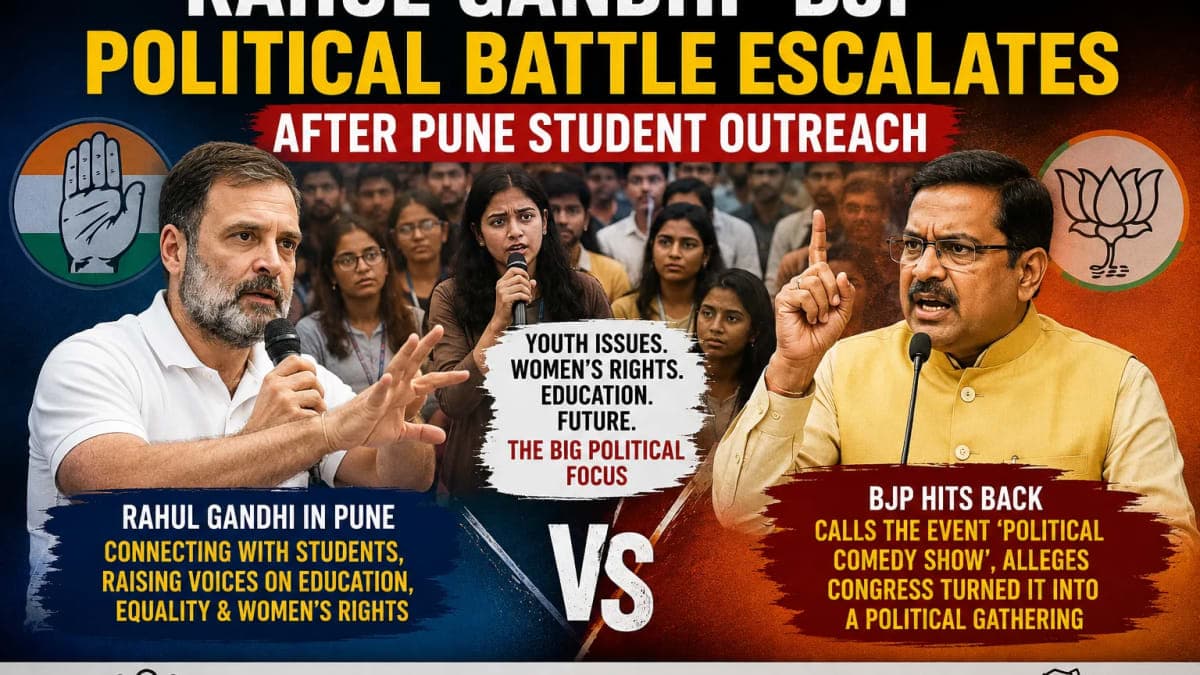
The event was designed as part of Gandhi’s broader outreach to students and young people, with the Pune programme placing particular emphasis on young women. During the interaction, Gandhi spoke about women’s independence, gender inequality and patriarchal attitudes, while students also raised concerns affecting their education and future.
But what began as a student outreach programme quickly developed into another confrontation between the country’s two biggest national political parties.
BJP Questions Political Nature of Event
Maharashtra BJP vice-president Keshav Upadhye sharply criticised the programme, describing it as a “political comedy show.” He accused Gandhi of concentrating on political attacks rather than adequately addressing issues affecting students.
Upadhye also alleged that students had been transported to the programme in college buses and claimed that Congress had effectively turned an event organised in the name of students into a political gathering. These are BJP allegations and should not be presented as independently established facts.
The criticism forms part of a wider BJP attack on Gandhi’s Pune outreach. Reports around the event also carried BJP allegations that Congress used paid influencers to attract attendance.
Congress Pushes Back Against BJP
Congress leaders have rejected the BJP’s framing of the programme and countered that the ruling party’s aggressive reaction reflects concern over Gandhi’s attempt to establish a stronger connection with students and younger voters.
The political disagreement therefore extends beyond what happened at a single Pune event. Both parties are competing to define who can more effectively represent the aspirations and frustrations of a generation concerned about education, employment opportunities, examinations, social equality and political representation.
Women’s Rights Become Central Political Theme
A significant portion of Gandhi’s Pune interaction focused on women.
He challenged traditional attitudes restricting women’s independence and criticised the Manusmriti while arguing against social structures that treat women as subordinate. Gandhi also accused the BJP and RSS of promoting a restrictive approach towards women — a charge forming part of his political argument rather than an established factual conclusion.
The programme also provided students with an opportunity to discuss practical problems. Reports from the event highlighted concerns involving education, safety and the consequences of alleged examination irregularities.
Why the Pune Political Battle Matters
The dispute is significant because young and first-time voters are becoming an increasingly important political constituency.
Political parties are consequently paying greater attention not only to conventional rallies but also to campus interactions, social-media campaigns and issue-based outreach aimed specifically at younger Indians.
The BJP itself has reportedly been developing a Gen Z outreach strategy as competition for younger voters intensifies.
That makes Gandhi’s Pune programme part of a much larger political contest. Congress is attempting to position issues such as examination integrity, employment, education and gender equality at the centre of its youth messaging, while the BJP is challenging both Gandhi’s credibility and the Congress party’s historical record.
From Student Issues to Political Narrative
The biggest challenge for both sides will be moving beyond political accusations.
For Congress, student interactions can provide Rahul Gandhi with a platform to directly hear grievances and present himself as an opposition leader willing to engage with younger citizens. However, the party will also face questions over whether these programmes produce concrete policy proposals or primarily serve as political mobilisation exercises.
For the BJP, aggressively challenging Gandhi may prevent Congress from dominating the youth narrative. At the same time, sustained criticism of opposition-led student programmes could give Congress an opportunity to claim that the government is uncomfortable with dissent or youth mobilisation.
Balanced Analysis
The Pune controversy illustrates how youth politics is becoming another major arena in the BJP-Congress rivalry.
Rahul Gandhi’s programme allowed issues involving women, education and social equality to receive national political attention. That does not automatically validate every political allegation made during the event. Likewise, BJP accusations concerning the organisation and political character of the programme require evidence before they can be treated as established facts.
Ultimately, the political impact of such outreach will depend less on competing claims about individual events and more on whether either party can convince young Indians that it has credible solutions to their everyday concerns.
With both Congress and BJP increasing their focus on younger citizens, the battle triggered by the Pune outreach could be an early indication of a broader competition to shape the political preferences of India’s next generation.
This article is based on reporting published by The Economic Times.