Rahul Gandhi’s Pune Event Cleared by Police
Rahul Gandhi’s student outreach campaign is set to reach Pune after receiving conditional approval from the city police.
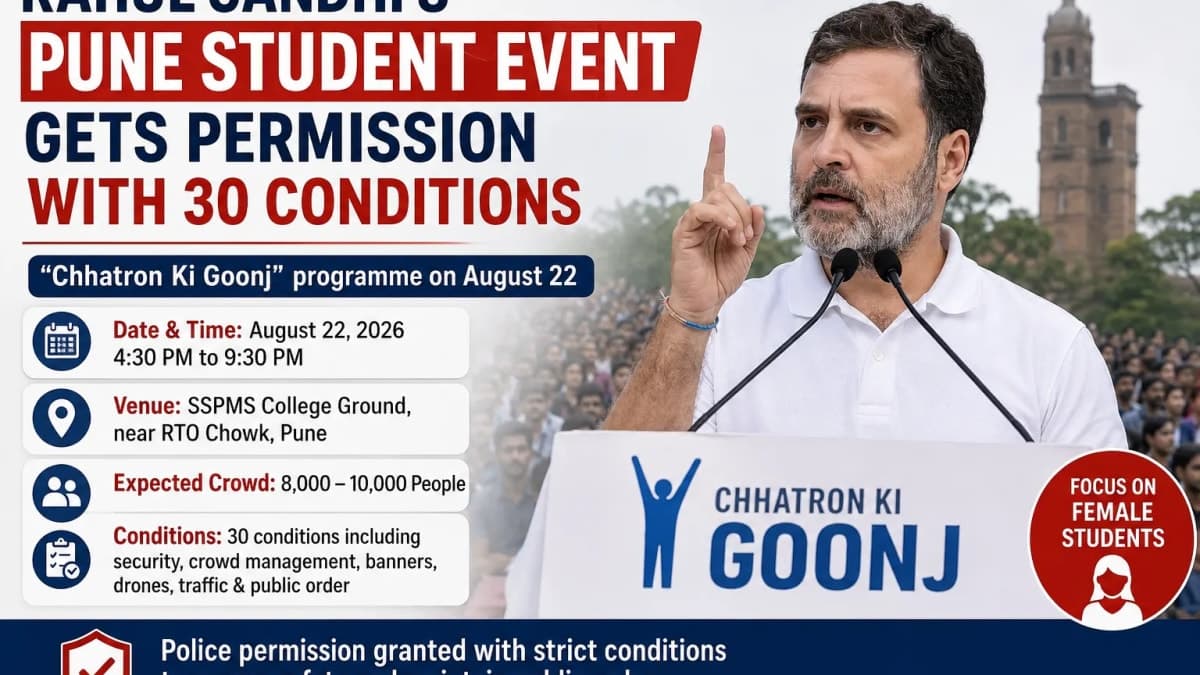
The programme will be organised at the SSPMS College Ground near RTO Chowk on August 22, between 4:30 pm and 9:30 pm. Police estimates suggest that around 8,000 to 10,000 people could attend the gathering.
However, the approval comes with a detailed list of 30 conditions that organisers must follow. The requirements cover security arrangements, crowd control, fire safety, surveillance, traffic management and restrictions intended to prevent disturbances to public order.
What Are the Major Conditions?
Among the key restrictions, organisers have been instructed not to display material, including banners, photographs or images, considered objectionable. They have also been directed to ensure that activities during the programme do not hurt religious sentiments or create a law-and-order problem.
Security and logistical requirements are also significant. Organisers have been asked to arrange adequate entry and exit points, drinking water, toilets, parking and fire-safety equipment. Private security personnel and volunteers, including women security guards and women volunteers, are also expected to be deployed. CCTV coverage of the venue is another requirement.
Drone photography and videography have also been prohibited, while the organisers must comply with applicable noise restrictions and obtain required clearances from authorities such as the traffic and fire departments.
Police have made it clear that permission can be withdrawn if the conditions are violated or if activities at the venue threaten law and order.
Pune Edition to Focus on Female Students
The Pune programme is being positioned as a special edition of “Chhatron Ki Goonj” centred on female students.
Issues expected to feature in the interaction include access to education, women’s safety, equality, competitive examinations and future career opportunities. The wider campaign has also highlighted concerns surrounding examination irregularities, paper leaks and education costs.
The focus on young women gives the Pune event a somewhat different character from a conventional political rally. It allows Congress to frame the gathering around student experiences and policy concerns while also expanding Rahul Gandhi’s outreach among younger voters.
What Is ‘Chhatron Ki Goonj’?
“Chhatron Ki Goonj,” meaning “Voice of Students,” is Rahul Gandhi’s nationwide student outreach initiative. The campaign was launched in Kota, Rajasthan, on June 17, 2026, and subsequent programmes were held in Dehradun and Prayagraj before the scheduled Pune event.
The initiative has sought to bring student concerns—including examinations, employment opportunities and problems within the education system—into the political conversation.
For Congress, the campaign also provides a platform to connect national political messaging with issues directly affecting students and young job seekers.
Congress Says It Will Follow the Conditions
Maharashtra Congress vice-president Mohan Joshi confirmed that permission had been received and said organisers would comply with the conditions imposed by Pune Police.
That commitment will be important because responsibility for maintaining order inside and around the programme has been placed substantially on the organisers.
With thousands of participants expected, crowd management and security will therefore be closely watched.
Political Debate Around the Programme
The event has also generated political criticism.
Maharashtra Chief Minister Devendra Fadnavis questioned whether the programme would amount to a genuine dialogue with students, arguing that its participant structure could make it closer to a political “monologue.”
Congress, meanwhile, presents the initiative as an opportunity to provide students—particularly young women in the Pune edition—with a platform to discuss concerns affecting education and employment.
These competing interpretations illustrate the political dimension of the outreach. While Congress describes it as student engagement, opponents can view it as an effort to build political support among younger voters.
Why the Pune Event Matters
Pune is one of India’s major education centres, with a large population of university students, competitive-exam aspirants and young professionals. Holding a student-focused political programme in the city therefore gives Congress an opportunity to bring national debates over education and employment into a prominent academic environment.
The emphasis on female students also broadens the discussion beyond examinations and jobs to questions of safety, equality and opportunity.
At the same time, the extensive police conditions underline the challenge authorities face when balancing the right to hold large political gatherings with responsibilities surrounding public safety, traffic and law and order.
Balanced Analysis
The police decision represents a middle path: the programme has not been prevented from going ahead, but organisers have been placed under detailed operational and security obligations.
For Rahul Gandhi and Congress, the Pune event offers another opportunity to build political engagement around concerns affecting students rather than relying exclusively on conventional party rallies.
For the administration, the immediate priority is likely to remain orderly conduct of an event expected to attract thousands of participants.
The longer-term political impact will depend less on the controversy surrounding the permission conditions and more on whether the campaign succeeds in turning student concerns about education, examinations, safety and employment into sustained public discussion.