Sonia Gandhi Reflects on Manmohan Singh’s Legacy
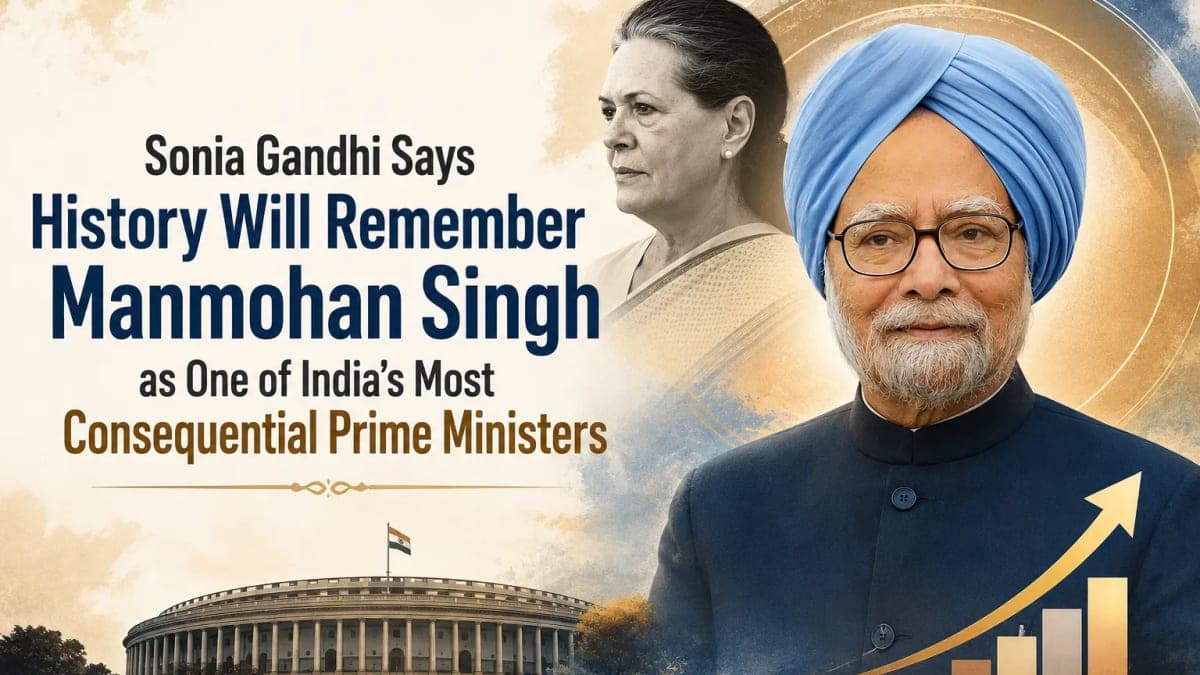
Former Congress president Sonia Gandhi has described Manmohan Singh as a leader whose long-term contribution to India will receive significant recognition from history.
Her assessment places Singh’s legacy beyond the political controversies that surrounded his years in office and focuses instead on the lasting impact of decisions associated with his career in economic policymaking and his decade as prime minister.
Singh served as India’s prime minister from 2004 to 2014, leading two successive United Progressive Alliance governments. Before becoming prime minister, he had already established himself as a prominent economist and policymaker, most notably as finance minister during the economic reforms launched in 1991.
From Economist to Prime Minister
Manmohan Singh’s political significance extends beyond his tenure in the Prime Minister’s Office.
As finance minister under Prime Minister P. V. Narasimha Rao, Singh became closely associated with the reforms undertaken as India confronted a severe economic crisis in 1991. The policy shift reduced several controls on the economy and expanded opportunities for private and foreign investment, contributing to a broader transformation of India’s economic model.
More than a decade later, Sonia Gandhi nominated Singh as the Congress-led coalition’s prime ministerial choice following the 2004 general election. He subsequently headed the UPA government for ten years and returned to power following the 2009 election.
Policies That Shaped the UPA Era
Singh’s tenure coincided with an important period in India’s economic and institutional development. His governments were associated with major rights-based and welfare initiatives, while India also experienced periods of rapid economic expansion.
One of the defining foreign-policy achievements of his premiership was the India-US civil nuclear agreement. Singh invested substantial political capital in the initiative, which helped end India's long-standing isolation from international civilian nuclear commerce and marked a significant development in relations between New Delhi and Washington.
His years in government were also associated with measures such as the Right to Information framework and expanded social programmes, reinforcing the argument among supporters that Singh’s legacy combined economic policy with institutional and welfare reforms.
Why Sonia Gandhi’s Remarks Matter
Sonia Gandhi’s comments are significant because the relationship between the Congress leadership and Singh’s government has long been part of the debate surrounding his premiership.
Critics frequently argued that the UPA operated under a dual-centre model of political authority, with Gandhi exercising substantial influence as Congress president while Singh headed the government. That criticism contributed to questions over how much independent political authority Singh exercised as prime minister.
Her latest assessment therefore does more than commemorate a former colleague. It contributes to an ongoing reassessment of Singh’s place in modern Indian political history.
A Legacy That Remains Debated
Any assessment of Singh’s premiership also has to account for the controversies of the UPA period.
His supporters point to economic growth, social legislation, greater international engagement and his reputation for personal integrity. Critics, however, have highlighted governance difficulties during his second term, allegations of corruption involving members of the wider UPA establishment and concerns that political authority was divided between the government and Congress leadership.
These competing interpretations explain why Singh’s legacy remains politically relevant. The debate is not simply about whether individual policies succeeded, but about how economic transformation, institutional reform, coalition politics and political accountability should be weighed against one another.
Balanced Analysis
Sonia Gandhi’s description of Manmohan Singh as a consequential prime minister represents a political judgment rather than an uncontested historical conclusion. India has had several prime ministers whose governments fundamentally changed the country in different ways, making comparisons inherently subjective.
Yet there is little doubt that Singh occupied an unusual position in modern Indian history. His influence stretched from the economic transformation associated with the early 1990s to a decade at the head of the Union government.
His restrained political style sometimes became a weakness in an increasingly confrontational political environment. At the same time, that same understated approach became central to the public image of a leader who preferred policy and institutions to political spectacle.
Ultimately, the historical assessment of Manmohan Singh will continue to evolve. Sonia Gandhi’s remarks underline a broader argument now surrounding his legacy: that the significance of a government can sometimes become clearer only after the immediate political battles of its era have faded.