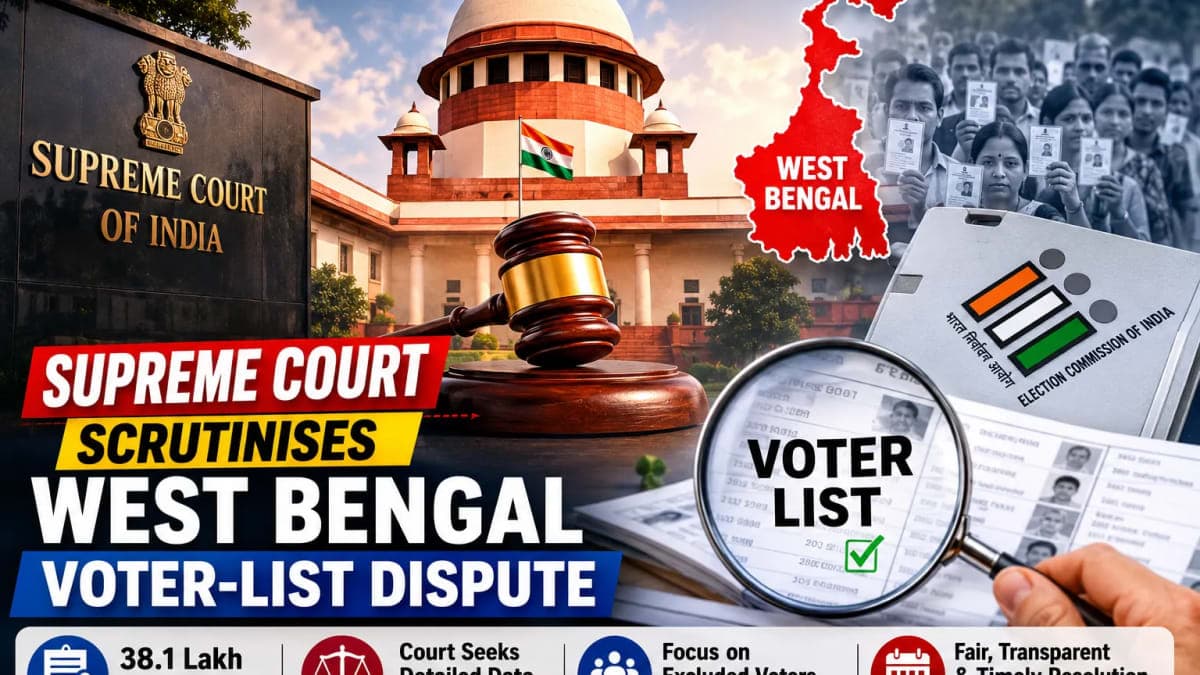
The Supreme Court has intensified its scrutiny of the West Bengal electoral-roll dispute, directing the Election Commission of India to provide detailed information on millions of appeals arising from the Special Intensive Revision of voter lists. The court is examining how quickly cases involving excluded voters can be resolved and whether the appellate mechanism needs to be strengthened.
Supreme Court Seeks Detailed Data From Election Commission
New Delhi, August 27, 2026: The Supreme Court has turned its attention to the scale and pace of unresolved electoral-roll disputes in West Bengal, seeking detailed information from the Election Commission of India (ECI) about appeals filed after the state's Special Intensive Revision (SIR) of voter lists.
A three-judge Bench headed by Chief Justice of India Surya Kant, along with Justices Joymalya Bagchi and V. Mohana, asked the ECI to provide a clearer picture of the cases pending before appellate tribunals. The court wants the data separated into appeals by people seeking restoration to the electoral roll and cases challenging the inclusion of other voters.
The Bench also sought information about cases already decided, the relief granted, the steps taken to reflect successful appeals in the electoral rolls, and whether more tribunals are required to deal with the backlog.
What the Appeal Figures Show
Data placed before the court, based on an RTI response, indicated that approximately 38.1 lakh appeals had been filed before the appellate tribunals. Of these, only around 7 lakh were said to have been filed by voters challenging their own exclusion, while roughly 31 lakh concerned objections to names being included in the rolls.
The figures have become particularly important because only a relatively small portion of the total appeals has been resolved.
According to the RTI data cited during the proceedings, 82,782 appeals had recorded outcomes as of August 7. Of those, 75,443 resulted in names being included in the electoral rolls, while 7,339 resulted in exclusions. That means more than 91% of those decided cases resulted in inclusion.
The numbers do not by themselves establish that every original deletion was improper, since individual cases can involve different facts and procedural circumstances. They do, however, underline why the accuracy and speed of the appeal system have become central to the litigation.
Court Considers Priority for Excluded Voters
One of the major questions before the Supreme Court is whether appeals filed by people whose names were removed should receive priority over objections seeking the removal of people already included in the rolls.
During the hearing, petitioners argued that an excluded voter faces an immediate loss of the ability to exercise the franchise unless the appeal is resolved. The Bench indicated that this distinction deserves consideration and asked for a category-wise breakdown before deciding how the pending cases should be prioritised.
The court has also examined whether additional tribunals may be needed to process the large volume of cases within a reasonable period.
The ECI told the court that it had been consulting tribunal members and examining changes that could accelerate the process.
How the West Bengal Voter-List Dispute Developed
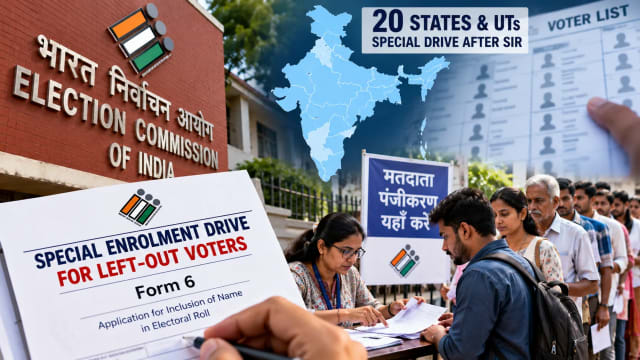
The controversy stems from the Special Intensive Revision of West Bengal's electoral rolls.
According to the Chief Electoral Officer's February 28 press note, the revision involved physical verification by Booth Level Officers and was intended to ensure the inclusion of eligible electors while removing ineligible entries.
The process nevertheless generated extensive litigation over inclusion, deletion, verification and procedural safeguards.
Earlier in the dispute, the Supreme Court intervened in the adjudication mechanism. Judicial officers were entrusted with handling claims and objections, while appellate tribunals consisting of former High Court chief justices and judges were subsequently constituted to review contested decisions.
Those tribunals are now at the heart of the latest phase of the case.
Political Arguments Add Another Layer to the Dispute
The electoral-roll controversy also carries significant political implications.
During the latest hearing, Senior Advocate Kalyan Bandyopadhyay, appearing for a petitioner, referred to 31 Assembly constituencies where, according to his submission, the number of deleted voters exceeded the BJP's margin of victory over TMC candidates in the recently concluded state election.
Such comparisons are politically significant, but deletion figures alone cannot establish that an election result would have been different. Determining electoral impact would require knowing, among other things, whether the deleted individuals were eligible voters, whether they challenged their exclusion and how they would actually have voted.
The Supreme Court indicated that its concern would not be restricted to selected constituencies and instead focused on the broader functioning of the appeal mechanism across West Bengal.
Why the Supreme Court's Intervention Matters
The dispute involves two legitimate objectives that an electoral system must reconcile.
On one side is the need for accurate voter lists. Electoral authorities have a responsibility to identify duplicate, incorrect or otherwise ineligible entries so that electoral rolls remain reliable.
On the other is the equally important requirement that eligible citizens are not wrongly excluded and that anyone affected by an incorrect decision has access to a meaningful and timely remedy.
An appeal mechanism loses much of its practical value if a valid appeal is decided only after the relevant election has passed. That is why the speed of tribunal proceedings has become nearly as important as the existence of the tribunals themselves.
What Happens Next?
The Election Commission is expected to provide the Supreme Court with a more detailed account of the pending cases, including their categories, disposal status and the steps required to improve the appellate process.
The information could help the court determine whether appeals from excluded voters should be taken up first and whether additional institutional capacity is required.
The Bench has also indicated that the broader exercise should be resolved well before the next parliamentary election.
The next phase of the case is therefore likely to focus less on headline numbers alone and more on how quickly the system can identify genuine voters, correct erroneous decisions and update the electoral rolls after successful appeals.
Balanced Analysis
The West Bengal dispute illustrates the difficult balance involved in maintaining electoral rolls in a democracy as large as India's.
The Election Commission has a constitutional responsibility to maintain credible electoral records, and mechanisms for challenging questionable inclusions are an important part of that responsibility. At the same time, removing an eligible voter creates a serious democratic consequence, particularly when the remedy arrives too late to restore that person's opportunity to participate in an election.
The Supreme Court's demand for more granular data could therefore be significant. A category-wise and district-wise picture may allow the court to distinguish between different types of disputes rather than treating millions of appeals as a single backlog.
For the ECI, the challenge is to demonstrate that voter-list accuracy can be pursued without creating procedural delays that leave legitimate voters waiting indefinitely. For those challenging the revision, the legal task remains to establish specific failures and obtain remedies through the mechanisms established by the courts.
Ultimately, the credibility of the process will depend not simply on how many names are included or removed, but on whether decisions are transparent, reviewable and implemented quickly enough to protect electoral participation.
This article is based on reporting published by Moneycontrol.