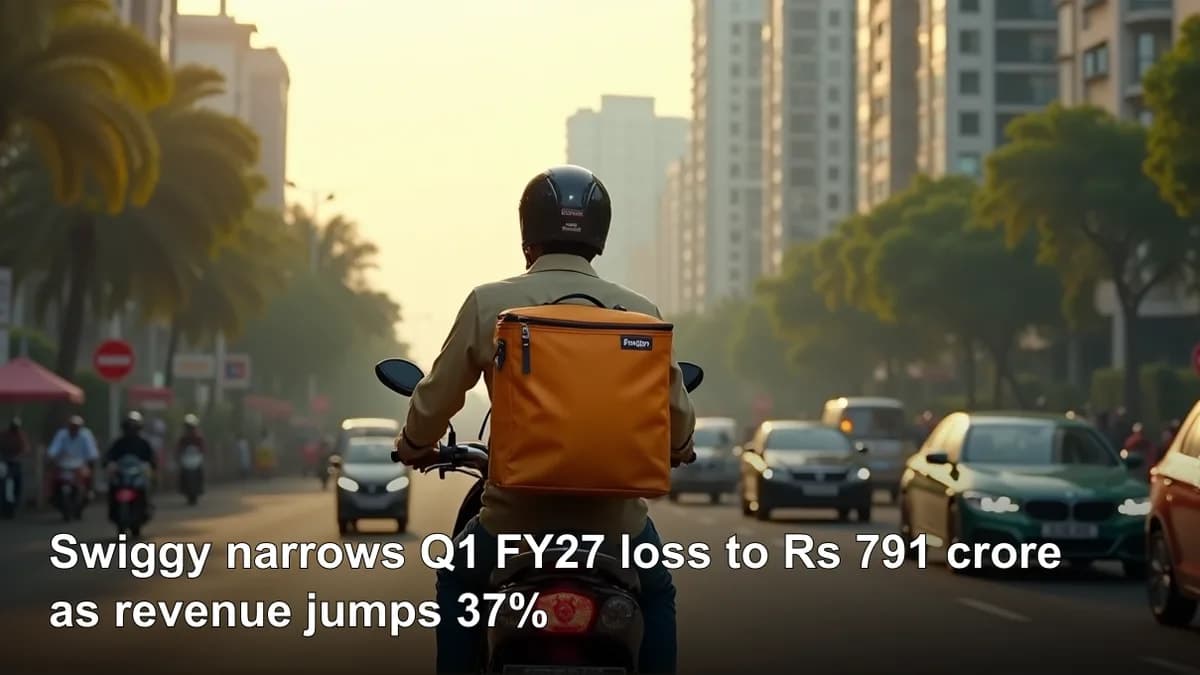
Swiggy, the Indian consumer‑internet firm best known for food delivery, announced on July 30 that its first‑quarter loss for fiscal year 2026‑27 narrowed to Rs 791 crore, a 34% improvement over the same period a year earlier. The company also reported a 37% increase in revenue, reaching Rs 6,812 crore, as it pursued a more sustainable operating model amid intensifying competition.
The earnings release highlighted robust performance across Swiggy’s three core verticals – B2B services, food delivery, and the Instamart quick‑commerce platform. While the B2B segment posted a 41.4% year‑on‑year (YoY) revenue rise to Rs 3,195 crore, Instamart grew 53% YoY to Rs 1,232 crore, and the food‑delivery arm expanded 22.66% to Rs 2,208 crore.
What Happened
Swiggy’s net loss for Q1 FY27 stood at Rs 791 crore, compared with Rs 1,197 crore in Q1 FY26. The narrowing loss reflects both top‑line growth and tighter cost control, especially in the quick‑commerce business, which achieved contribution‑margin break‑even in May 2026. Adjusted EBITDA – earnings before interest, taxes, depreciation and amortisation – improved, with the overall figure narrowing to Rs 778 crore.
Instamart, Swiggy’s rapid‑delivery service, recorded a 39.8% YoY increase in gross order value (GOV) to Rs 7,907 crore and lifted its revenue per order (RPO) to Rs 108. The company expanded its “dark‑store” network to 1,171 locations across 131 cities, a strategy aimed at densifying inventory closer to consumers and reducing delivery times.
In the food‑delivery segment, gross order value grew 17.4% YoY to Rs 9,490 crore. Monthly transacting users rose 27.4% overall to 27.5 million, with the food‑delivery base adding 0.9 million users to reach 19.2 million, an 18% increase. Adjusted EBITDA for food delivery improved by Rs 100 crore YoY to Rs 292 crore, indicating better unit economics.
Swiggy Group CEO and Managing Director Sriharsha Majety emphasized that the company had met its guidance set a year earlier, delivering contribution‑break‑even and positioning its differentiated assortment strategy as the engine for future growth. He noted that as basic quick‑commerce offerings become commoditised, Swiggy’s focus on a curated product mix would drive the next phase of expansion and further EBITDA improvement.
Background
Swiggy entered the Indian market in 2014 as a food‑delivery platform and quickly scaled to become one of the country’s largest players, rivalled primarily by Zomato. Over the past few years, the company diversified into B2B logistics, cloud kitchens, and quick‑commerce through Instamart, seeking higher‑margin revenue streams beyond traditional restaurant deliveries.
The firm has faced mounting pressure from price‑sensitive consumers, rising fuel costs, and aggressive discounting wars. To counteract thin margins, Swiggy has invested heavily in technology, data analytics, and a sprawling network of dark stores – fulfilment centres that operate without a physical storefront, enabling faster delivery of groceries and everyday essentials.
Why It Matters
The narrowing loss signals that Swiggy’s strategic shift toward higher‑margin businesses is beginning to bear fruit. For investors, the improvement in adjusted EBITDA and contribution‑margin break‑even in Instamart reduces the risk profile of a company that has historically burned cash to win market share.
For consumers, the expansion of dark‑store infrastructure and the growth of Instamart suggest faster delivery times and a broader product assortment. The 27.4% rise in monthly transacting users indicates that Swiggy’s ecosystem is resonating with a larger audience, potentially unlocking the “next 100 million users” the CEO referenced.
From a macro perspective, Swiggy’s performance provides a barometer for the health of India’s digital commerce sector, which has attracted billions in foreign investment. A sustainable path to profitability could encourage further capital inflows and spur competition that benefits end‑users.
Industry Impact
Swiggy’s earnings underscore a broader industry trend: food‑delivery platforms are pivoting toward quick‑commerce and B2B logistics to offset thin margins in restaurant deliveries. Competitors such as Zomato and Amazon Fresh are also expanding dark‑store footprints, intensifying the race for geographic density.
Analysis
Analysts note that Swiggy’s ability to improve EBITDA while scaling Instamart suggests that economies of scale are beginning to offset the high fixed costs of maintaining a large dark‑store network. However, the company’s reliance on continued user growth means that any slowdown in consumer spending or heightened regulatory scrutiny on gig‑economy workers could pose challenges.
Key Takeaways
Swiggy’s Q1 FY27 loss narrowed to Rs 791 crore, a 34% improvement YoY.
Revenue surged 37% to Rs 6,812 crore, driven by B2B (41.4% growth) and Instamart (53% growth).
Instamart achieved contribution‑margin break‑even in May 2026 and expanded to 1,171 dark stores in 131 cities.
Food‑delivery gross order value rose 17.4% YoY, with adjusted EBITDA improving to Rs 292 crore.
Monthly transacting users grew 27.4% YoY to 27.5 million, indicating broader ecosystem adoption.
Conclusion
Swiggy’s latest financials suggest the company is transitioning from a high‑growth, loss‑making phase to a more disciplined, profit‑oriented model. The next quarter will reveal whether the momentum in quick‑commerce and B2B services can sustain EBITDA improvements and further narrow losses.
Stakeholders will watch closely for updates on dark‑store expansion, pricing strategies, and potential regulatory developments affecting gig workers, all of which could shape Swiggy’s trajectory toward sustained profitability.