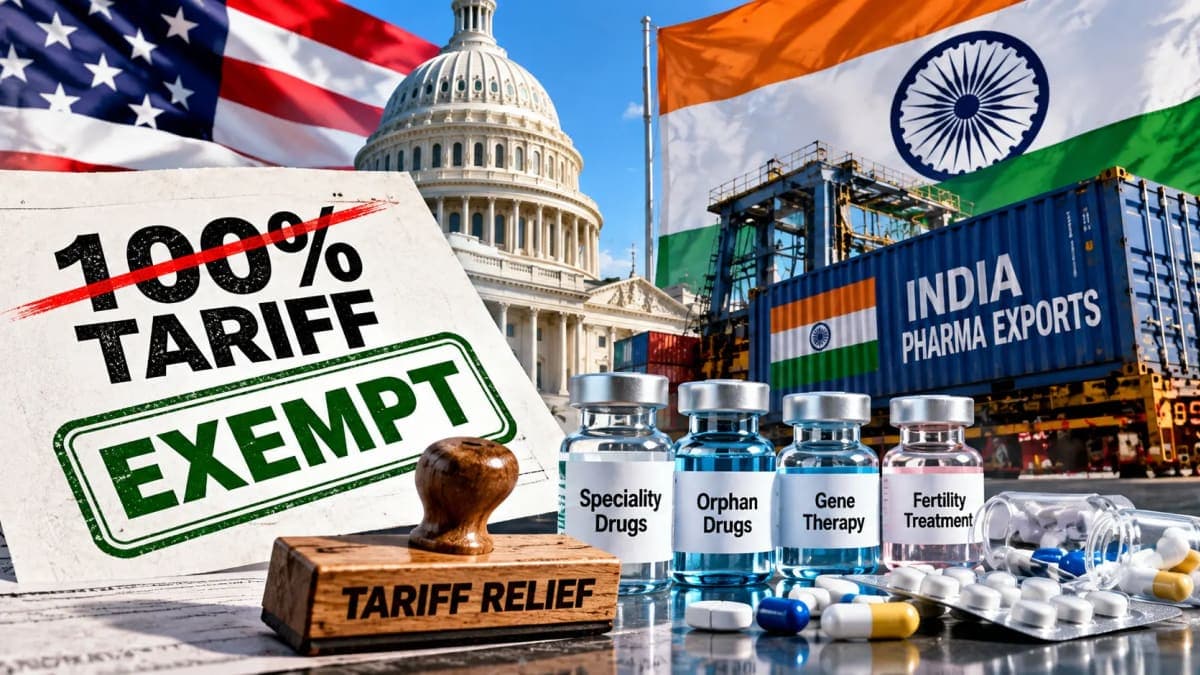
US Exempts Select Indian Speciality Medicines From 100% Tariff
Indian pharmaceutical exporters have received targeted relief from the United States as Washington implements its new tariff regime for patented medicines.
According to a notice issued by the U.S. Department of Commerce's Bureau of Industry and Security (BIS), India is among the jurisdictions whose qualifying speciality pharmaceutical products and associated ingredients can receive a zero percent ad valorem tariff rate.
The change is significant because the broader U.S. measure imposes a 100% ad valorem tariff on specified patented pharmaceuticals and associated pharmaceutical ingredients, subject to exemptions and alternative tariff treatments established under the policy.
For companies not already covered from July 31, the broader tariff provisions take effect from September 29, 2026.
Which Indian Medicines Are Exempt?
The zero-tariff treatment does not cover every pharmaceutical product exported from India.
According to the U.S. Commerce Department notice, the speciality categories eligible for zero-duty treatment include:
Drugs and associated ingredients where all approved indications are designated as orphan, meaning they relate to qualifying rare diseases or conditions
Nuclear medicines
Plasma-derived therapies
Fertility drugs and treatments
Cell therapy products
Gene therapy products
Antibody-drug conjugates (ADCs)
Certain medical countermeasures addressing chemical, biological, radiological and nuclear threats
Qualifying animal-health pharmaceutical products
Associated pharmaceutical ingredients used in these eligible products can also receive zero-tariff treatment when the applicable conditions are met.
What About Generic Medicines?
This is an especially important distinction for understanding the impact on India.
The Commerce Department's September 23 notice states that Section 232 pharmaceutical tariffs currently do not apply to generic pharmaceutical products and their associated ingredients.
Therefore, describing the latest development simply as a waiver of the 100% tariff for the entire Indian pharmaceutical industry would be inaccurate.
Instead, there are different forms of protection from the new tariff regime: generics currently remain outside its scope, while specified speciality medicines from eligible jurisdictions receive a zero-tariff rate under the conditions established by the U.S. government.
Why Has India Qualified for Zero-Tariff Treatment?
The U.S. framework allows qualifying speciality medicines to receive the zero tariff when they originate in a jurisdiction that has a current or forthcoming trade and security framework agreement recognised under the relevant U.S. rules.
The framework also allows zero-tariff treatment when a speciality pharmaceutical product is determined to meet an urgent U.S. health need.
India is included alongside 19 other jurisdictions in the Commerce Department's eligibility framework.
The other listed jurisdictions include Argentina, Bangladesh, Cambodia, Ecuador, El Salvador, the European Union, Guatemala, Indonesia, Japan, Jordan, Malaysia, North Macedonia, South Korea, Switzerland and Liechtenstein, Taiwan, Thailand, the United Kingdom and Vietnam.
Why the Tariff Relief Matters for India
The United States is an important destination for India's pharmaceutical industry, making changes to American drug-import rules particularly relevant to Indian manufacturers.
According to the Pharmaceuticals Export Promotion Council of India figures cited by Financial Express, India's drugs and pharmaceutical exports were valued at $30.46 billion in FY2024-25, with the United States among the country's biggest pharmaceutical markets.
A 100% tariff effectively adds a duty equal to the customs value of a covered product before accounting for other applicable costs. For high-value patented or speciality treatments, such a tariff could significantly change the economics of supplying the U.S. market.
The zero-duty provision therefore protects eligible Indian speciality products from that additional tariff burden.
Why Did the US Introduce the Pharmaceutical Tariff?
The pharmaceutical duties were introduced under Section 232 of the Trade Expansion Act.
In its April 2026 proclamation, the White House said the measures were intended to address what it viewed as national-security risks associated with U.S. dependence on imported patented pharmaceuticals and pharmaceutical ingredients.
The proclamation established a 100% duty on covered patented pharmaceutical imports but also created several exceptions and alternative rates, including the zero-tariff treatment for specified speciality medicines.
The policy therefore combines trade restrictions with exemptions intended to protect access to certain medically important products.
Companies Can Also Seek Relief for Urgent Health Needs
The Commerce Department has established another mechanism that could potentially provide tariff relief beyond products qualifying through their country of origin.
Companies can submit information requesting zero-tariff treatment for speciality pharmaceutical products considered necessary to address an urgent U.S. health need.
Applicants must provide information about the pharmaceutical product, its classification, active ingredients, manufacturer, country of origin and the health need involved.
The Commerce Department can evaluate such applications in consultation with the U.S. Trade Representative and the Department of Health and Human Services.
What the Decision Does — and Does Not — Mean
For Indian pharmaceutical companies, the development removes a potentially substantial tariff burden from specific categories of high-value speciality medicines.
However, the impact will not be identical across the industry.
Companies whose U.S. businesses are concentrated in eligible speciality medicines could benefit differently from manufacturers focused on other patented products. Generic manufacturers face a separate situation because generics and their associated ingredients currently remain outside the Section 232 pharmaceutical tariffs.
The commercial effect on individual Indian drugmakers will therefore depend on their product portfolios, manufacturing locations, U.S. exposure and whether specific products satisfy the exemption criteria.
Balanced Analysis
The zero-tariff provision provides meaningful protection for certain Indian pharmaceutical exports at a time when U.S. trade policy is placing substantially higher duties on some patented medicines.
It could also help reduce the risk of tariff-driven disruption in specialised areas of healthcare where alternative suppliers may be limited.
At the same time, the exemption should not be interpreted as a complete reversal of the U.S. pharmaceutical tariff policy or as universal tariff-free access for Indian medicines.
The broader 100% tariff framework remains in place for covered patented pharmaceutical products unless another exemption, reduced rate or approved arrangement applies.
For Indian pharmaceutical companies, the next practical question will be which individual products satisfy the U.S. definitions and how much of each company's American business falls within exempt categories.
Conclusion
The United States' decision gives India targeted protection from its new pharmaceutical tariff regime.
Eligible orphan drugs, nuclear medicines, plasma-derived therapies, fertility treatments, cell and gene therapies, antibody-drug conjugates, certain emergency medical countermeasures, animal-health products and their qualifying ingredients can receive a zero percent tariff rate under the U.S. framework.
Meanwhile, generic medicines and their associated ingredients currently remain outside the Section 232 pharmaceutical tariffs.
The development is therefore significant for India's pharmaceutical sector, but its benefits will depend heavily on the products and U.S. exposure of individual drug manufacturers.