Karunanidhi Reference Triggers Uproar in Tamil Nadu Assembly
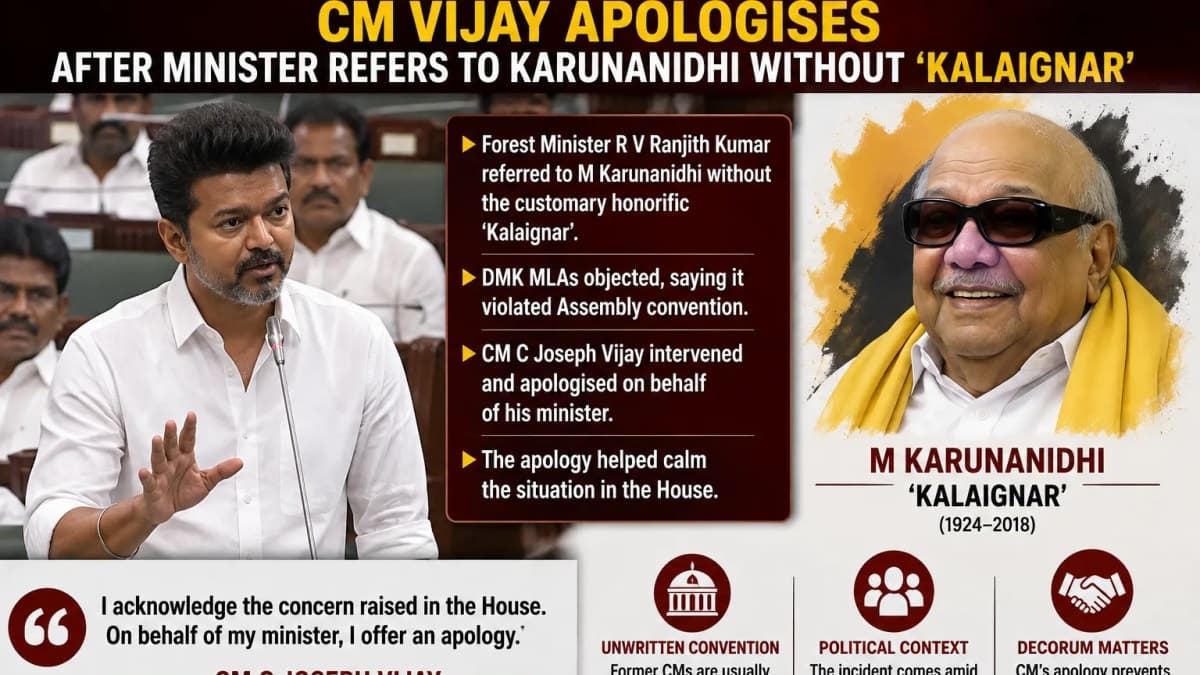
A debate in the Tamil Nadu Legislative Assembly turned contentious after Forest Minister R V Ranjith Kumar’s reference to former Chief Minister M Karunanidhi prompted objections from opposition DMK legislators.
During Monday’s proceedings, Ranjith Kumar mentioned the late DMK leader by name without using the customary honorific “Kalaignar” or another respectful title. DMK members immediately protested, arguing that the reference went against the convention traditionally followed in the House while speaking about former chief ministers.
Chief Minister C Joseph Vijay subsequently intervened to prevent the dispute from escalating.
What Did CM Vijay Do?
As protests continued from the DMK benches, Vijay acknowledged that the minister’s manner of referring to Karunanidhi was inappropriate in the context of Assembly convention.
The Chief Minister then apologised on his cabinet colleague’s behalf, helping bring down the temperature inside the House. Reports from the proceedings indicate that his intervention helped defuse the immediate confrontation.
The episode was notable because the apology came from the head of the government rather than leaving the dispute to develop into a prolonged confrontation between the treasury and opposition benches.
Why Did the Word ‘Kalaignar’ Become an Issue?
“Kalaignar,” meaning an artist or scholar of the arts, became inseparably associated with M Karunanidhi over his long public career.
Karunanidhi was not only a dominant political figure in Tamil Nadu but also had an extensive association with Tamil literature, screenwriting and cinema.
More importantly in the context of the Assembly dispute, there is an unwritten convention in the Tamil Nadu legislature of referring to former chief ministers—including Karunanidhi and J Jayalalithaa—with due respect rather than simply using their names.
The DMK legislators’ objection therefore centred on legislative decorum and the manner in which a former chief minister was addressed.
Who Was M Karunanidhi?
M Karunanidhi was one of the most influential personalities in Tamil Nadu’s modern political history.
A towering figure in the Dravidian movement and the DMK, he served multiple terms as Chief Minister of Tamil Nadu and remained deeply involved in state politics for decades.
His influence extended beyond electoral politics. His work as a writer and screenwriter helped establish his cultural identity, and “Kalaignar” became the honorific most closely associated with him.
For the DMK, Karunanidhi remains a central figure in the party’s political history, making references to his legacy particularly sensitive.
Vijay’s Apology Sends a Political Message
Vijay’s decision to intervene can also be viewed through the wider political context.
As Chief Minister, he had several options: defend his minister, allow the Speaker to deal with the protests, or directly acknowledge the opposition’s objection.
He chose the conciliatory route.
That decision does not erase the intense rivalry between the government and the opposition DMK. But it demonstrates how political competition and institutional courtesy can operate separately inside a legislature.
An apology can also prevent a relatively narrow dispute over language from consuming Assembly time that would otherwise be devoted to legislative business.
TVK and DMK’s Political Rivalry Adds Another Layer
The episode comes amid continuing political friction between Vijay’s ruling Tamilaga Vettri Kazhagam (TVK) and the DMK.
Recent Assembly proceedings have seen disagreements between the two sides, although there have also been issues on which they have found common ground. For example, the DMK supported a recent anti-delimitation resolution moved by Vijay’s government.
That context makes the Chief Minister’s apology noteworthy.
Rather than using the Karunanidhi controversy to intensify the political confrontation, Vijay effectively accepted the objection and sought to close the matter.
Was Simply Saying ‘Karunanidhi’ Disrespectful?
Outside the specific conventions of the Assembly, referring to someone by their actual name is not automatically disrespectful.
The controversy needs to be understood within the traditions and political culture of the Tamil Nadu legislature.
The objection was not that Karunanidhi’s name itself could never be used. It concerned the expectation that former chief ministers and major political figures be addressed with the customary respect associated with their position and legacy.
That distinction is important because otherwise the controversy can easily be reduced to a debate over whether an honorific is technically mandatory.
Why the Incident Matters
On the surface, the controversy involved a single omitted honorific. At a broader level, however, it raises questions about legislative etiquette.
Assemblies are inherently adversarial institutions. Governments and opposition parties are expected to disagree strongly on policy, governance and ideology.
But parliamentary traditions also depend on conventions governing how members address one another and refer to former constitutional and political leaders.
Respecting those conventions can help keep political disagreements focused on substantive issues rather than personal or symbolic disputes.
Balanced Analysis
The DMK’s objection is understandable when viewed through the established traditions of Tamil Nadu politics and the Assembly’s convention of respectfully referring to former chief ministers. Karunanidhi’s extraordinary importance to the party also explains why its legislators reacted quickly.
At the same time, the incident should not necessarily be interpreted as evidence of a major political crisis. The dispute arose from the way a former leader was addressed rather than from a substantive policy disagreement.
Vijay’s response ultimately became the more consequential part of the episode.
By acknowledging the objection and apologising on behalf of his minister, the Chief Minister prevented a relatively small controversy from developing into a larger confrontation.
The episode demonstrates that the language used inside legislatures can carry political weight far beyond the literal meaning of individual words. In Tamil Nadu, where political history, cultural identity and leadership legacies are closely intertwined, even an omitted honorific can become an issue of institutional respect.