Karnataka BJP Protest Over Valmiki Corporation Case Creates Tension at Vidhana Soudha
Political tensions surrounding Karnataka's Maharshi Valmiki Scheduled Tribes Development Corporation case intensified as BJP leaders and workers staged a major demonstration around the state's seat of government in Bengaluru.
The opposition party has been demanding the removal of Planning and Statistics Minister B Nagendra from the state cabinet over allegations connected to the diversion of funds from the state-run corporation. Nagendra has disputed the political accusations against him, while the state government has faced sustained pressure from the opposition over his presence in the cabinet.
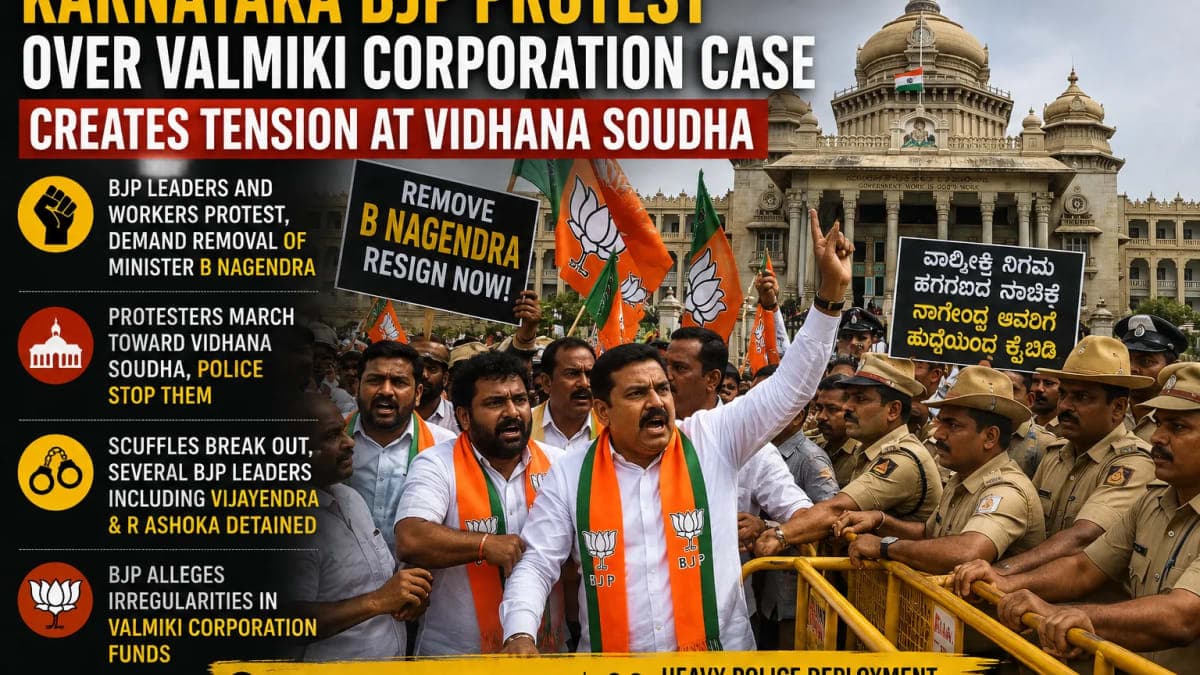
The confrontation moved beyond arguments inside the legislature when protesters marched toward Vidhana Soudha on August 24.
What Happened Outside Vidhana Soudha?
BJP leaders and supporters attempted to advance toward the legislature as part of their campaign seeking Nagendra's resignation.
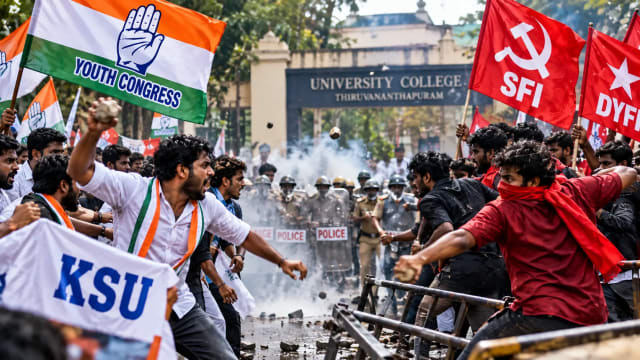
Police prevented protesters from entering the government complex, resulting in tense scenes and brief scuffles around the barricades. Several BJP leaders and workers were detained as authorities sought to bring the demonstration under control.
Among the prominent leaders detained during the protest were Karnataka BJP president B Y Vijayendra and Leader of the Opposition R Ashoka.
The security deployment around Vidhana Soudha was substantial, with more than 500 police personnel and Karnataka State Reserve Police platoons deployed around the complex, according to a report published on August 25.
Why Is BJP Demanding B Nagendra's Removal?
The political confrontation centres on alleged irregularities involving the Karnataka Maharshi Valmiki Scheduled Tribes Development Corporation, which administers welfare initiatives for Scheduled Tribe communities.
The controversy originally surfaced in 2024 following the death of corporation accounts superintendent P Chandrasekharan. Nagendra, who was Tribal Welfare Minister at the time, subsequently resigned from the cabinet and was later arrested by the Enforcement Directorate. He eventually returned to the state cabinet, a development that revived opposition demands for his removal.
The BJP has alleged that large amounts of money belonging to the corporation were improperly diverted and has accused the government of failing to provide satisfactory answers about the funds.
The precise amount cited in political statements and reports has varied, making it important to distinguish between established investigative findings and broader allegations being made by political parties.
BJP-JD(S) Pressure Builds Inside Karnataka Assembly
The street protest did not emerge in isolation.
BJP and JD(S) legislators had already been putting pressure on the Congress government during the Karnataka Assembly's Monsoon Session, demanding that Nagendra be removed.
The confrontation disrupted Assembly proceedings for several days. On August 20, for example, opposition protests continued for a fourth consecutive day while legislative business, including Question Hour and the passage of bills, proceeded amid the standoff.
BJP then announced plans to intensify its campaign by marching toward Vidhana Soudha. R Ashoka said party workers would take out a procession and press the government for Nagendra's resignation.
Nagendra and Government Push Back Against Opposition
The political dispute also has another side.
Nagendra has rejected the BJP's campaign against him and argued that he is being targeted politically. He has also challenged the opposition over allegations involving its own leaders.
Government representatives have pushed for the matter to be debated within the legislature rather than allowing repeated protests to disrupt proceedings. During an earlier round of Assembly disruption, Bengaluru Development Minister Krishna Byre Gowda suggested that the opposition formally seek a debate on the issue.
This leaves Karnataka's political debate divided between the opposition's demand for ministerial accountability and the government's argument that allegations should be addressed through institutional and legislative processes.
Why the Valmiki Corporation Case Matters
The controversy carries significance beyond the immediate political battle between the Congress and BJP.
The money at the centre of the allegations was connected to a corporation established to support Scheduled Tribe communities. Any misuse of welfare funds therefore raises questions not only about financial accountability but also about whether public resources intended for vulnerable communities reached their intended beneficiaries.
That explains why the controversy has remained politically sensitive even after the original allegations emerged.
It also demonstrates how unresolved corruption allegations can return to dominate legislative politics when a politician associated with an earlier controversy returns to government.
Protest Raises Questions About Political Accountability and Legislative Functioning
The BJP has the democratic right to challenge the government and seek accountability over alleged misuse of public funds. Opposition scrutiny is an important component of parliamentary government, particularly when allegations involve money intended for welfare programmes.
At the same time, attempts to breach security barriers or confront police can shift attention away from the substantive financial questions at the heart of a controversy.
Repeated disruption of Assembly proceedings presents another challenge. Protests can generate political pressure, but extended disruption can also reduce opportunities for detailed questioning, debate and examination of evidence inside the legislature.
The strongest resolution would ultimately depend on verifiable investigative findings rather than competing political claims.
Political Pressure on Karnataka Government Unlikely to Fade Quickly
The confrontation at Vidhana Soudha indicates that the Valmiki Corporation controversy remains a significant political issue in Karnataka.
For the BJP and JD(S), Nagendra's continuation in the cabinet provides a focal point for their campaign against the Congress government. For the ruling party, the challenge is to defend its position while answering questions about accountability and the handling of the corporation's funds.
With opposition protests having moved from sustained Assembly disruption to demonstrations around Vidhana Soudha, the dispute has entered a more confrontational phase.
What happens next will depend on the government's response, the opposition's strategy and, most importantly, the evidence and findings emerging from the legal and investigative processes surrounding the Valmiki Corporation funds case.
This article is based on reporting published by TOI.