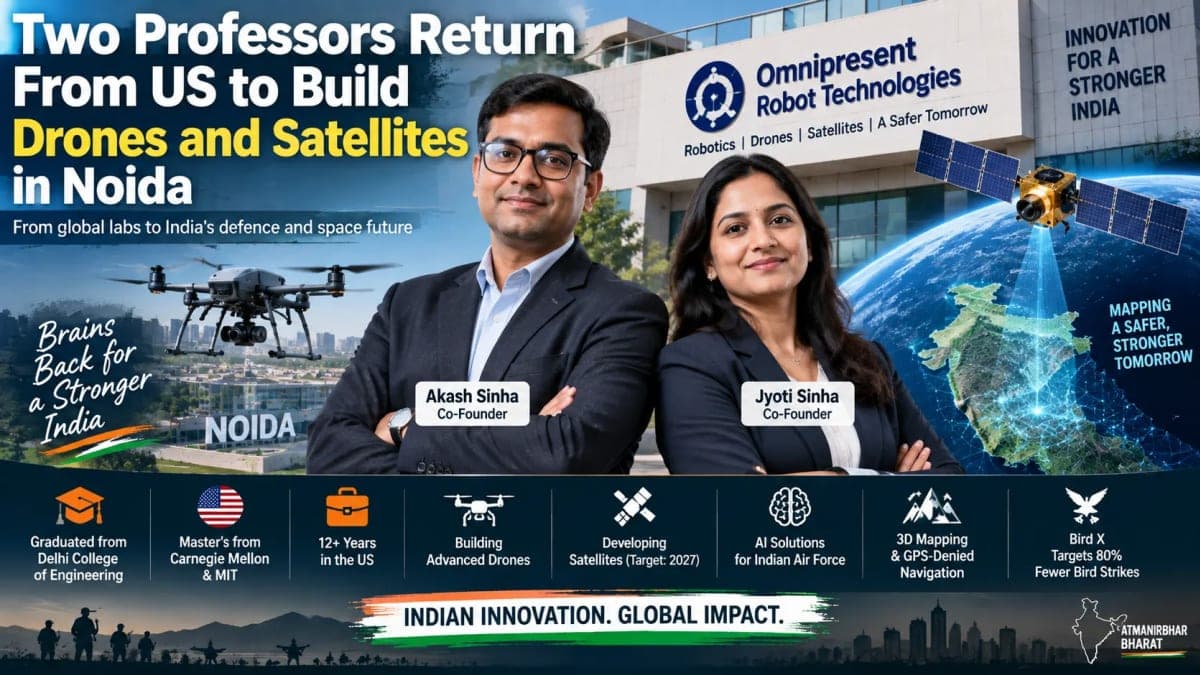
From US Labs to Noida: Professors Akash and Jyoti Sinha Build Drones, Satellites for India’s Defence Sector
Description:
After spending more than 12 years in the United States, professors Akash Sinha and Jyoti Sinha returned to India and are now building defence and space technologies through Noida-based Omnipresent Robot Technologies. Their work spans drones, satellite-based 3D mapping, AI for the Indian Air Force and navigation technology designed for GPS-denied environments.
From the US to a Noida Deep-Tech Startup
Inside an industrial building in Noida’s Sector 80, a team of young engineers is working on technologies that could have applications from military drones to satellites and high-resolution 3D mapping.
At the centre of the operation are Akash Sinha and Jyoti Sinha, a husband-wife duo and professors who returned to India after spending more than 12 years in the United States.
The two founders now lead Omnipresent Robot Technologies, a Noida-based deep-tech company developing drone, robotics, artificial-intelligence and space technologies.
According to Moneycontrol, the company has received support through the Ministry of Defence’s Innovations for Defence Excellence (iDEX) framework and is working on technologies for the Indian Army and Indian Air Force.
Both Studied in the US After Delhi College of Engineering
Akash and Jyoti graduated from Delhi College of Engineering before moving to the United States for higher education.
They subsequently pursued master’s degrees at two leading American institutions — Carnegie Mellon University and the Massachusetts Institute of Technology (MIT).
During their more than 12 years in the US, they worked on robots and other advanced technologies for the US Army, according to Moneycontrol’s report.
After returning to India, they initially took up teaching roles at a private university in Noida. But changes in India’s defence ecosystem — particularly greater participation by private companies and startups — encouraged them to move deeper into defence and space technology.
Why India's Changing Defence Ecosystem Mattered
Akash Sinha said the environment for deep-tech companies in India had changed considerably in recent years.
He pointed to programmes including iDEX, ADITI and RDI, along with the opening of areas such as space and mapping to greater private participation.
“When we first came back here, things were difficult but we have seen a lot of change in the last five years,” Akash told Moneycontrol.
He added that the emerging funding environment now appeared increasingly similar to mechanisms they had seen in the United States.
Building a Satellite With Defence Ministry Funding
One of Omnipresent Robot Technologies’ most ambitious projects is in space.
Moneycontrol reports that the company is developing a satellite expected to go into space, most likely in 2027, with funding from the Ministry of Defence.
The company was selected from 75 firms that bid for the satellite project and received funding to develop prototypes.
It is also working with the defence establishment on border mapping and plans to develop multiple satellites if the programme progresses as intended.
Separately, the company is working on artificial-intelligence technology for the Indian Air Force, with trials underway at a major air base.
What Is iDEX and Why Is It Important?
The government's Innovations for Defence Excellence (iDEX) framework was launched in 2018 to encourage innovation in defence and aerospace by connecting the armed forces with startups, MSMEs, individual innovators, research organisations and academic institutions.
Government data cited by Moneycontrol shows that, as of March 2026, 676 startups and innovators had engaged with iDEX and 551 contracts had been signed.
Procurement worth more than ₹2,400 crore had been approved from startups and MSMEs, while projects worth more than ₹1,500 crore had been sanctioned for new technologies.
These figures provide important context to the Sinhas' story: their startup is emerging within a broader government effort to create domestic suppliers of sophisticated defence technologies rather than relying exclusively on established defence companies.
Defence Secretary: 25% of DRDO R&D Budget Earmarked for Outside Partners
Defence Secretary Rajesh Kumar Singh told Moneycontrol that 25% of DRDO's research and development budget has been internally earmarked for industry, startups and academia.
He also said there are around 11 centres of excellence across academic institutions where defence authorities work with academia in specialised areas.
Singh said iDEX supports startups through the prototype-building stage, after which procurement normally moves into a bidding process.
The evolving procurement framework is also looking at ways of providing repeat orders for technologies developed in consultation with the armed forces.
Startup Says It Is Building High-Resolution 3D Mapping Satellites
Akash Sinha says the company is developing what he describes as the world's highest-resolution 3D mapping satellite constellation.
This is a company claim rather than an independently established global ranking.
According to Akash, the technology aims to combine detailed three-dimensional mapping with precise geolocation, targeting less-than-one-metre resolution, including in mountainous terrain.
He says the company is confident in the approach based on results from its initial work.
If successfully demonstrated at scale, such technology could have applications in terrain mapping, navigation and defence. However, its ultimate performance will depend on successful development, deployment and validation.
Technology Used for Chandrayaan's Pragyan Rover, Founder Says
Akash also says Omnipresent Robot Technologies developed mapping and navigation software for the Pragyan rover used in India's Chandrayaan programme.
“Once the rover came out, it was running and driving on the technology that we built,” he told Moneycontrol.
The founders further say that after the Chandrayaan work, the company participated in the Saumitra mission, where it mapped more than 10,000 villages across India using 3D-mapping drones.
These project details are attributed to the founders as reported by Moneycontrol.
Working on Drones That Can Navigate Without GPS
Another potentially important area of development involves navigation when conventional satellite positioning is unavailable.
The company is developing technology intended to help kamikaze drones operate in GPS- or GNSS-denied environments.
This matters in military environments because GPS signals can potentially be jammed or spoofed, disrupting systems dependent on satellite navigation.
Jyoti Sinha described the challenge as effectively flying without GPS while still being able to reach a designated target.
The company says its technology could eventually be integrated into drones built by other manufacturers that need to operate under such restricted conditions.
Bird X Targets an 80% Reduction in Bird Strikes
The startup has also developed a system called Bird X, designed to reduce bird strikes at airports.
According to Akash, the first trial and installation took place at an important air base and the system is now being scaled.
The company is targeting an 80% reduction in bird hits.
That 80% figure represents the company's stated target, rather than a verified result across airport deployments.
A Reverse Brain Drain Story Emerging in Noida?
The founders' own return from the United States is now being mirrored by some of their hiring.
Akash said Omnipresent has recruited engineers from institutions including IIT Delhi, IIT Kanpur and the Indian Institute of Space Science and Technology.
He also said the company had hired engineers directly from the US, including a top-performing student from an AI programme at Carnegie Mellon.
The founders described increasing interest among both young and mid-career professionals in relocating to India.
Their experience provides one example of what is often described as reverse brain drain — highly trained professionals returning to India or choosing Indian technology companies after studying or working abroad.
Why This Story Matters Beyond One Startup
Omnipresent Robot Technologies' story is significant not simply because two academics returned from the US.
It reflects a broader shift in India's defence-industrial model.
Historically, sophisticated defence and aerospace development in India was dominated by government organisations and large established companies. Initiatives such as iDEX are attempting to bring startups, universities and smaller technology companies directly into that ecosystem.
The Sinhas' journey illustrates what this model is intended to enable: researchers with advanced technical experience building prototypes for specific military requirements, testing them with the armed forces and potentially moving successful technologies into procurement.
Whether Omnipresent's ambitious satellite constellation, GPS-independent navigation and other technologies ultimately reach their stated performance targets will require successful testing and deployment.
But the company is already an example of how India's defence and space reforms are creating a pathway for scientists, professors and engineers to move from research laboratories into commercial deep-tech manufacturing.