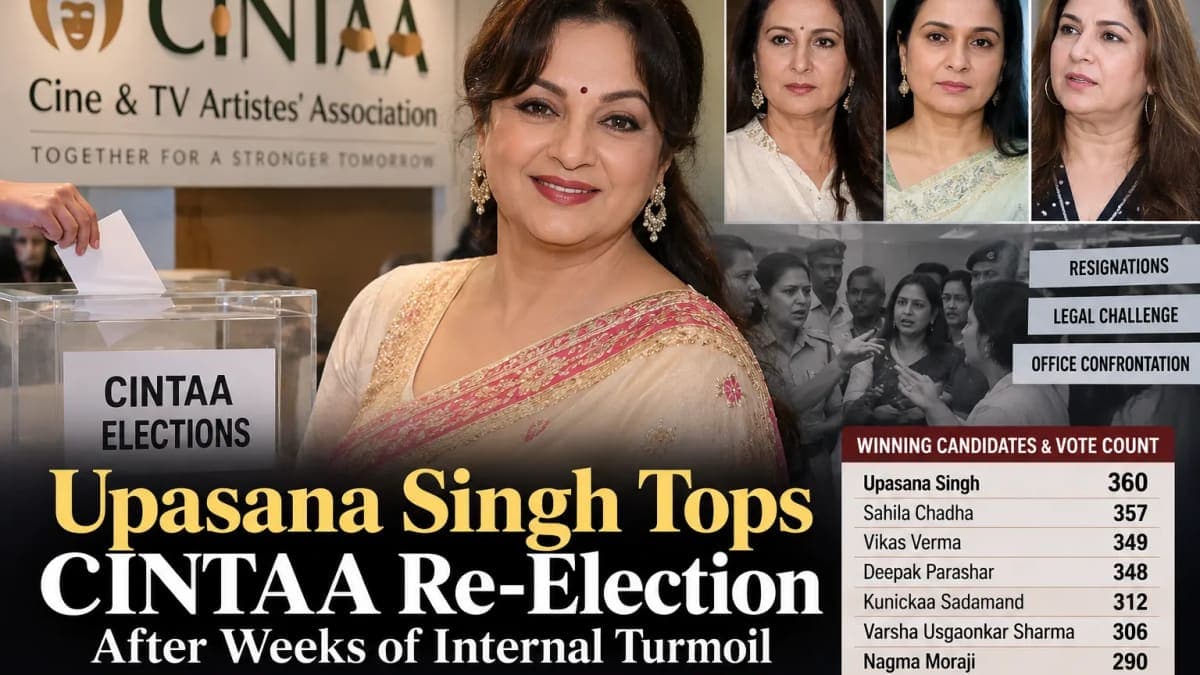
Upasana Singh received 360 votes in CINTAA’s September 12 re-election, the highest tally among the reported winning candidates. Sahila Chadha followed closely with 357 votes, leaving only three votes between the two.
The election came after weeks of instability inside the actors’ association, including the resignation of several Executive Committee members, disagreements over who had authority to run the organisation and a legal challenge to the fresh polling process.
The court permitted the election to go ahead, but with an important condition: its outcome remains subject to the final decision in the pending suit.
Singh Leads a Closely Contested Vote
The results placed several familiar names from film and television on the winning list.
Behind Singh and Chadha, Vikas Verma received 349 votes and Deepak Parashar secured 348. Kunickaa Sadanand polled 312 votes, Varsha Usgaonkar Sharma received 306 and Nagma Moraji finished with 290.
For Singh, the result brought both a personal victory and a larger organisational responsibility. After the vote, she thanked CINTAA members for their support and said she would work for the association and its members.
Parashar also struck a conciliatory note after the results, speaking about working for members and bringing people together. Sadanand, meanwhile, said the election victory was only a starting point and that those elected would now have to justify the confidence placed in them.
That task may prove more complicated than the vote count suggests.
How CINTAA Reached the Fresh Election
The September poll followed a breakdown within CINTAA’s elected leadership.
Eight members of its 15-member Executive Committee had resigned amid differences involving groups associated with Poonam Dhillon and Upasana Singh. The departures created a dispute over the functioning and authority of the remaining committee.
The Federation of Western India Cine Employees subsequently announced a fresh election.
That decision itself became contentious. Dhillon challenged FWICE’s authority to conduct the poll and argued against the validity of the process. Singh and those supporting the new election maintained that a fresh mandate was required following the resignations.
The disagreement therefore developed into more than a contest between individual actors. At its centre were competing interpretations of how CINTAA should be governed after a majority of the committee had stepped down.
Court Challenge Leaves an Important Qualification
The dispute eventually reached the Dindoshi Sessions Court.
On September 8, the court allowed the September 12 election to proceed. It did not, however, give an unconditional endorsement to the outcome. The results were made subject to the final decision in the ongoing suit, with further proceedings listed for October 26.
That legal position is important when assessing the significance of Singh’s result.
Her 360 votes make her the highest vote-getter in the election that was conducted on September 12. The result does not, by itself, settle the separate legal arguments over the process or the competing claims concerning CINTAA’s governance.
Office Confrontation Deepened the Divide
The tensions surrounding the association became public shortly before voting when a confrontation at the CINTAA office involved Singh, Poonam Dhillon, Padmini Kolhapure, Kunickaa Sadanand, Priti Sapru and others.
Videos of the episode circulated online and showed police at the premises while members argued over access to the office, control of documents and the association’s leadership.
The competing sides offered sharply different accounts of what had happened.
Singh and others alleged that important association documents were being removed without proper authorisation. Dhillon and Kolhapure disputed the opposing account, while further allegations concerning CINTAA records and data emerged during the confrontation.
Those assertions should be treated as allegations rather than established findings. Police officers present at the scene were reported to have described their immediate responsibility as maintaining law and order, rather than determining which side was correct in the dispute over the documents.
A Result, But Not Yet a Resolution
The re-election has now produced a clear set of vote totals. It has not erased the divisions that led to the poll.
Singh enters the next phase with the strongest individual tally, while Chadha’s result shows how closely contested the top of the ballot was. Several other prominent members have also secured places through the election.
Their immediate challenge is institutional rather than electoral.
CINTAA represents working actors across film and television, making confidence in its administration particularly important for members who depend on the association for professional representation and industry-related support. Weeks of resignations, rival claims of authority and public accusations have put that confidence under strain.
The legal proceedings add another layer of uncertainty. Because the court allowed voting to proceed while keeping the result subject to the pending case, the election and the litigation cannot yet be treated as entirely separate matters.
For the newly elected representatives, the vote provides a mandate from participating members. Restoring a functional working relationship within an organisation that has just endured an unusually public internal conflict may be the more difficult test.