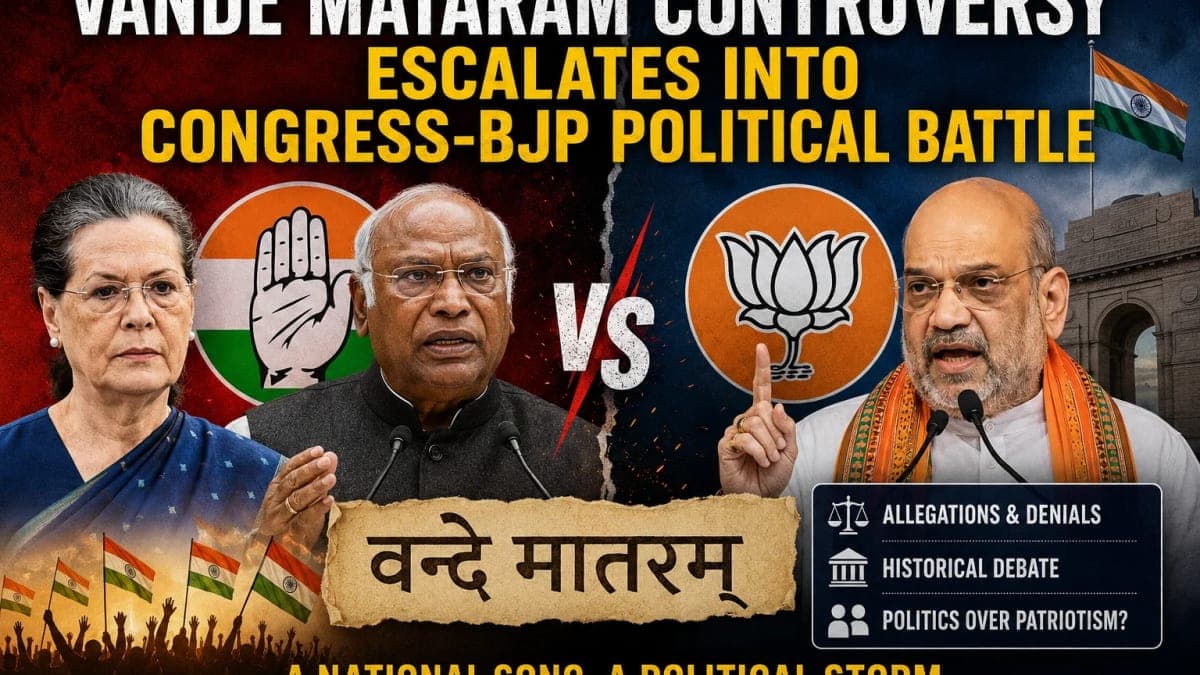
Vande Mataram Row Turns Into Major Congress-BJP Confrontation
New Delhi, August 19, 2026: The political dispute surrounding Vande Mataram has intensified into a wider confrontation between the Congress and Bharatiya Janata Party (BJP), with leaders from both sides trading accusations over respect for the national song and each party's historical relationship with India's freedom movement.
The controversy emerged following the Congress's Independence Day programme at the AICC headquarters in New Delhi. A video from the event showed senior Congress leaders, including Sonia Gandhi and party president Mallikarjun Kharge, interacting while Vande Mataram was being performed. BJP leaders alleged that the interaction indicated an attempt to interrupt or stop the full rendition of the song. Congress leaders have rejected the allegation and maintained that the party respects Vande Mataram.
The dispute has since moved beyond the original video, developing into a political argument about which version of the song should be performed and how its historical legacy should be interpreted.
BJP Accuses Congress of Disrespecting National Song
The BJP has sharply criticised the Congress over the episode. Union Home Minister Amit Shah accused the opposition party of insulting Vande Mataram and demanded an apology, while other BJP leaders have also questioned the Congress's conduct during the Independence Day event.
The dispute has also acquired a legal dimension. BJP leaders filed police complaints against Sonia Gandhi in Karnataka over the alleged incident. According to reports, complaints were submitted in Bengaluru and Mangaluru, with police seeking legal opinion before deciding further action.
For the BJP, the controversy has become part of a larger argument about nationalism and the importance of giving national symbols their prescribed respect.
Congress Rejects BJP's Allegations
Congress, meanwhile, has accused the BJP of turning Vande Mataram into a political weapon.
Congress president Mallikarjun Kharge defended the party's rendition, arguing that the version sung by Congress was consistent with the historical practice associated with leaders of India's freedom movement. He cited figures including Mahatma Gandhi, Jawaharlal Nehru and Sardar Vallabhbhai Patel while challenging the BJP's criticism.
Congress general secretary K.C. Venugopal has also rejected allegations that the party disrespected the song. He described the controversy surrounding the AICC event as a communication-related issue and accused the BJP of attempting to extract political advantage from it.
The Congress has therefore sought to shift the debate from the specific Independence Day incident toward the historical role of the party and its leaders in the freedom struggle.
Why the Number of Stanzas Has Become Important
The present political battle also draws on a much older debate surrounding Vande Mataram.
Written by Bankim Chandra Chattopadhyay and published as part of his novel Anandamath in the 19th century, the composition became an important rallying expression during India's struggle against British rule.
The first two stanzas have long occupied a particularly significant place in official and political renditions. Later portions of the composition contain religious imagery, an issue that historically generated objections and debate.
That history now forms part of the Congress-BJP argument. Congress is relying on historical precedent to defend its position, while the BJP argues for fuller recognition and rendition of the composition.
From Independence Day Incident to Freedom-Struggle Debate
What began as a dispute over a few moments captured during an Independence Day ceremony has therefore expanded into a contest over political history.
Kharge has questioned the BJP and RSS over their role in the freedom movement while defending Congress's patriotic credentials. BJP leaders, in contrast, have argued that Congress cannot claim exclusive ownership over India's independence legacy or determine how national symbols should be honoured.
The competing arguments reveal why the controversy has remained politically potent: both parties are debating not simply a song, but their respective narratives of Indian nationalism.
Why This Controversy Matters
Vande Mataram carries exceptional historical and emotional significance because of its association with India's independence movement. A dispute surrounding its rendition can therefore quickly move beyond questions of ceremony and become connected with broader debates about national identity.
For the BJP, the issue provides an opportunity to reinforce its emphasis on nationalism and respect for national symbols.
For Congress, the challenge is different. The party is defending itself against allegations of disrespect while simultaneously invoking its deep institutional connection with the freedom movement and the historical circumstances under which particular portions of Vande Mataram became widely accepted.
The dispute consequently allows both parties to speak to their political bases through competing interpretations of patriotism and history.
Balanced Analysis: National Symbol or Political Battleground?
The controversy illustrates the difficulty of separating deeply symbolic national issues from electoral politics.
The BJP is entitled to question conduct it believes falls short of the respect expected for a national symbol. The Congress, equally, has the right to contest the interpretation of the video and point toward historical precedent for its preferred rendition.
However, allegations surrounding an ambiguous interaction at a political event should be distinguished from established facts. The available reporting confirms that the video triggered the dispute, while the claim that Congress leaders deliberately sought to disrespect Vande Mataram remains politically contested.
The larger risk is that a composition historically associated with resistance to colonial rule becomes primarily viewed through the lens of contemporary party competition.
With both Congress and BJP escalating their rhetoric, the Vande Mataram controversy is increasingly about more than what happened at one Independence Day ceremony. It has become another arena in India's continuing political struggle over nationalism, historical legacy and who gets to define the symbols of patriotism.
This article is based on reporting published by The Indian Express.