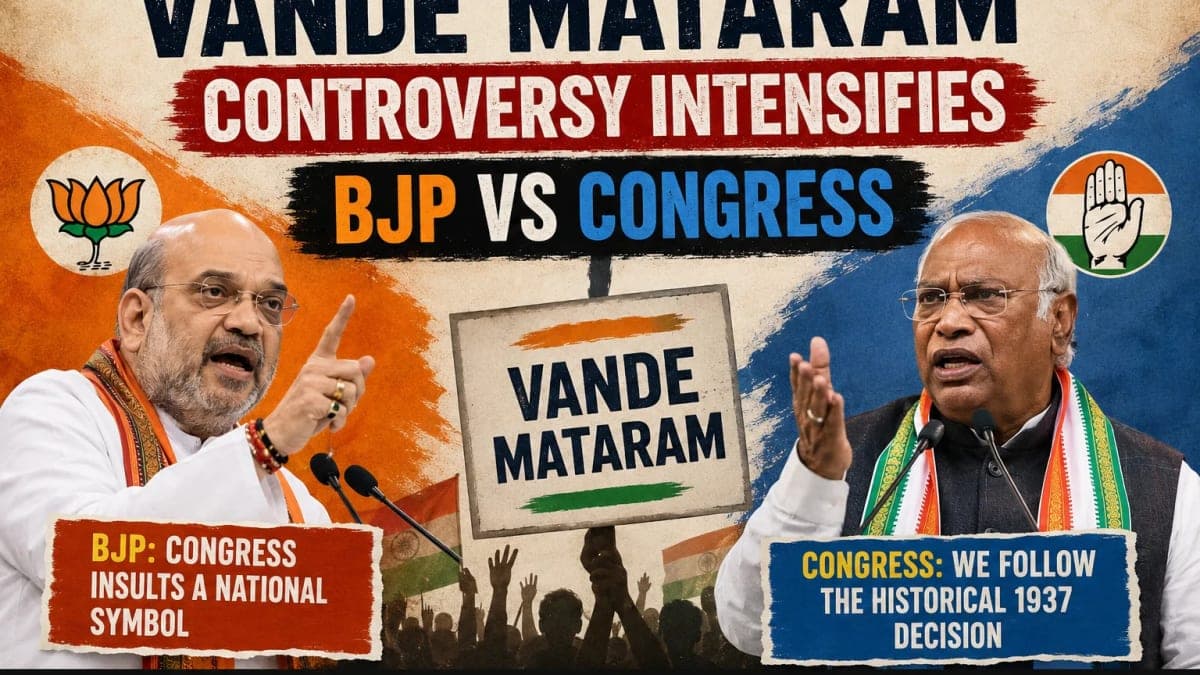
BJP-Congress Battle Over ‘Vande Mataram’ Intensifies
“Vande Mataram,” one of the most enduring patriotic expressions associated with India’s freedom struggle, has once again become the centre of a major political debate.
The latest controversy revolves around the Congress party’s position that the first two stanzas should be used at its programmes, consistent with a historical decision dating to 1937. BJP leaders have strongly criticised that approach and argued that the complete composition deserves recognition and respect.
The disagreement has now expanded beyond how many stanzas should be sung. It has become a broader political argument about nationalism, historical interpretation, religious inclusivity and the way national symbols are used in contemporary public life.
Amit Shah Attacks Congress Over Two-Stanza Position
Union Home Minister Amit Shah has been among the strongest BJP voices in the dispute. He accused the Congress of taking an “anti-national” position and linked its approach toward the song to what he described as the party’s history of appeasement politics.
Other BJP leaders have also attacked the Congress, arguing that limiting the rendition diminishes a composition that inspired generations during the independence movement.
Maharashtra Chief Minister Devendra Fadnavis similarly accused the Congress of returning to “appeasement politics” through its position on the song.
For the BJP, therefore, the dispute has become part of a wider argument about national identity and the treatment of symbols associated with the freedom struggle.
Congress Defends Its Position, Points to 1937 Decision
Congress has rejected the BJP’s accusations and defended its practice by pointing to the historical position adopted by the party in 1937.
Congress president Mallikarjun Kharge has argued that the version being sung by the party follows the tradition associated with national leaders and the freedom movement. The party maintains that singing the first two stanzas should not be interpreted as disrespect toward “Vande Mataram.”
The historical debate matters because objections to some later portions of the composition, including their religious imagery, emerged well before independence. The Congress leadership at the time settled on the first two stanzas for national gatherings in an effort to retain the song’s patriotic significance while addressing concerns over religious inclusivity.
Congress therefore presents its current position as continuity with an old political and historical compromise rather than a new attempt to alter the national song.
How the Latest Controversy Began
The immediate dispute gained momentum after Independence Day celebrations at the Congress headquarters, where a video involving senior Congress leaders during the rendition of “Vande Mataram” triggered accusations from the BJP.
BJP leaders alleged that Sonia Gandhi had sought to interrupt or stop the rendition. Congress disputed the interpretation, while the controversy subsequently generated complaints and political exchanges. Delhi Police has also been reported to be examining a complaint connected to the episode.
The Congress Working Committee later reaffirmed the party’s historical position of using the first two stanzas at its programmes, further escalating the BJP-Congress confrontation.
Why ‘Vande Mataram’ Has Such Historical Importance
Written by Bankim Chandra Chattopadhyay, “Vande Mataram” became deeply associated with India’s struggle against British rule.
It emerged as a powerful patriotic expression during the freedom movement and was sung at Congress sessions, including by Rabindranath Tagore in 1896.
After independence, Constituent Assembly president Rajendra Prasad stated on January 24, 1950, that “Vande Mataram,” because of its historic role in the freedom struggle, should be honoured alongside “Jana Gana Mana.”
Its historical importance is therefore broadly shared across political traditions, even though disagreements over particular verses and their religious imagery have existed for decades.
Why the Controversy Matters
The dispute is significant because it raises a larger question about how India interprets national symbols in a diverse democracy.
From the BJP’s perspective, the complete song represents cultural heritage and patriotic continuity, and reducing its rendition can be portrayed as diminishing an important symbol of the independence movement.
Congress takes a different view. It argues that its two-stanza practice follows a historical compromise designed to preserve the song’s patriotic role while maintaining religious inclusivity.
The two positions illustrate why the dispute is politically powerful: both sides can invoke different elements of the same freedom-movement history to support their arguments.
Balanced Analysis: History Meets Modern Political Competition
The controversy cannot be understood simply as a disagreement about the length of a song.
Historically, “Vande Mataram” inspired anti-colonial nationalism, while debates about some of its religious imagery also emerged during the freedom struggle. The decision to emphasise its opening stanzas was therefore part of a much older discussion over how patriotic traditions could accommodate India's religious diversity.
The BJP is now using the issue to question Congress’s approach toward nationalism and national symbols. Congress, meanwhile, is relying on the historical record to argue that its position is neither new nor a rejection of the song.
As a result, an issue rooted in the independence movement has become a contemporary political battleground. The central challenge is whether political parties can debate the historical meaning of “Vande Mataram” without turning a symbol associated with the freedom struggle into another source of lasting partisan division.
This article is based on reporting published by TOI.