BJP vs Congress: Women’s Reservation Triggers Fresh Political Fight
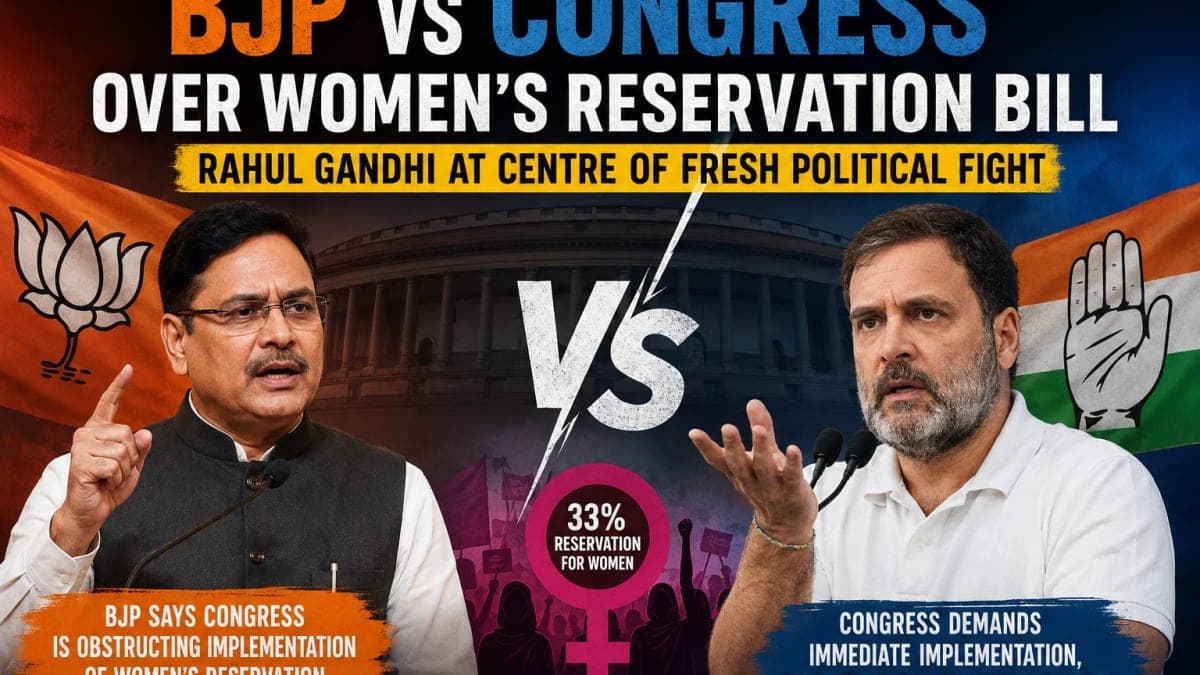
A fresh political confrontation has erupted between the Bharatiya Janata Party and Congress over women’s reservation, bringing Leader of the Opposition Rahul Gandhi into the middle of an increasingly heated debate.
The latest exchange follows Gandhi’s remarks on women’s empowerment and patriarchy during an interaction with students in Pune. BJP leaders responded by questioning the Congress leader’s position on the government’s proposed route for implementing the 33% reservation for women in legislatures.
The Congress, meanwhile, argues that the central question is no longer whether women deserve greater political representation, but why the reservation promised through legislation passed in 2023 has not yet translated into reserved seats.
That distinction has become the heart of the political battle.
What BJP Is Saying
BJP leaders have attempted to turn Rahul Gandhi’s statements about women’s rights into a political challenge.
Former Union minister and BJP leader Smriti Irani urged Gandhi to support swift implementation of the 33% reservation, while other BJP figures accused the Congress of adopting contradictory positions—publicly advocating women’s empowerment while resisting the government’s legislative approach.
Parliamentary Affairs Minister Kiren Rijiju has also argued that implementation of women’s reservation is connected with the census and delimitation process and has blamed the Opposition for blocking measures the government says are necessary to move the process forward.
The BJP’s political message is therefore straightforward: parties that support greater representation for women should cooperate with the government’s proposed mechanism for putting the reservation into effect.
Rahul Gandhi and Congress Push Back
Rahul Gandhi has challenged that argument by pointing out that Parliament already approved women’s reservation legislation in 2023.
His response has focused on implementation: if the principle of reserving one-third of seats for women has already received parliamentary approval, Congress wants the government to explain why women should have to continue waiting.
The Congress has also questioned the linkage between women’s reservation and the wider delimitation exercise. Gandhi and the party have pushed for implementation without allowing the delimitation question to become a reason for further delay.
This makes the current dispute more complicated than a simple battle between supporters and opponents of women’s reservation.
Both major parties publicly support increasing women’s representation. Their disagreement centres on the legislative mechanism, timing and political responsibility for getting it implemented.
Why the 2023 Women’s Reservation Law Matters
The Nari Shakti Vandan Adhiniyam, passed by Parliament in September 2023, provides for roughly one-third of seats in the Lok Sabha and state legislative assemblies to be reserved for women.
Its passage represented one of the most significant changes proposed for women’s representation in Indian electoral politics.
The larger debate, however, quickly moved from whether reservation should exist to when it would actually become operational.
Rahul Gandhi supported the principle of the legislation during the 2023 parliamentary debate while also calling for greater representation of Other Backward Classes within the reservation framework. Congress leaders also sought faster implementation.
That history is important because the latest political fight is less about the basic principle of women’s reservation and more about competing claims over who is responsible for ensuring that it becomes reality.
Delimitation Becomes the Biggest Flashpoint
Delimitation has emerged as the crucial dividing line.
The process involves redrawing parliamentary and assembly constituencies and potentially changing their representation based on population and other constitutional requirements.
The government maintains that the implementation framework for women’s reservation has to be considered alongside this process.
Congress has resisted making women’s representation dependent on a broader delimitation exercise and has argued for implementing the quota within the existing structure of the Lok Sabha.
Recent discussions between Kiren Rijiju and Rahul Gandhi have failed to resolve this disagreement, highlighting how difficult it may be for the government and Opposition to reach a political compromise.
Why This Political Battle Matters
The dispute has consequences far beyond the exchanges between BJP and Congress.
Women make up roughly half of India’s population, but their representation in Parliament and many state legislatures remains significantly below that level. A 33% reservation could substantially change the composition of elected institutions and potentially influence candidate selection, party organisation and policy priorities.
The debate also carries major electoral significance.
Both BJP and Congress want to strengthen their appeal among women voters, making women’s empowerment an increasingly important part of their political messaging.
For the BJP, the reservation law is presented as a landmark reform associated with the Modi government.
For Congress, the emphasis is increasingly on immediate implementation and challenging what it sees as unnecessary delays or conditions.
Balanced Analysis: Political Credit vs Practical Implementation
The latest confrontation demonstrates how broad political agreement on an objective does not necessarily produce agreement over its execution.
The BJP can point to the passage of the landmark 2023 legislation as evidence that it pushed the issue forward after decades of political debate. Its leaders argue that completing the constitutional and delimitation process is essential to turning the promise into an operational system.
Congress, however, can argue that passing a law has limited immediate impact if women must wait years before actually receiving reserved representation. Its demand therefore focuses on shortening that gap.
There is also a political-credit battle underneath the policy disagreement.
Both parties want voters to associate them with expanding women’s political participation, while simultaneously portraying the other side as responsible for delays.
For citizens, however, the most important question is likely to be simpler: when will the promised 33% representation actually become visible inside Parliament and state assemblies?
Until there is political agreement on implementation and delimitation, that question will remain at the centre of the debate.
This article is based on reporting published by TOI.