Xi Jinping Expected in New Delhi for BRICS Summit
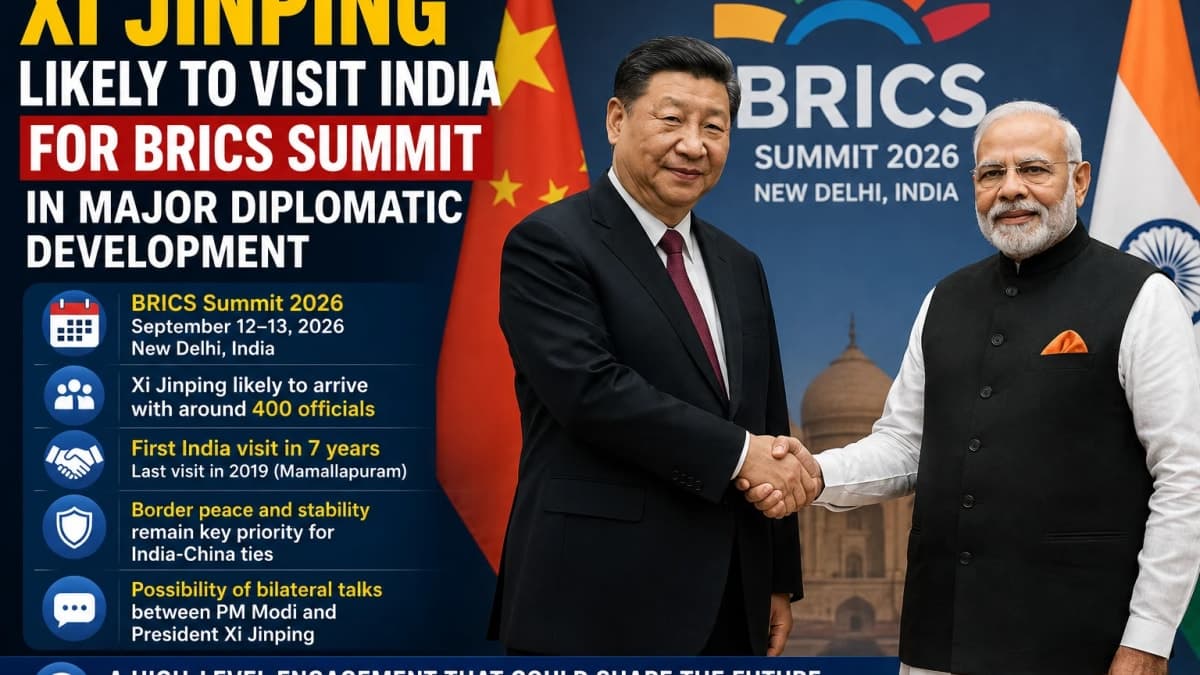
Chinese President Xi Jinping is likely to visit India in September 2026 to participate in the BRICS Summit being hosted in New Delhi, potentially marking an important moment in the gradual effort by India and China to stabilise their relationship.
India will host the summit on September 12 and 13, and Xi is expected to arrive with a substantial Chinese delegation. Reuters reported, citing sources familiar with preparations, that the delegation could include around 400 officials, considerably larger than the group accompanying him during his previous India visit in 2019.
However, the trip should still be described as likely rather than confirmed. China's foreign ministry has expressed support for India's BRICS chairmanship but said it had no information to provide regarding Xi's participation, while his final travel arrangements remain under discussion.
First India Visit in Seven Years
If the visit goes ahead, it would be Xi's first trip to India since 2019.
His last visit came for an informal summit with Prime Minister Narendra Modi in Mamallapuram, Tamil Nadu, months before India-China relations entered one of their most difficult periods in decades.
The relationship deteriorated sharply following the deadly Galwan Valley clash in June 2020. Twenty Indian soldiers and four Chinese soldiers were killed, and the confrontation was followed by a prolonged military standoff along sections of the Line of Actual Control.
A disengagement agreement reached in October 2024 subsequently helped create conditions for a gradual diplomatic thaw.
Against that history, Xi returning to India would carry symbolism extending well beyond attendance at another international summit.
Why Xi Jinping's Potential India Visit Matters
India and China are two of Asia's largest powers, major global economies and influential members of BRICS. At the same time, their relationship combines economic connections with deep strategic competition.
The two countries share a roughly 3,800-kilometre disputed Himalayan border, and the unresolved boundary question remains one of the biggest obstacles to a durable improvement in bilateral ties.
India has repeatedly maintained that peace and tranquillity along the border are essential for normal bilateral relations. New Delhi reiterated the importance of border stability this month amid reports of another encounter involving patrols in a remote Himalayan area.
Xi's potential visit therefore does not mean that India-China disagreements have disappeared. Instead, it would indicate that both governments see value in maintaining high-level political engagement while attempting to manage those disagreements.
Large Chinese Delegation Could Accompany Xi
One notable aspect of the expected trip is the reported size of Xi's delegation.
Two sources cited by Reuters said approximately 400 Chinese officials could accompany the president, compared with fewer than 200 officials during his 2019 visit. Preparations involving hotels and security arrangements were reportedly underway.
A delegation of that scale would underline the importance Beijing is attaching to the summit and the logistical preparations surrounding the potential visit.
It could also provide opportunities for engagement beyond meetings between national leaders, although the precise agenda has not yet been finalised.
Will Modi and Xi Hold Bilateral Talks?
One of the most closely watched questions will be whether Prime Minister Narendra Modi and Xi Jinping hold a separate bilateral meeting alongside the BRICS Summit.
The agenda for any such meeting has not been finalised.
However, if bilateral discussions take place, the border situation, economic engagement, regional security and mechanisms for stabilising relations are likely to attract significant attention.
Modi and Xi previously met on the sidelines of the BRICS Summit in Kazan in October 2024, shortly after India and China reached an understanding related to their military standoff.
Another face-to-face meeting in New Delhi would provide an opportunity to assess how far the relationship has progressed since then.
Border Issue Remains the Biggest Challenge
Despite signs of diplomatic engagement, the boundary dispute remains unresolved.
The 2020 confrontation fundamentally changed the political environment surrounding India-China relations. Both sides subsequently deployed large numbers of troops and military equipment in border areas while holding multiple rounds of military and diplomatic negotiations.
The October 2024 disengagement arrangement represented an important step toward reducing tensions, but it did not resolve the broader territorial dispute.
India's National Security Adviser Ajit Doval has also travelled to Beijing for discussions with Chinese Foreign Minister Wang Yi under the Special Representatives mechanism dealing with the boundary question.
Such talks ahead of the BRICS Summit demonstrate that border management remains closely connected with efforts to improve the wider bilateral relationship.
BRICS Summit Gives India a Major Diplomatic Platform
Xi's expected participation would also increase international attention on India's BRICS presidency.
BRICS began with Brazil, Russia, India, China and South Africa and has since expanded to include additional emerging economies.
For India, hosting the summit provides an opportunity to shape discussions around cooperation among developing economies while reinforcing its role as an independent diplomatic power capable of maintaining relationships across competing geopolitical blocs.
China has publicly said it supports India in successfully hosting this year's BRICS Summit and described the grouping as an important platform for emerging markets and developing countries.
India-China Relations Show Signs of Gradual Stabilisation
High-level diplomatic engagement between New Delhi and Beijing has increased since the prolonged military standoff began easing.
Prime Minister Modi travelled to China in 2025, his first visit there in seven years, while the two governments have continued discussions through diplomatic and security channels.
The potential Xi visit would represent another step in that process.
However, improved communication should not automatically be interpreted as a complete normalisation of relations.
India and China continue to compete strategically across Asia, maintain differing positions on the border and face broader disagreements involving regional security.
Balanced Analysis: Diplomatic Opening, but Major Differences Remain
Xi Jinping's potential visit presents both an opportunity and a test for India-China relations.
On the positive side, a visit by China's top leader after seven years would demonstrate that both governments are willing to maintain direct political communication despite their difficult recent history.
Regular leadership-level engagement can help reduce misunderstandings, establish mechanisms for managing disagreements and potentially create space for economic cooperation.
The BRICS setting also allows the two governments to engage without portraying the summit exclusively as a bilateral reconciliation exercise.
Yet expectations should remain measured.
The unresolved border dispute remains a fundamental source of distrust, and recent border-related concerns demonstrate how quickly tensions can return to the centre of the relationship.
India and China are also strategic competitors whose interests do not always align across South Asia and the wider Indo-Pacific.
Xi's visit, therefore, would be better viewed as evidence of careful diplomatic re-engagement rather than a complete reset.
Conclusion
Xi Jinping's likely attendance at the September 12–13 BRICS Summit could become one of the most significant India-China diplomatic developments of 2026.
If confirmed, it would be the Chinese president's first visit to India in seven years and would come after a prolonged period dominated by the consequences of the 2020 border confrontation.
The prospect of a roughly 400-member delegation and potential talks between Xi and Prime Minister Modi will ensure that the visit is watched far beyond the formal BRICS agenda.
Whether it produces lasting improvement will depend less on symbolism and more on progress in managing the border dispute, rebuilding confidence and establishing a stable framework for coexistence between two powerful neighbours.