3,400 Voter-Revision Forms Found at Navi Mumbai Photocopy Shop; Five BLOs Suspended
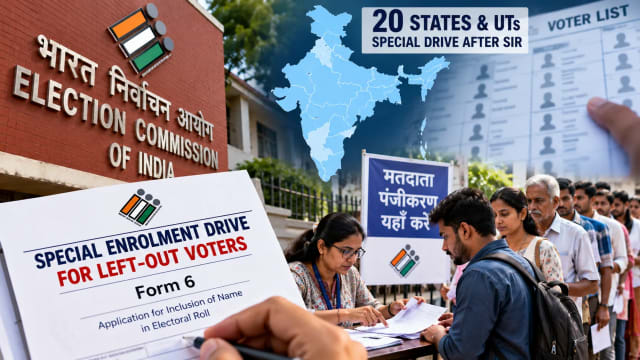
A major controversy over the handling of voter records has erupted in Maharashtra after thousands of Special Intensive Revision (SIR) enumeration forms were discovered at a private photocopy shop in Navi Mumbai's Kharghar area.
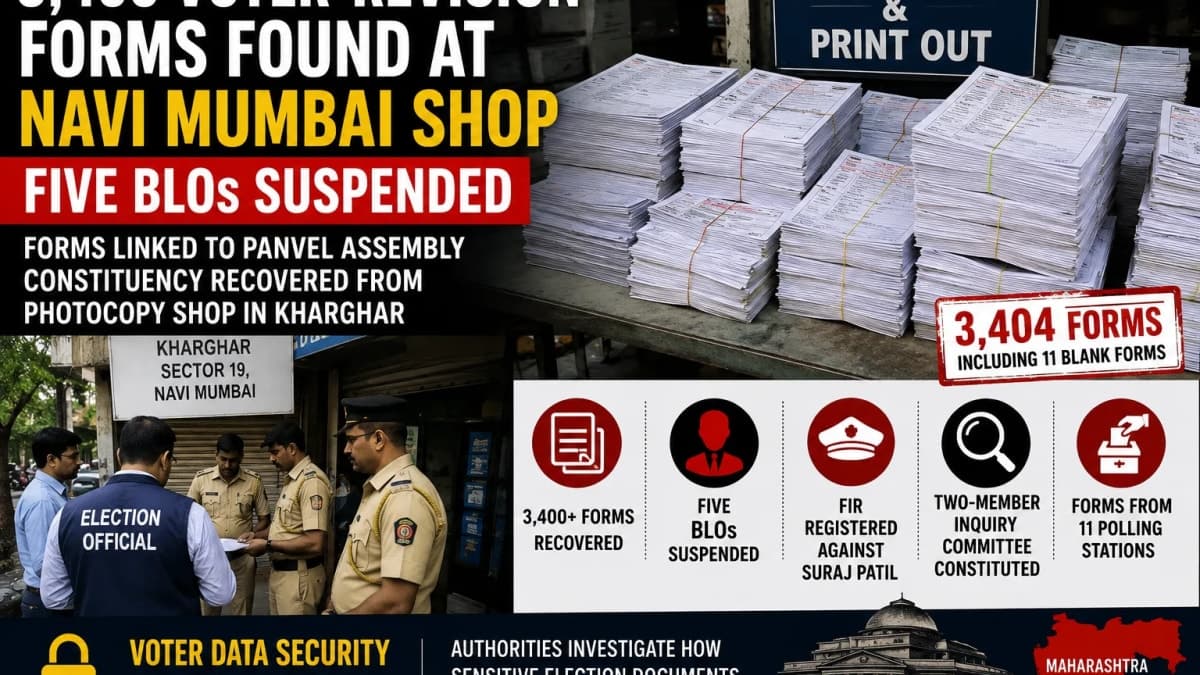
Authorities initially reported finding around 3,400 forms connected with voters from the Panvel Assembly constituency at the shop in Sector 19, Kharghar.
Subsequent reporting put the number seized at 3,404 forms, including 11 blank forms.
The discovery has prompted administrative and police action, with five Booth Level Officers (BLOs) suspended, an FIR registered and an inquiry launched to establish how election-related documents reached a private photocopy centre.
How Were the Voter Forms Discovered?
The matter surfaced after a complaint was made about Special Intensive Revision forms allegedly being photocopied at a private shop in Kharghar.
Following the complaint, Assistant Electoral Registration Officers were sent to inspect the premises.
During the inspection, officials found thousands of SIR enumeration forms that had been brought to the shop by a man identified as Suraj Patil.
Authorities subsequently took possession of the documents.
The forms were connected with voters from the Panvel Assembly constituency and came from 11 polling stations.
According to officials, most of the forms were associated with five polling stations, while single copies were linked to six other polling stations.
Five Booth Level Officers Suspended
The discovery immediately raised questions about the chain of custody of the election documents.
Raigad district authorities suspended five Booth Level Officers pending disciplinary proceedings.
Show-cause notices were also issued in connection with the incident.
Officials are now investigating how forms that should have remained within the authorised electoral process ended up at a commercial photocopy establishment.
Determining whether the documents were deliberately transferred, mishandled or taken outside the authorised process without proper permission will be an important part of the inquiry.
FIR Registered in Connection With the Case
Police have also initiated criminal proceedings.
An FIR was registered against Suraj Patil in connection with the alleged unauthorised possession and handling of the voter enumeration forms.
The case reportedly invokes provisions of the Representation of the People Act and the Bharatiya Nyaya Sanhita (BNS).
Authorities are investigating the circumstances surrounding the possession and photocopying of the forms.
The registration of an FIR does not itself establish guilt. The allegations and circumstances surrounding the documents will have to be established through the investigation and subsequent legal process.
What Information Do SIR Enumeration Forms Contain?
Special Intensive Revision is an exercise related to updating and verifying electoral rolls.
Booth Level Officers play an important ground-level role in the process, including handling voter-related documentation and helping verify electoral information.
Because enumeration forms can contain voter information, their custody and handling require safeguards.
That is why the presence of thousands of such documents at an unauthorised private location has attracted significant attention.
The controversy is not simply about photocopying paperwork. It raises a larger question: how did election-related documents leave the authorised chain of custody in the first place?
Two-Member Inquiry Committee Formed
Authorities have moved beyond the immediate suspensions and initiated a wider investigation.
A two-member inquiry committee has reportedly been constituted to examine the incident.
The inquiry is expected to focus on how the forms reached the photocopy centre, whether established procedures were violated and who was responsible for their custody at different stages.
The investigation will also be important in determining whether the incident represents an isolated procedural lapse or points to broader weaknesses in document-handling practices.
Incident Triggers Political Confrontation
The discovery quickly acquired a political dimension.
Shiv Sena (UBT) representatives alleged that Patil was connected with the BJP's youth wing and questioned how thousands of voter forms could have reached a private individual.
BJP representatives in Panvel, however, denied that party workers were connected with the matter.
Opposition leaders have also used the episode to raise broader questions about the conduct and credibility of the voter-revision exercise.
These political allegations should be distinguished from the facts officially established so far.
What has been confirmed is that thousands of SIR-related forms were discovered at a private photocopy centre, five BLOs were suspended, an FIR was registered and authorities initiated an inquiry.
Questions about political responsibility or motive remain subject to investigation and competing claims.
Why This Incident Matters
Electoral rolls are fundamental to the voting process.
Any revision exercise must balance two important objectives: keeping voter lists accurate and protecting the integrity of voter information.
BLOs occupy a particularly important position because they connect election authorities with voters at the local level.
If election-related documents move outside authorised channels without adequate controls, it can create concerns about privacy, data security and confidence in the electoral process.
Even if an investigation ultimately concludes that there was no attempt to manipulate voter records, an unexplained breakdown in document custody can itself expose procedural vulnerabilities.
Voter Data Security Comes Into Focus
The incident also highlights the growing importance of protecting personal information during large-scale electoral exercises.
Election administration involves collecting and processing information belonging to millions of citizens.
Physical records therefore require safeguards just as digital databases do.
Photocopying or moving documents through private establishments can potentially expand the number of people who have access to voter information.
The investigation will need to determine exactly what information was contained in the forms, whether copies were made, who had access to them and whether any voter information was improperly retained or used.
Administrative Accountability Will Be Key
The suspension of five BLOs demonstrates that authorities have treated the alleged custody lapse seriously.
However, suspension is an interim administrative measure rather than a final determination of responsibility.
A comprehensive inquiry will need to establish the complete movement of the forms—from their collection and processing to their appearance at the Kharghar shop.
That process should help determine whether established procedures were ignored and whether stronger controls are needed to prevent similar incidents.
Balanced Analysis: What We Know and What Remains Unclear
The episode has generated strong political reactions, but several questions remain unanswered.
Authorities have confirmed the discovery of thousands of forms and initiated administrative and criminal proceedings.
What has not yet been conclusively established is why the documents were taken to the private photocopy shop, who authorised or facilitated their movement, whether copies were distributed elsewhere, or whether the incident had any impact on the electoral roll itself.
Those distinctions matter.
A document-security breach would be serious on its own, but it should not automatically be treated as proof of voter-roll manipulation without evidence establishing such activity.
Similarly, political affiliation claims surrounding individuals involved should be assessed separately from the question of institutional responsibility.
The ongoing police investigation and administrative inquiry will therefore be crucial in establishing what actually happened.
What Happens Next?
Attention will now turn to the findings of the inquiry committee and police investigation.
Authorities will need to reconstruct the chain of custody of the forms and establish how thousands of election documents connected with multiple polling stations reached one private establishment.
The findings could also determine whether additional officials face disciplinary action or whether procedures for handling physical voter documents need to be strengthened.
For election authorities, resolving those questions transparently will be important not only for assigning responsibility but also for maintaining public confidence in the voter-revision process.
This article is based on reporting published by TOI.