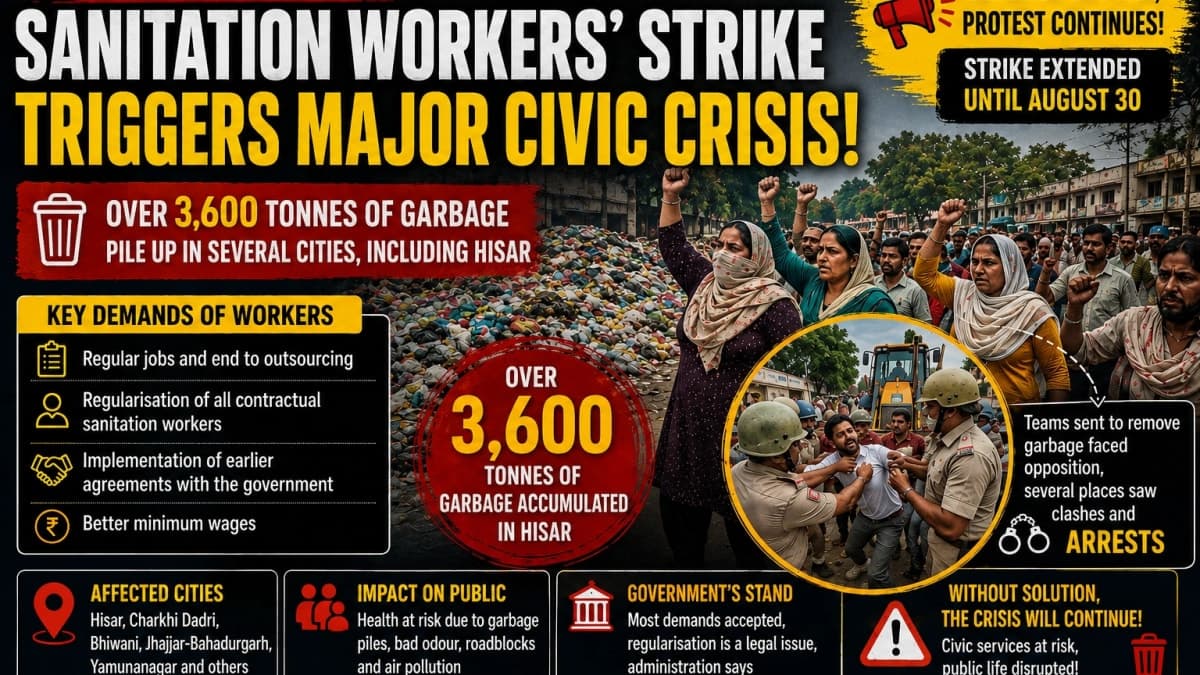
Haryana Sanitation Strike Escalates as Garbage Piles Up Across Cities
What began as an employment-related protest by sanitation workers has developed into a wider civic challenge across Haryana, leaving residents caught between striking employees demanding job security and municipal administrations trying to keep essential waste-management services running.
The agitation has affected garbage collection in several urban centres, including Hisar, Charkhi Dadri, Bhiwani, Jhajjar-Bahadurgarh, Yamunanagar and other areas.
Hisar has emerged as one of the main flashpoints. By August 23, when the strike there had reached its 18th day, more than 3,600 tonnes of garbage had reportedly accumulated across roads, residential areas and public spaces.
As waste continued to build up, municipal authorities began deploying machinery and police personnel to clear dumping points — moves that brought the administration directly into confrontation with striking workers.
Early-Morning Clean-Up Operation Sparks Tension in Hisar
One of the most serious confrontations unfolded at Hisar's ITI Chowk.
At around 5 am on August 23, municipal teams accompanied by police arrived with JCB machines and other equipment to remove accumulated garbage.
Striking workers attempted to oppose the operation, following which several protesters were detained. A confrontation also took place involving women sanitation workers and women police personnel.
Police alleged that some protesters threw garbage towards personnel during the confrontation.
The incident followed an earlier confrontation at ITI Chowk.
Police subsequently registered an FIR naming 16 sanitation workers, including union representatives, while around 100 unidentified workers were also booked. Authorities alleged that protesters had obstructed a garbage-removal team and interfered with a JCB operation.
The allegations form part of the police case and should not be treated as judicial findings against the workers.
Crisis Spreads Beyond Hisar
Hisar is not the only Haryana city struggling with the effects of the strike.
In Charkhi Dadri, authorities deployed JCBs, tractors and trolleys alongside police personnel to remove accumulated garbage. Eleven workers, including a union president, were detained after opposing one such operation.
In Jhajjar-Bahadurgarh, an overnight garbage-clearance operation also prompted protests and detentions.
Bhiwani authorities, meanwhile, deployed an outside agency to remove waste from parts of the city. Around 90 trolley-loads of garbage were removed from Circular Road during one operation, according to the initial reports.
Authorities later intensified cleaning operations in Hisar and Bhiwani, with hundreds of tonnes of waste being lifted from multiple locations in Hisar and another roughly 60 trolley-loads being removed during a subsequent Bhiwani operation.
Yamunanagar-Jagadhri was also affected. Authorities there began removing hundreds of tonnes of accumulated waste from dozens of dumping locations, while protesting employees were detained during the operation.
Why Are Haryana’s Sanitation Workers on Strike?
At the heart of the dispute are employment conditions and long-running demands from sanitation and municipal workers.
Among the key issues raised by employees are the regularisation of contractual workers, opposition to outsourcing and the contractual employment system, implementation of an earlier agreement with the state government, and improved employment conditions.
Workers have also sought departmental appointments for employees working through contractors and higher minimum wages for door-to-door sanitation workers.
The dispute is particularly centred on regularisation.
Government representatives have said most of the workers' demands have been accepted, but the question of regularising contractual employees remains complicated by legal considerations.
That unresolved issue has prevented negotiations from producing a final breakthrough.
Government and Workers Present Two Different Arguments
The dispute has created two competing concerns.
From the workers' perspective, the strike is about long-term employment security and implementation of commitments they say were previously made to them.
Union representatives have argued that the government should resolve their employment-related demands through negotiations rather than relying on police-backed alternative sanitation arrangements.
The administration, however, faces a different immediate responsibility.
With garbage accumulating in residential neighbourhoods and public areas, municipal authorities argue that they cannot allow essential sanitation services to remain suspended indefinitely.
Officials say garbage removal is necessary to protect residents and prevent deteriorating public-health conditions.
Haryana minister Krishan Kumar Bedi subsequently warned that workers could continue their protest but should not obstruct government clean-up operations, adding that action could follow if protesters directly confronted the administration.
Public Health Becomes the Biggest Concern
Beyond the labour dispute, the growing piles of garbage have created another problem: public health.
Waste accumulating for days in streets and residential areas can create foul odours, obstruct roads and potentially provide breeding conditions for insects and disease-carrying organisms.
The problem becomes particularly concerning during wet and humid weather.
In Charkhi Dadri, residents reportedly resorted to burning garbage at some locations, sending smoke into surrounding areas and creating an additional air-pollution concern.
This places residents in a difficult position.
The workers' employment dispute may require negotiation and policy decisions, but households still need daily garbage collection and clean public spaces.
As the strike stretches on, that conflict between labour rights and uninterrupted essential services is becoming increasingly difficult for the administration to manage.
Strike Continues — And the Situation Has Escalated Further
The crisis did not end with the August 23 confrontations.
By August 27, the sanitation workers' strike had entered its 22nd day and unions had extended the agitation until August 30.
Fresh tensions were reported in Hisar when authorities attempted to operate alternative garbage-collection arrangements.
Police said around 50–60 protesting sanitation workers were detained after allegedly obstructing vehicles assigned to collect household waste.
Protests against alternative sanitation arrangements were also reported elsewhere, while authorities in Jhajjar reportedly removed around 125 tonnes of garbage during an overnight operation.
This means the Haryana sanitation dispute is no longer simply a short-term workers' protest.
It has evolved into a prolonged standoff involving labour demands, public-health concerns, municipal services, police intervention and the everyday lives of thousands of residents.
Why This Story Matters
The Haryana sanitation strike highlights a difficult question faced by governments whenever essential-service employees launch prolonged industrial action.
Workers have the right to raise employment grievances and seek improved job security. At the same time, municipal administrations carry a responsibility to ensure that basic civic services continue.
When negotiations fail, ordinary residents can become the unintended victims.
The growing garbage crisis also demonstrates how quickly a labour dispute in sanitation services can develop into a broader urban-management problem.
A sustainable solution therefore requires more than clearing garbage under police protection. It requires meaningful negotiations capable of addressing the unresolved employment issues while ensuring that waste collection and other essential services remain available to residents.
What Happens Next?
Attention will now remain on negotiations between employee organisations and the Haryana government.
The government says it has moved on most demands, while regularisation remains a key unresolved issue. Workers, meanwhile, have continued their agitation and opposed alternative garbage-collection arrangements in several locations.
Unless both sides reach an agreement, Haryana could continue facing a difficult combination of overflowing waste, repeated confrontations and pressure on civic services.
For residents, however, the most urgent question is much simpler: when will normal garbage collection resume?