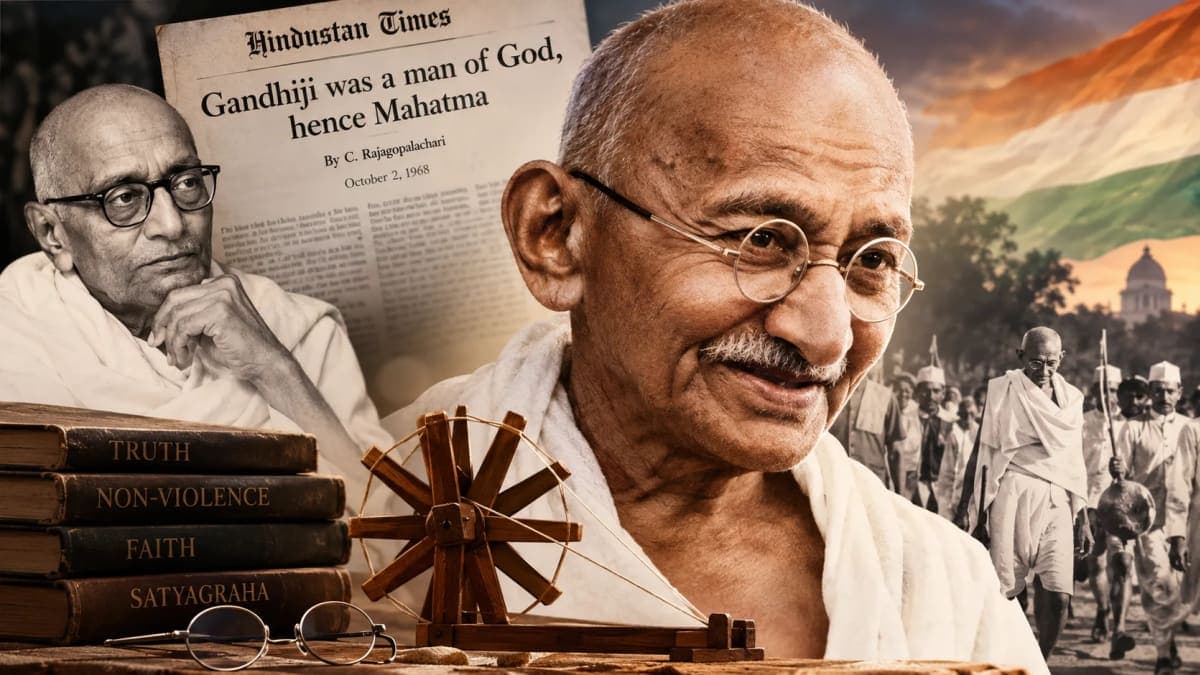
A Decades-Old Reflection Returns on Gandhi Jayanti
As India marks the birth anniversary of Mahatma Gandhi on October 2, a historical essay by C. Rajagopalachari has returned to public attention, offering a distinctly spiritual interpretation of Gandhi’s philosophy of non-violence.
Hindustan Times republished edited excerpts from Rajagopalachari’s article on October 2, 2026. The newspaper states that the original piece was published on October 2, 1968, during the period leading into celebrations of Gandhi’s birth centenary.
Rather than treating non-violence simply as an effective political method, Rajagopalachari argued that Gandhi’s approach depended on deeper moral and spiritual commitments.
Rajagopalachari’s Interpretation of Gandhi
Rajagopalachari challenged the idea that Gandhian non-violence could be separated from the beliefs that sustained it.
His central argument was that truth and love were not tools that could simply replace physical force. In his interpretation, Gandhi’s ability to practise non-violence rested on faith, self-discipline and a conviction that moral power could confront injustice without reproducing hatred.
The distinction is important. A person can refrain from physical violence while continuing to harbour hostility toward an opponent. Rajagopalachari argued that this would fall short of Gandhi’s conception of non-violence.
His essay therefore presented Gandhian thought not merely as the absence of weapons but as a demanding moral discipline requiring a transformation in how an adversary is viewed.
Gandhi’s Own Writings Connect Truth, Faith and Non-Violence
Rajagopalachari’s interpretation can also be considered alongside Gandhi’s own writings.
The Gandhi Heritage Portal, which preserves Gandhi-related documents and writings, contains numerous statements connecting truth, non-violence, religion, self-purification and faith. The archive also houses major texts including Hind Swaraj, Satyagraha in South Africa and The Story of My Experiments with Truth.
An official Mahatma Gandhi archive records Gandhi describing truth as central to his understanding of God and non-violence as the means through which that truth could be pursued.
This provides historical context for Rajagopalachari’s argument: Gandhi’s political methods and spiritual convictions frequently intersected rather than operating as completely separate parts of his life.
More Than a Political Strategy
Gandhi's historical significance is strongly associated with satyagraha — resistance grounded in truth and non-violence.
After developing methods of resistance while confronting discrimination in South Africa, Gandhi returned to India in 1915 and became one of the most prominent leaders of the independence movement. Campaigns associated with him included the movement for swadeshi and the 1930 Salt March, which challenged British colonial restrictions on salt.
His methods subsequently became influential far beyond India's independence struggle, contributing to his international reputation as a symbol of non-violent resistance.
Yet Rajagopalachari’s essay highlights a distinction that can be lost when Gandhi’s methods are reduced to protest tactics: for Gandhi, non-violence involved ethical obligations as well as political action.
Why Rajagopalachari’s Argument Still Matters
The republication is significant because it raises a broader question about how Gandhi’s legacy is understood today.
One interpretation emphasizes the practical effectiveness of peaceful protest and civil resistance. Another places greater emphasis on the ethical and spiritual framework behind Gandhi’s methods.
Rajagopalachari clearly belonged to the latter camp. His argument was that copying the outward form of non-violence without cultivating its underlying moral principles risked turning Gandhian philosophy into little more than a technique.
That interpretation does not mean every modern application of non-violent resistance must share Gandhi’s religious convictions. Secular movements have also adopted non-violent strategies for political and social objectives.
But Rajagopalachari’s essay helps explain how Gandhi himself connected politics, morality, truth and faith — and why understanding those connections can provide a fuller picture of his philosophy.
Gandhi’s Continuing Global Legacy
Born Mohandas Karamchand Gandhi in Porbandar on October 2, 1869, Gandhi became a central figure in India's independence movement and one of the world's most recognisable advocates of non-violent resistance.
October 2 is observed in India as Gandhi Jayanti and internationally as the International Day of Non-Violence.
More than seven decades after Gandhi's death in 1948 — and nearly six decades after Rajagopalachari wrote the essay — debates over the meaning, practicality and foundations of non-violence continue.
The resurfacing of the 1968 article therefore offers more than a historical tribute. It provides an opportunity to revisit the intellectual and spiritual foundations behind one of Gandhi's most enduring ideas: that lasting resistance to injustice requires not merely the rejection of physical violence, but a commitment to truth, discipline and humanity.