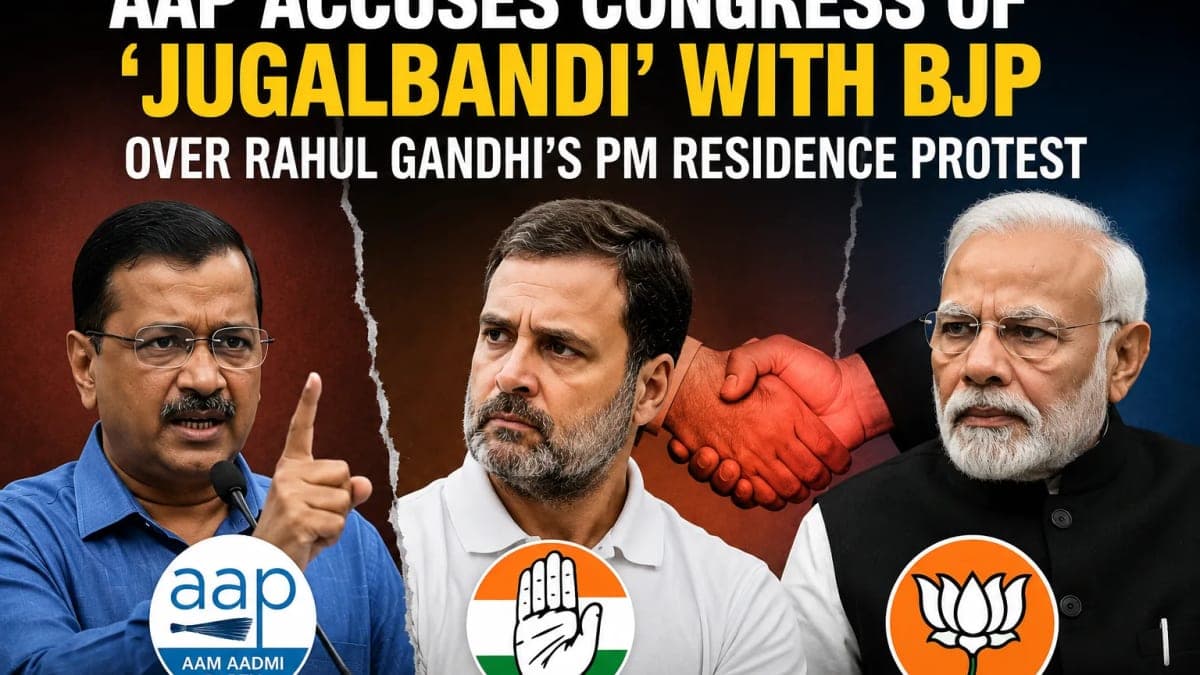
AAP Questions Congress Strategy After Rahul Gandhi’s Protest
The Aam Aadmi Party has launched a sharp attack on the Congress, alleging a "jugalbandi" (political duet) between the Congress and the Bharatiya Janata Party after Rahul Gandhi staged a sit-in protest near the Prime Minister’s residence in New Delhi.
AAP leaders questioned how the Congress leadership was able to hold a demonstration outside one of the country's most secure locations and engage with the government so quickly, contrasting it with the prolonged protests by student groups and other activists who, they claimed, had struggled to receive a similar response from the authorities.
Rahul Gandhi’s Protest Followed Student Agitation
Rahul Gandhi, accompanied by senior Congress leaders and Members of Parliament, organized the protest outside the Prime Minister’s residence to demand accountability over the alleged NEET paper leak controversy and police action against demonstrators. The protest ended with police detaining Rahul Gandhi and several Congress leaders before they were later released.
Congress maintained that the protest was aimed at seeking accountability from the government over examination irregularities and the treatment of student protesters.
AAP Alleges Congress Is Weakening the Protest Movement
AAP argued that the Congress protest shifted attention away from the broader student-led movement and created unnecessary political competition within the opposition.
Party leaders suggested that the timing and handling of Rahul Gandhi's demonstration benefited the ruling BJP by diverting focus from the original protest campaign. They alleged that the Congress' actions diluted the momentum of the larger agitation instead of strengthening it.
Congress, however, has defended its decision, saying that it has consistently raised concerns over examination irregularities and has every right to protest against government policies.
Political Differences Surface Within the Opposition
The exchange highlights growing tactical differences among opposition parties despite their shared criticism of the government's handling of the alleged paper leak issue.
While AAP has emphasized supporting the existing student-led campaign, Congress has chosen to launch its own high-profile political protests, creating friction between two parties that have cooperated on several national issues in the past.
The disagreement has fueled fresh speculation about the cohesion of opposition parties as they prepare for future political battles.
Why the Issue Matters
The controversy extends beyond a dispute between political parties. It reflects a broader debate over how opposition groups should coordinate their response to major public issues and whether competing political strategies strengthen or weaken public movements.
For students affected by examination controversies, the focus remains on demands for accountability, transparency, and reforms, while political parties continue to debate the most effective way to press the government.
Balanced Analysis
AAP's criticism reflects concerns that competing opposition campaigns may fragment public attention and reduce pressure on the government. Congress, on the other hand, argues that visible political action is necessary to keep issues such as examination integrity and student welfare at the forefront of national debate.
The BJP has rejected the opposition's allegations altogether, describing the protests as politically motivated attempts to gain attention rather than genuine public advocacy.
The exchange underscores the challenge of maintaining opposition unity while multiple parties seek to establish their own political identity on high-profile national issues.
Conclusion
AAP's "jugalbandi" accusation against Congress has added a new political dimension to the debate surrounding Rahul Gandhi's protest outside the Prime Minister's residence. While both parties continue to criticize the government's handling of the alleged paper leak issue, their public disagreement has also drawn attention to the evolving dynamics within the opposition alliance and the differing strategies being adopted to engage with public concerns.