BJP–Akali Dal Student Wings Form Alliance in Panjab University Election, Back ABVP’s Ankit Bidhan
CHANDIGARH, August 31, 2026: The student organisations associated with the Bharatiya Janata Party (BJP) and Shiromani Akali Dal (SAD) have joined forces in the Panjab University Campus Students’ Council election, creating a politically significant campus alliance at a time when the relationship between their parent parties is again under scrutiny.
The Akhil Bharatiya Vidyarthi Parishad (ABVP) and the Akali Dal-affiliated Students’ Organisation of India (SOI) announced their electoral understanding on Sunday, August 30, just one day before voting.
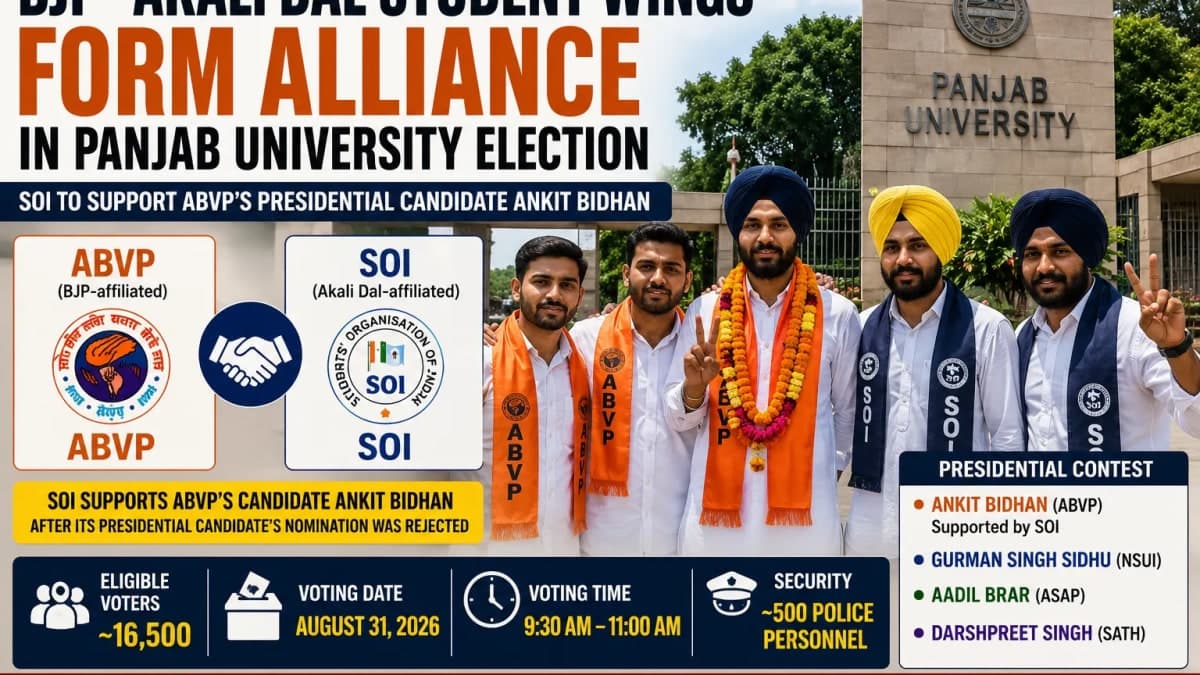
Under the arrangement, SOI is supporting ABVP presidential candidate Ankit Bidhan and has said it will mobilise its supporters in favour of the alliance. The development follows the rejection of SOI’s own presidential candidate’s nomination.
The alliance is confirmed at the student-organisation level. It should not, however, be interpreted as confirmation that the BJP and SAD have reached a formal agreement for the 2027 Punjab Assembly election.
SOI Backs ABVP’s Ankit Bidhan for President
SOI has not fielded a candidate for the presidential post after the nomination of its candidate was rejected during the election process.
The organisation subsequently decided to support ABVP’s Ankit Bidhan.
The decision has altered the electoral arithmetic of the presidential race because SOI can now attempt to consolidate its supporters behind the ABVP candidate rather than competing separately.
In a statement reported by The Tribune, SOI said the alliance had been formed with the larger objective of student welfare and the betterment of the student community.
The organisation said:
“The SOI has entered into an alliance with the ABVP for the upcoming PUCSC elections, with a mutual candidate, Ankit Bidhan, representing the alliance.”
The statement further said that the decision had been made while “keeping the interests of the campus above political differences.”
SOI also described the arrangement as an example of Sikh-Hindu unity and argued that campus politics should focus on development, student welfare and constructive representation rather than divisive sentiments.
Alliance Announced Just Before Voting
The timing has added to the political significance of the arrangement.
ABVP and SOI announced their alliance on August 30, with voting for the Panjab University Campus Students’ Council scheduled for August 31.
SOI national general secretary Jashanpreet Singh and ABVP representatives including Gauravveer Singh Sohal, Jaskaran Bhullar and Parvinder Singh Negi were among the student leaders associated with the announcement. Following the alliance, representatives visited the gurdwara in Panjab University’s Sector 14 campus.
The campus agreement therefore emerged at the final stage of campaigning, giving both organisations limited time to transfer their respective voter support behind the joint strategy.
Around 16,500 Students Eligible to Vote
Approximately 16,500 students are eligible to participate in this year’s Panjab University Campus Students’ Council election.
Voting is scheduled from 9:30 am to 11 am, with counting for the main council positions beginning at noon at the university’s Gymnasium Hall.
Results are expected by the evening.
A total of 16 candidates are contesting the major council positions, while four candidates are competing for president.
Female students form the largest part of the electorate, with approximately 9,000 women voters, compared with 7,467 male voters and one transgender voter.
The university has established 191 polling booths, while around 500 police personnel, including reserve forces, are expected to be deployed as part of security arrangements.
Four-Way Contest for PUCSC President
Despite the ABVP-SOI agreement, the presidential race remains a four-way contest.
The candidates are:
Ankit Bidhan — BJP-backed ABVP, now supported by SOI
Gurman Singh Sidhu — Congress-affiliated National Students’ Union of India (NSUI)
Aadil Brar — AAP-backed Association of Students for Alternative Politics (ASAP)
Darshpreet Singh — Sath
The combination of four candidates and a late electoral alliance makes the presidential result particularly significant.
The central question is whether SOI can successfully transfer its campus support to Bidhan and give ABVP an advantage over the other three candidates.
Why the ABVP-SOI Alliance Is Politically Significant
The alliance has attracted attention beyond Panjab University because of the history between the BJP and Shiromani Akali Dal.
For decades, the BJP and SAD were political allies in Punjab.
Their partnership lasted for more than two decades before the Akali Dal withdrew from the BJP-led National Democratic Alliance in 2020, amid opposition to the Centre’s three farm laws.
Six years later, political discussion about whether the former allies could cooperate again has returned ahead of the 2027 Punjab Assembly election.
The Panjab University development therefore has symbolic significance: organisations associated with two former political partners have found a reason to cooperate electorally even while the future relationship between their parent parties remains uncertain.
Campus Alliance Does Not Confirm BJP-SAD Reunion
It is important to distinguish confirmed developments from political speculation.
Confirmed: ABVP and SOI have entered into an electoral understanding for the Panjab University student council election, and SOI is supporting ABVP presidential candidate Ankit Bidhan.
Not confirmed: The BJP and Shiromani Akali Dal have reached a formal alliance for the 2027 Punjab Assembly election.
Reports in recent days have presented conflicting signals about the relationship between the two parties.
Some reports have indicated discussions or interest in renewed cooperation, while BJP leaders have also publicly spoken about contesting independently.
The campus alliance therefore demonstrates that cooperation remains possible between organisations associated with the two parties, but it cannot by itself establish what the BJP and SAD will ultimately decide at the state level.
Panjab University Election Takes on Wider Political Importance
Panjab University student politics frequently attracts attention extending beyond the university because several competing organisations are associated with major political parties.
This year is particularly notable.
The presidential field includes organisations associated with the BJP, Congress and Aam Aadmi Party, alongside Sath, while the Akali Dal-linked SOI has now thrown its support behind ABVP.
That gives the campus contest characteristics of a broader political competition, even though university elections remain fundamentally about student representation.
With Punjab scheduled to hold an Assembly election in 2027, political observers may inevitably examine the result for indications of organisational strength and voter sentiment among students.
Such interpretations should be treated cautiously. A university electorate is small and demographically distinct compared with Punjab’s overall voting population, so the result cannot reliably predict a statewide election.
What the Alliance Means for ABVP
The immediate beneficiary of the arrangement could be Ankit Bidhan.
SOI’s decision not to field a presidential candidate removes one competing organisation from the race and potentially gives Bidhan access to a larger pool of student voters.
Whether that translates into additional votes depends on how effectively SOI can persuade its supporters to back the ABVP candidate.
Campus alliances do not automatically guarantee complete voter transfer, particularly in student elections where candidates, departments, personal networks and local issues can play an important role.
The final result will therefore provide a clearer indication of whether the late alliance materially changed the presidential contest.
Student Issues Remain at the Centre of the Election
Despite the attention surrounding the BJP-SAD political relationship, the organisations involved have publicly framed their alliance around campus concerns.
SOI said the arrangement was intended to prioritise student welfare, development and constructive representation.
That framing matters because national and state political narratives can sometimes overshadow the issues directly affecting university students.
For the approximately 16,500 eligible voters, the council they elect will represent them on matters connected to campus life and student interests.
The significance of the election therefore operates at two levels: the immediate question of who will lead the student council, and the broader political interest generated by the alliances surrounding the contest.
Conclusion
The ABVP-SOI alliance has transformed the final stage of the 2026 Panjab University student election into a contest with implications extending beyond campus politics.
The confirmed arrangement is straightforward: Shiromani Akali Dal-affiliated SOI is supporting BJP-backed ABVP presidential candidate Ankit Bidhan after its own candidate’s nomination was rejected.
The wider political meaning is less certain.
With speculation continuing over whether the BJP and SAD could revive their former partnership ahead of Punjab’s 2027 Assembly election, cooperation between their student organisations will inevitably attract attention.
But the Panjab University agreement remains a campus-level electoral alliance—not confirmation of a state-level political reunion.
For now, the more immediate test is electoral: whether SOI’s support can help Ankit Bidhan overcome his three rivals and secure the presidency of the Panjab University Campus Students’ Council.