Centre Puts a Timeline on Its Anti-Drug Campaign
India's campaign against narcotics is moving into a three-year phase that will combine tougher action against trafficking networks with a substantial expansion of treatment, rehabilitation and drug-prevention programmes.
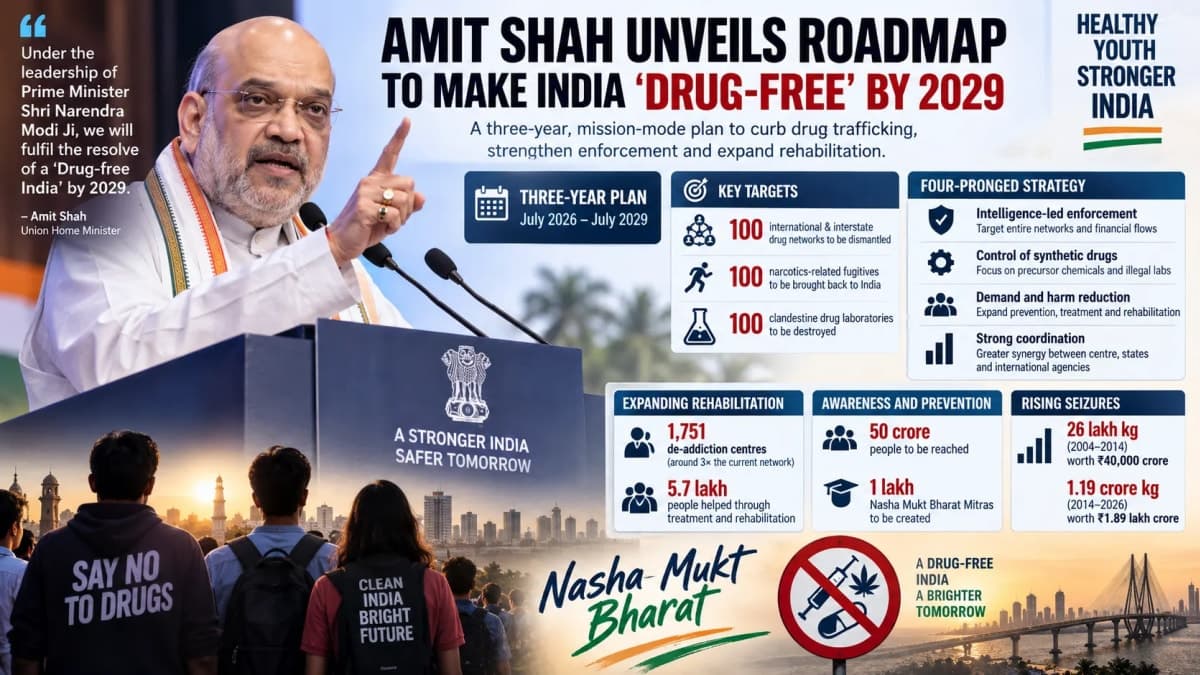
Union Home Minister Amit Shah, outlining the government's roadmap in Panaji, said the plan would run from July 2026 to July 2029. Its stated objective is a “Drug-Free India” by the end of that period.
“Under the leadership of Prime Minister Shri Narendra Modi Ji, we will fulfil the resolve of a ‘Drug-free India’ by 2029,” Shah said.
The phrase sets an ambitious political goal. The more concrete part of the plan lies in the targets underneath it: breaking up major trafficking networks, pursuing fugitives, shutting illegal drug laboratories, tracing narcotics money and increasing access to de-addiction services.
The government is also treating users and traffickers differently. Enforcement agencies have been told to intensify action against organised drug networks, while people dealing with addiction are to be directed towards treatment and rehabilitation.
Four Areas Will Drive the 2026-29 Strategy
The roadmap is built around four areas: intelligence-led enforcement, synthetic drugs and precursor chemicals, demand and harm reduction, and better coordination and institutional capacity.
On enforcement, the Centre wants agencies to look beyond individual drug seizures and investigate the networks behind them.
That means tracing consignments upwards towards organisers and financiers as well as following large traffickers down through distribution chains. Financial investigations are expected to play a bigger role, particularly in identifying assets and money flows linked to the narcotics trade.
The government also wants wider use of legal provisions available under PIT-NDPS, the Prevention of Illicit Traffic in Narcotic Drugs and Psychotropic Substances Act.
The approach reflects a shift in what authorities count as a meaningful result. A large seizure can remove drugs from circulation, but dismantling the organisation responsible for moving them can have a longer-lasting effect.
100 Drug Networks and 100 Fugitives on Target List
Some of the objectives have been given specific numbers.
Authorities have been tasked with dismantling 100 international and interstate narcotics networks during the three-year period. The government also wants 100 fugitives linked to drug offences brought back to India.
That part of the plan will require cooperation beyond India's borders. Trafficking organisations can source narcotics in one country, finance operations through another and distribute them across several markets.
Extradition proceedings, Red Corner Notices and cooperation with foreign governments are expected to form part of the effort to pursue suspects operating overseas.
Shah has also linked the narcotics trade with organised crime and national security, arguing that illegal drug proceeds can feed other criminal and terrorist activities.
Following the money, rather than concentrating only on the physical movement of narcotics, is therefore a significant part of the strategy.
Synthetic Drugs Change the Enforcement Challenge
The government is giving separate attention to synthetic drugs and the chemicals used to manufacture them.
Unlike narcotics that depend heavily on cultivation and established smuggling routes, synthetic substances can be produced in clandestine laboratories closer to the markets where they are sold. Chemicals with legitimate industrial uses can also be diverted into illegal manufacturing.
Authorities have been given a target of identifying and destroying 100 clandestine drug laboratories by July 2029.
Enforcement agencies are expected to focus not just on the laboratories but on the supply chains that provide chemicals, equipment and other inputs.
Technology has complicated that task. Darknet marketplaces, encrypted communication, cryptocurrency and parcel networks can allow sellers, buyers and financiers to operate without following traditional trafficking patterns.
The new strategy consequently puts greater weight on intelligence and coordination between agencies.
India's Borders Are Only One Part of the Problem
India's location places it near major narcotics-producing regions, making border enforcement a longstanding part of the country's drug-control policy.
Shah referred to trafficking linked to the “Death Crescent” and “Death Triangle,” terms used in discussions of narcotics-producing areas around India's broader neighbourhood.
But stopping drugs at land borders cannot address every route.
Ports, airports, maritime corridors and international parcels are also used to move illegal substances. Domestic networks then carry narcotics between states and into local markets.
The Centre's strategy is therefore designed to connect border agencies, central organisations and state police forces rather than treating each interception as a separate case.
Treatment Network Set for Major Expansion
The other side of the roadmap deals with demand.
According to government figures, the Nasha Mukt Bharat Abhiyaan has reached 25 crore people through its pledge campaign, while 5.7 lakh people have received help to move out of drug addiction through treatment and rehabilitation.
The government now plans to expand the number of de-addiction centres to 1,751, roughly three times the existing network.
The Department of Social Justice, the Health Department and prison authorities are expected to be involved in that expansion.
Schools, colleges and youth organisations will also play a larger role in prevention. The government intends to use NCC, NSS and MY Bharat to build a network of one lakh Nasha Mukt Bharat Mitras.
The broader awareness campaign has been given a target of reaching 50 crore people.
Those measures recognise a basic limit of an enforcement-only strategy: reducing supply does not remove the underlying demand for drugs or provide treatment to people who have developed dependence.
Government Points to Sharp Rise in Drug Seizures
Shah cited seizure data to demonstrate how enforcement has expanded over the past decade.
Government figures show that agencies seized 26 lakh kilograms of drugs worth about ₹40,000 crore between 2004 and 2014.
Between 2014 and 2026, the reported quantity increased to more than 1.19 crore kilograms, valued at approximately ₹1.89 lakh crore.
The numbers show a substantial increase in seizures, though they need to be interpreted carefully.
A higher volume of confiscated narcotics can indicate stronger enforcement, but seizure totals alone cannot establish whether the overall drug market has expanded or contracted. Nor do they directly show whether drug use is falling.
That is one reason the new roadmap includes other measures of progress, such as dismantled networks, destroyed laboratories, fugitives returned and expanded treatment capacity.
States Will Determine How Much of the Plan Reaches the Ground
The Centre can set national targets, but much of the implementation will depend on states.
State police forces and Anti-Narcotics Task Forces work alongside agencies at the central level, while health, education, prisons, border management and social-welfare departments have separate responsibilities.
The Narco-Coordination Centre, or NCORD, is intended to connect those different parts of the system.
Shah has called for state Anti-Narcotics Task Forces to operate as dedicated, full-time units with adequate resources. That becomes particularly important when the same trafficking network moves drugs through several states.
The government plans to review progress after the first year, providing an opportunity to assess whether the national targets are translating into results.
The 2029 Goal Will Need More Than Seizures
A completely “drug-free” country is difficult to define as a measurable policy outcome. Drug markets change quickly, and consumption is harder to track than arrests or seizures.
The roadmap provides more useful benchmarks.
By July 2029, the government can measure whether it has dismantled the 100 targeted interstate and international networks, returned 100 fugitives, destroyed 100 clandestine laboratories, expanded the treatment system and built the prevention network it has promised.
Longer-term success will depend on more than meeting those numerical targets. Falling availability of illegal drugs, reduced dependence, successful rehabilitation and the ability to disrupt new trafficking methods will provide a clearer picture of whether the strategy is changing conditions on the ground.
For that reason, the significance of the new roadmap is not simply its 2029 slogan. It is the government's attempt to put enforcement, financial investigation, prevention and treatment on the same timetable — and make each part accountable to measurable results.