Anjali Arora knows that not everyone is happy about seeing her as Sita in the upcoming Mahakavya Shri Ramayan Katha. But she has a simple request for those criticising the casting: watch the performance first.
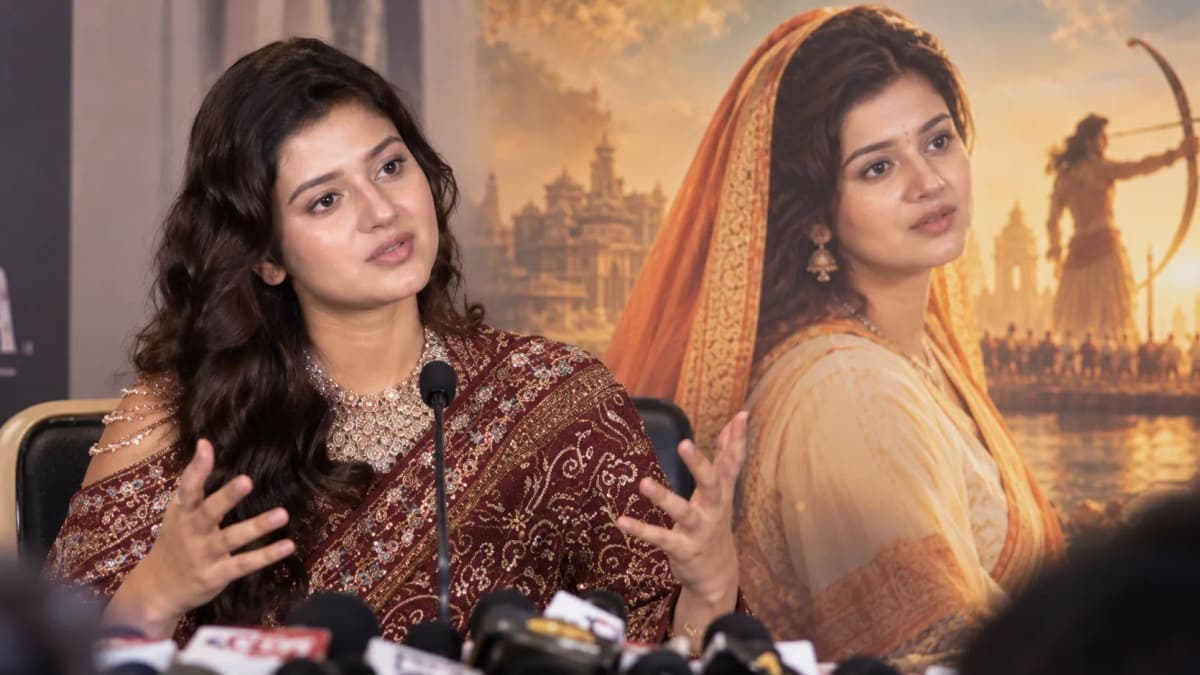
At the film’s trailer launch on September 17, Arora addressed the criticism that has followed her since promotional material revealed her as Sita. Much of the reaction has focused not on scenes from the film, but on her past as a social-media creator—particularly the viral dance reel she made to “Kacha Badam.”
Arora did not try to distance herself from that part of her career. Instead, she defended it.
“Everyone dances; which actor doesn’t dance? I love to dance; it is my hobby. I am not ashamed of it.”
Her point was straightforward. A dance video is one part of her public life; it should not automatically decide whether she can convincingly play a completely different character on screen.
She Isn’t Asking Viewers to Like the Casting
One thing that gets lost in the headlines is that Arora did not say audiences have to approve of her as Sita.
At the trailer launch, she acknowledged that public figures will be judged and that viewers are free to like or dislike a performance. What she questioned was judging the performance primarily through her social-media history.
She wants viewers to separate Anjali Arora, the internet personality they already know, from the character they see in the film.
She also addressed the “Kacha Badam” connection directly. Arora said she took part in a trend that happened to become hugely popular. She is grateful for the recognition it brought her, but she does not believe that one viral moment represents her entire life or career.
That makes her response more nuanced than simply hitting back at “trolls.” She accepts that people can question the casting. She just wants the eventual judgment to be based on her work in the film.
Why Did Her Casting Become So Controversial?
The criticism did not begin with Arora’s latest comments.
When the film’s teaser arrived in August, some social-media users objected to her being cast as Sita. Several comments linked their objections directly to her reputation as an influencer and dance-video creator. Others had different complaints, including the film’s visual effects and overall presentation, with some drawing comparisons to Adipurush.
Some online reactions went much further. Reports documenting comments beneath promotional material showed people calling the casting disrespectful and, in a few cases, demanding an FIR against those responsible.
Those comments need to be kept in perspective. They were reactions posted by individual users. They were not findings by a court, police force or other authority, and there is no evidence in the material reviewed that Arora or the filmmakers committed any wrongdoing by casting her as Sita.
What is clearly documented is online criticism. What cannot be established is whether those comments represent the opinion of the wider audience.
From a Viral Reel to Sita
Arora first became widely known online after her dance reel using the viral Bengali song “Kacha Badam” attracted attention. She later appeared in the first season of the reality programme Lock Upp and went on to feature in music videos.
That background explains why the Sita role feels like such a sharp career turn.
Mahakavya Shri Ramayan Katha is being presented as her feature-film debut. Arora plays Sita opposite Dev Sharma as Ram, while Rajniesh Duggall plays Ravan. Sheel Verma and Nirbhay Wadhwa are also part of the main cast.
The film is directed by Abhishek Singh and produced by Prakash Mahobiya and Sanjay Bundela. Its Hindi trailer has been certified by the Central Board of Film Certification, which lists Mahobiya Films Production Private Limited as the producer and applicant.
Current promotional material gives the theatrical release date as September 25, 2026 and identifies Hindi and Chhattisgarhi versions of the film.
That date is worth noting because an earlier report mentioned September 26. The newer promotional material consistently lists September 25.
Another Ramayana Adaptation Is Already Looming Large
The film is also arriving at a time when Indian cinema has once again turned its attention to the Ramayana.
The biggest project in that space is Nitesh Tiwari’s Ramayana, featuring Ranbir Kapoor, Sai Pallavi and Yash. That production is operating on a very different scale, so comparing the two films simply because they draw from the same epic would not be particularly useful.
Mahakavya Shri Ramayan Katha has its own narrative approach. Current cinema listings describe Hanuman appearing as a sage and guiding a young boy named Shashwat through the story and journey of Ram.
The promotional campaign has naturally put Ram and Sita at the centre, showing familiar elements including Ayodhya, their relationship and exile.
The makers have also taken the promotion beyond social media. Earlier this month, Haryana Chief Minister Nayab Singh Saini unveiled a poster for the film at his Chandigarh office in the presence of Arora, Dev Sharma and producer Prakash Mahobiya.
None of that answers whether Arora is the right choice for Sita. It does, however, make clear that the production is positioning the project as a theatrical mythological film rather than simply building it around her online fame.
Two Different Questions Are Getting Mixed Together
There are really two debates happening at the same time.
The first is perfectly ordinary: Is Anjali Arora convincing as Sita?
That is something audiences can judge from her performance—her acting, dialogue delivery, screen presence and the way the character has been written and directed.
The second question is very different: Does someone's previous social-media content make them unsuitable to play Sita?
That is the assumption Arora is challenging.
She is not saying her performance should be protected from criticism. In fact, she has explicitly accepted the audience’s right to judge her. Her objection is to the idea that having made dance reels automatically disqualifies her from portraying the character.
That distinction makes this more than another familiar celebrity-versus-trolls story.
There Is Also a Question About Expectations From Female Actors
Another part of the discussion deserves attention, although it should not be treated as a proven explanation for every negative comment.
A noticeable part of the reported criticism connects Arora’s dancing and online persona with whether she is appropriate to portray Sita. Her response—“which actor doesn’t dance?”—goes directly to that point.
Actors regularly move between very different kinds of work. Someone can appear in a glamorous song, advertisement, comedy or action film and later play a religious or historical figure. The basic premise of acting is that the performer is not the character.
Whether Arora manages that transformation successfully is another matter. Audiences will be able to decide that after watching the film.
But rejecting her before seeing the performance because she previously made dance reels changes the question from “Can she play Sita?” to “How should an actor who plays Sita behave in her personal or professional life?”
Those are not the same thing.
At the same time, it would be unfair to describe every negative reaction as sexist. Some users have raised questions about the visual effects, production quality and casting itself. There is not enough evidence to assign one motive to everyone criticising the film.
In the End, the Film Has to Answer the Question
Arora can explain her position in interviews, but she cannot settle the casting debate that way.
The trailer may change some opinions. Others probably will not change until audiences see the full performance.
Perhaps that is why the most interesting part of her response is not the “I am not ashamed” quote that makes an easy headline. It is her request for viewers to leave behind the Anjali Arora they know from social media when they watch her as Sita.
That is ultimately what any unexpected casting choice asks of an audience.
Mahakavya Shri Ramayan Katha is scheduled to reach cinemas on September 25. Arora is not asking viewers to decide in advance that she is right for the role. She is asking them not to decide in advance that she is wrong for it either.