Viral Exchange Puts Identity in the Spotlight
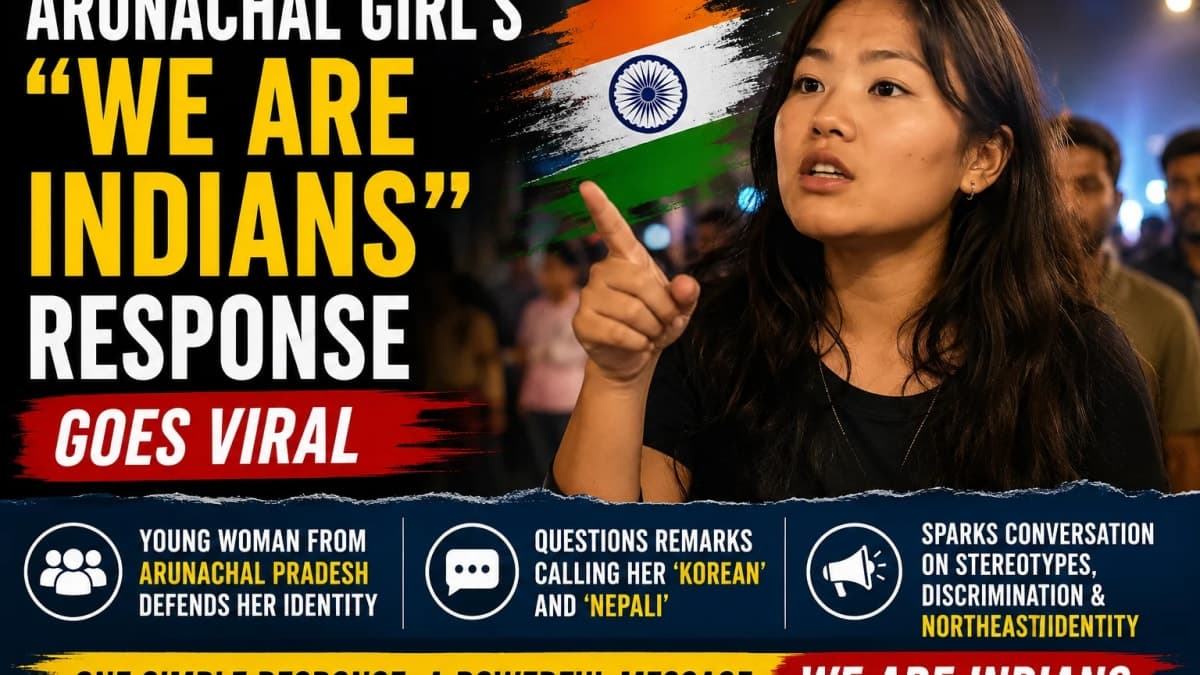
A young woman from Arunachal Pradesh has become the focus of an online discussion after a video showing her defending her identity circulated widely on social media.
In the clip, the woman confronts men after allegedly being referred to as “Korean” and “Nepali.” She questions why her facial appearance should lead anyone to doubt whether she is Indian and firmly makes clear that she belongs to Arunachal Pradesh and India.
The straightforward response struck a chord with many social-media users, turning what appeared to be an everyday confrontation into a broader discussion about identity and belonging.
Why the Moment Resonated
The significance of the exchange extends beyond one viral video.
People from India’s northeastern states have repeatedly spoken about being mistaken for foreigners or being subjected to stereotypes because of their physical appearance, language, food or cultural traditions.
Such experiences have been documented over the years in cities outside the Northeast. Recent reporting has similarly highlighted allegations of racial slurs, profiling and discrimination faced by Northeastern residents.
The Arunachal woman’s response therefore resonated with an existing concern: an Indian citizen should not have to repeatedly establish their nationality simply because they look different from someone else’s idea of what an Indian is supposed to look like.
Arunachal Pradesh and the Question of Identity
Arunachal Pradesh’s position gives the conversation another layer.
The northeastern state is an integral part of India, while China continues to make territorial claims over Arunachal Pradesh that India rejects. Residents of the state have repeatedly asserted their Indian identity amid those geopolitical disputes.
The issue is not confined to international politics. Arunachal residents have also spoken about facing misconceptions within India. Earlier reports have documented students from the state complaining about being incorrectly labelled “Chinese” or “Nepali” because of their appearance.
That background helps explain why a simple assertion of identity can carry considerably greater meaning.
A Wider Conversation About Northeast Indians
The viral response has also highlighted the enormous cultural and ethnic diversity within India.
The Northeast is home to hundreds of communities, languages and cultural traditions. Differences in appearance or culture do not make residents any less Indian, and judging nationality through physical features risks reinforcing stereotypes.
At the same time, viral videos should be interpreted carefully. Short clips do not always provide the full context of an interaction, and online discussions can quickly become more confrontational than the original event itself.
The more constructive takeaway is the conversation the incident has generated about awareness, respect and everyday discrimination.
Why This Viral Moment Matters
The popularity of the video demonstrates how an ordinary encounter can become symbolic of a much larger social issue.
For many viewers from Northeast India, the woman's response reflects frustration at repeatedly having their nationality questioned. For others, it serves as a reminder that Indian identity encompasses a much wider range of appearances, languages and cultures than stereotypes sometimes suggest.
The lasting significance of the moment may therefore lie not in how many views the video receives, but in whether conversations like these encourage greater awareness about India's northeastern communities.
Balanced Analysis
The strong reaction to the video shows that questions surrounding identity and discrimination remain sensitive in India. Condemning stereotypes is important, but it is equally necessary to avoid turning an individual confrontation into hostility toward an entire city, region or community.
Education, cultural exposure and responsible public discussion can address misconceptions more effectively than exchanging stereotypes in the opposite direction.
The message at the centre of the controversy is ultimately straightforward: being from Arunachal Pradesh and possessing a distinct ethnic or cultural identity are entirely compatible with being Indian.
This article is based on reporting published by India Today.