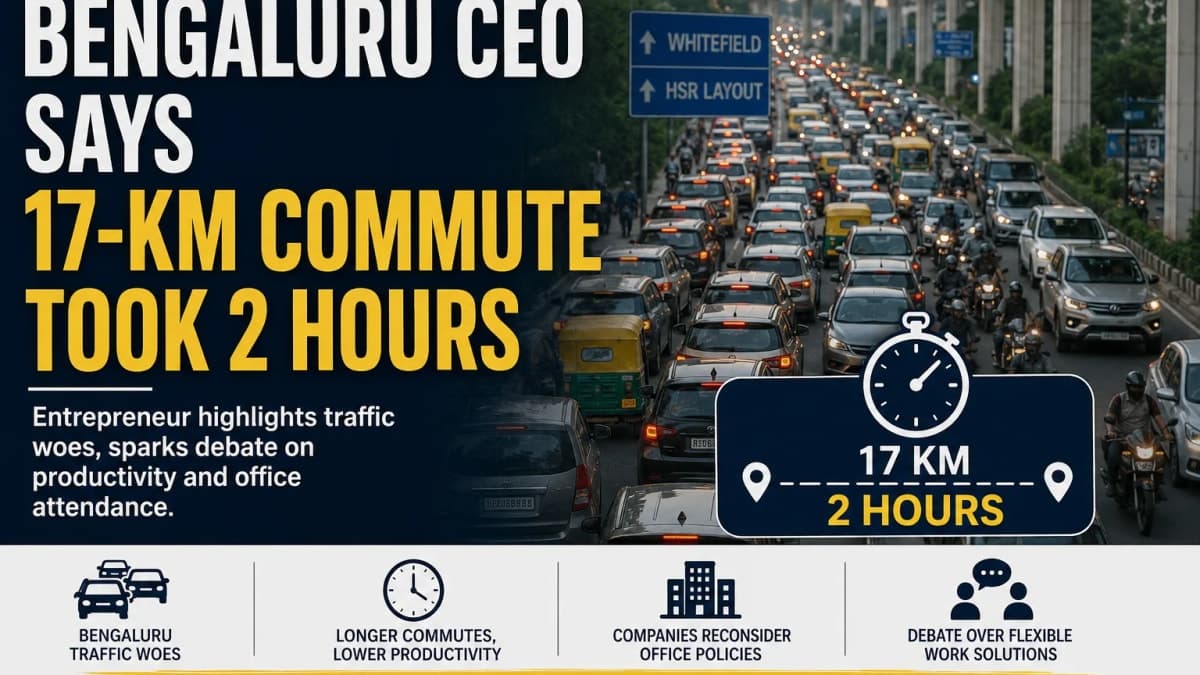
Bengaluru’s Traffic Problem Enters the Workplace Debate
Bengaluru’s traffic troubles have once again become the focus of an online conversation after entrepreneur Bala Panneerselvam, identified as the founder of Applied AI Studio and the Applied AI Club community, described the strain caused by lengthy daily commutes.
Panneerselvam shared a photograph showing an office with few people present at around 10:15 am. His argument was that late arrivals should not automatically be viewed as a lack of commitment from employees because reaching the workplace itself can require considerable time and energy in Bengaluru.
His experience highlighted the scale of the problem: Panneerselvam said a recent journey between Whitefield and HSR, covering roughly 17 km, took him about two hours, despite starting at around 4 pm.
Even Short Trips Can Become Lengthy Journeys
According to Panneerselvam, congestion is not limited to longer cross-city trips.
He explained that travelling roughly four kilometres around HSR can take about 20 minutes by scooter and 30 minutes by car, with peak-hour congestion potentially adding more time.
The issue, he suggested, extends beyond the number of minutes spent on the road. Navigating crowded streets, unpredictable traffic movements and slow-moving vehicles can leave commuters tired before their working day has properly begun.
That raises an important question for employers: should workplace productivity be judged primarily by when workers reach their desks, or should companies also account for the realities of commuting in heavily congested cities?
Long Commutes Can Affect Productivity and Personal Time
The discussion is particularly relevant because Bengaluru remains one of India’s most important centres for technology, startups and corporate employment.
For workers who must regularly travel significant distances between their homes and offices, a lengthy commute effectively extends the working day without increasing productive working hours.
A two-hour journey in one direction can consume time that might otherwise be spent on family responsibilities, exercise, rest or personal activities. Panneerselvam also argued that evening journeys can become substantially longer after 6 pm, adding another layer of difficulty for office workers.
The consequences therefore go beyond simple inconvenience. Repeatedly arriving at work after a stressful journey may influence concentration, punctuality and employee satisfaction.
Why the Bengaluru CEO’s Experience Matters
Panneerselvam’s post matters because it connects Bengaluru’s familiar traffic problem with a broader corporate debate about productivity and office attendance.
Companies have spent recent years reconsidering remote, hybrid and office-based work. For businesses encouraging employees to return to physical workplaces, transportation infrastructure becomes part of that equation.
An office attendance policy may appear straightforward on paper, but its practical impact can differ dramatically depending on where employees live and how long it takes them to travel.
The viral discussion therefore shifts some attention away from whether employees want to come to offices and toward whether cities make daily office travel practical.
Bengaluru’s Growth Creates a Complicated Challenge
Bengaluru’s economic success has attracted companies, professionals and investment, while rapid urban expansion has also increased pressure on roads and transport infrastructure.
Recent reports about commuters spending unusually long periods covering relatively short distances show that Panneerselvam’s experience is part of a wider public conversation rather than an isolated complaint.
However, traffic congestion is also a complex urban problem. Flexible office timings or work-from-home policies can reduce pressure for some employees, but they cannot replace improvements to transport infrastructure.
Similarly, infrastructure expansion alone may not immediately resolve congestion if employment centres, residential development and travel demand continue growing rapidly.
Balanced Analysis: Who Should Solve the Problem?
The debate does not necessarily have a single solution.
Employers can consider flexible arrival times, hybrid schedules and policies that reduce unnecessary peak-hour commuting.
Employees may benefit from public transportation, shared mobility or choosing travel times outside the busiest periods where practical.
Meanwhile, urban authorities and policymakers face the longer-term responsibility of improving mobility through better public transport, road management, infrastructure planning and stronger connections between residential and employment areas.
Remote work cannot solve Bengaluru’s transportation challenges for everyone, particularly because many jobs require a physical presence. At the same time, demanding rigid office attendance without considering extreme commute times may impose hidden costs on both employees and businesses.
Panneerselvam’s two-hour journey ultimately illustrates a larger issue: traffic congestion is no longer only a transportation problem—it can become a productivity, workplace and quality-of-life problem as well.
This article is based on reporting published by Hindustan Times.