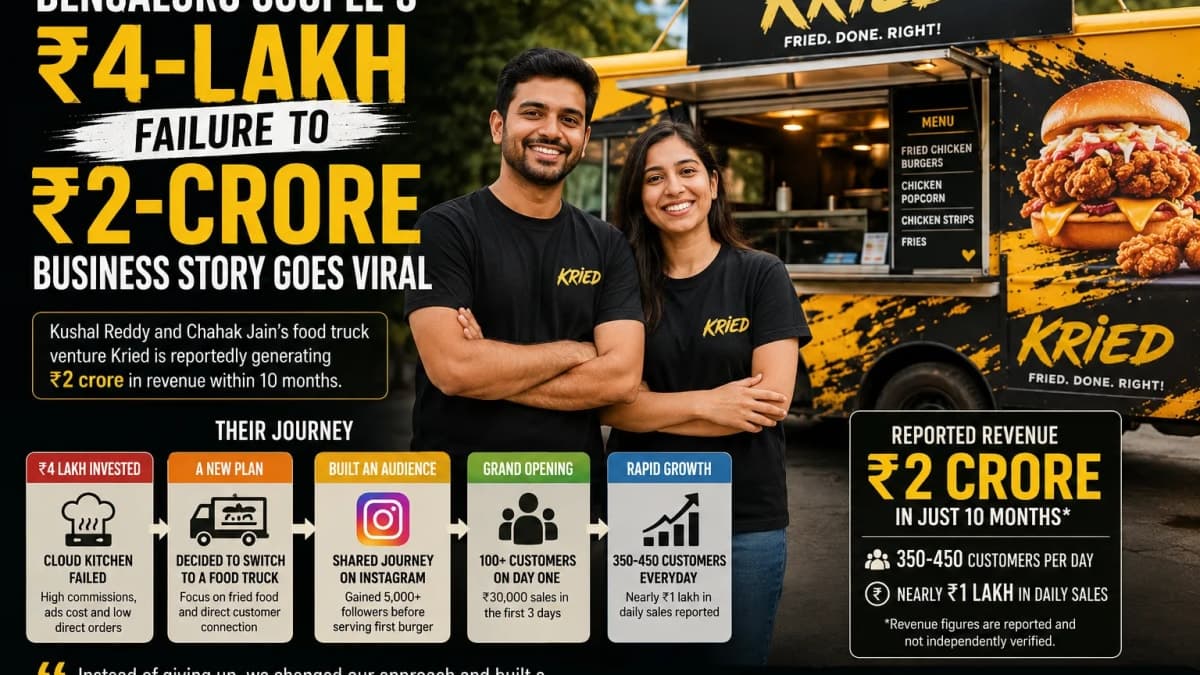
A failed ₹4 lakh cloud kitchen could have ended Kushal Reddy and Chahak Jain's entrepreneurial journey. Instead, the Bengaluru couple changed their business model, returned with a food truck and built an audience before serving their first burger.
Their second venture, Kried, has now become the centre of a viral business story. Reports published on September 2 say the Bengaluru food truck grew to serve roughly 350–450 customers per day, generating close to ₹1 lakh in daily sales, while its revenue reportedly reached approximately ₹2 crore within 10 months.
The numbers have attracted widespread attention, but an important qualification applies: NDTV states that the revenue figures originate from information shared in a social-media post and have not been independently verified. The ₹2 crore number also represents reported revenue, not profit.
The First Attempt: ₹4 Lakh Invested in a Cloud Kitchen
Reddy and Jain's first venture was a cloud kitchen in Bengaluru, into which they reportedly invested around ₹4 lakh.
The business struggled to generate sufficient orders. Reports attribute its difficulties to a combination of high commissions charged by food-delivery platforms, advertising expenses and insufficient direct customer orders. Eventually, the couple shut the operation.
Instead of abandoning the food business altogether, they reconsidered the economics of their first attempt.
Their response was not simply to reopen the same concept under a different name. They shifted toward a model that gave them a more direct connection with customers.
Kried Food Truck Becomes Their Second Attempt
The couple subsequently launched Kried, a fried-food brand operating from a food truck in Bengaluru's JP Nagar.
Its menu centres on products including fried-chicken and paneer burgers, along with chicken popcorn, strips and fries.
But one of the most significant differences between their first and second businesses appeared before Kried even opened.
Rather than waiting for customers to discover the venture after launch, Chahak began documenting the process of building the food truck on Instagram.
That effectively turned the preparation for the business into a marketing campaign of its own.
More Than 5,000 Followers Before the First Burger
According to reports, Kried had accumulated more than 5,000 Instagram followers before it served its first burger.
That audience gave the new venture something its failed cloud kitchen had struggled to achieve: a pool of potential customers who already knew the brand.
When Kried opened in September 2025, more than 100 customers reportedly arrived on its first day. The business generated approximately ₹30,000 in sales during its first three days, according to NDTV.
The strategy illustrates an increasingly important distinction for consumer startups: building distribution and audience can be as critical as developing the product itself.
For Kried, social-media content was not merely used to advertise finished food. The founders made the process of creating the business part of the story customers followed.
350–450 Customers a Day and Nearly ₹1 Lakh in Sales
Reports say Kried's customer volume subsequently increased to around 350–450 people per day, with daily sales approaching ₹1 lakh.
Those figures provide some context for the larger claim that has driven the story's viral popularity.
An X post by Pratham of CapitalLens said the venture had generated approximately ₹2 crore in revenue within 10 months. Multiple media reports subsequently highlighted the claim.
However, readers should distinguish between three different financial concepts: investment, revenue and profit.
The original ₹4 lakh relates to the reported investment in the earlier cloud-kitchen venture. The ₹2 crore figure refers to claimed revenue generated by Kried, not a ₹2 crore return on the ₹4 lakh investment or ₹2 crore in earnings.
No independently verified profit figure was disclosed in the reports reviewed.
Why the ₹2 Crore Figure Needs Context
The rapid growth claim has also generated scepticism online, with some social-media users questioning whether a food truck could consistently process roughly 400 orders or customers per day.
That scepticism makes the source of the numbers particularly important.
NDTV explicitly noted that the revenue figures and related claims were based on the CapitalLens X post and that it had not independently verified the reported revenue.
Therefore, the most accurate description is that Kried reportedly generated around ₹2 crore in revenue within 10 months, rather than presenting ₹2 crore as an independently audited financial result.
What Changed Between the Failed Business and Kried?
The turnaround is notable not merely because one business failed and another reportedly grew rapidly, but because the founders changed several parts of their approach simultaneously.
The first venture relied heavily on the economics of a cloud kitchen, where delivery-platform commissions, advertising costs and limited direct orders reportedly created pressure.
Kried introduced a physical food truck and direct customer interaction while simultaneously using social media to create awareness before launch.
In other words, the couple did not simply try harder at the original idea—they altered both their distribution model and customer-acquisition strategy.
That distinction offers a more useful entrepreneurial lesson than the headline revenue figure alone.
Social Media Turns the Story Viral
The couple's journey gained wider attention after the CapitalLens post highlighted their transition from the unsuccessful cloud kitchen to Kried.
Online responses ranged from admiration for their willingness to restart to scepticism about the scale of the reported daily customer numbers.
The combination of failure, reinvention and rapid reported growth helped make the story particularly shareable.
But Kried's own experience also demonstrates the commercial power of that same dynamic: storytelling was already part of its customer-acquisition strategy before the food truck launched.
What's Next for Kried?
The founders reportedly have ambitions beyond a single food truck.
According to NDTV, they are working toward a larger central kitchen and planning fast-casual restaurant outlets, which would move Kried toward a more scalable operating model.
Expansion would introduce a different challenge. Running one popular food truck and operating multiple restaurant outlets require different systems for staffing, supply chains, quality control, capital allocation and customer experience.
Whether Kried can translate its reported early momentum into a larger restaurant business remains to be seen.
A Bigger Lesson Behind the Viral Numbers
The headline transformation—from a ₹4 lakh failed venture to a business claiming ₹2 crore in revenue—is compelling, but the more valuable part of the story may be the change in strategy.
Reddy and Jain's experience suggests that an unsuccessful first business does not necessarily mean the underlying product category has no opportunity. Sometimes the problem can lie in distribution, customer acquisition or the economics of the chosen business model.
Kried's reported growth came after the founders changed how they sold food, how customers discovered them and how they built demand.
For aspiring entrepreneurs, that distinction may be more useful than simply focusing on the ₹2 crore number.