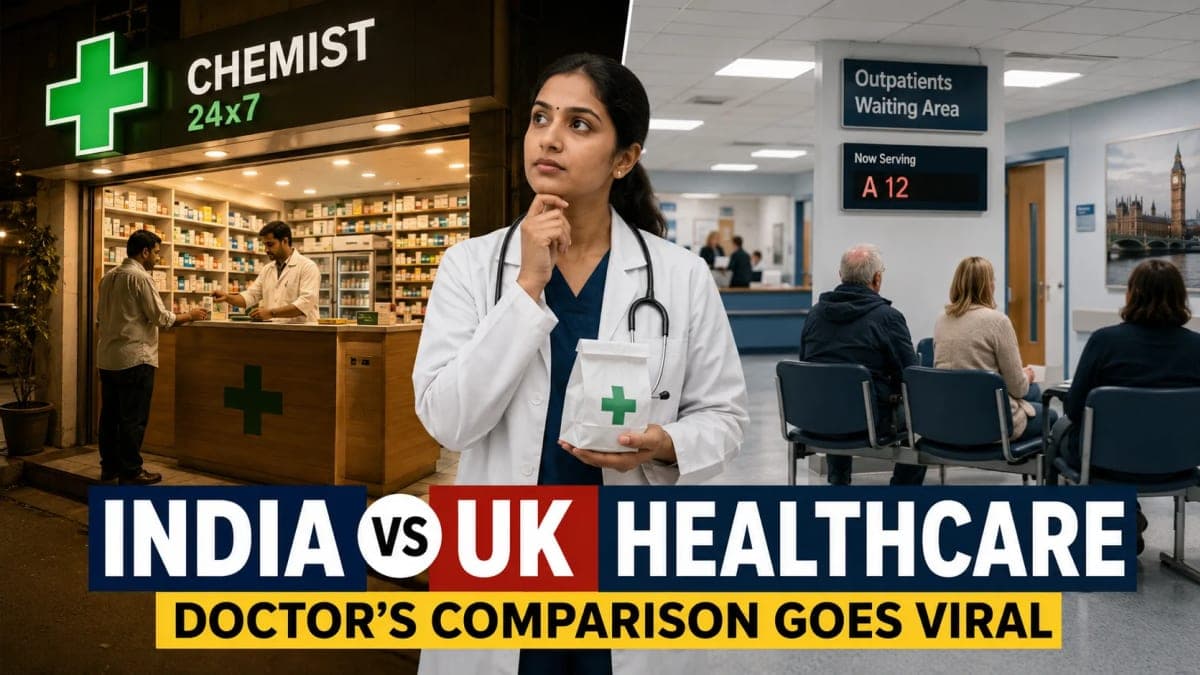
Indian Doctor’s India-vs-UK Healthcare Comparison Goes Viral After Late-Night Emergency
A personal account shared by an Indian doctor has attracted widespread attention online after she compared late-night access to healthcare in India with her experience in the United Kingdom.
Dr Deepanjali Sharma, who previously worked in Britain’s National Health Service, posted a video after her husband—also a doctor—became unwell at approximately 10 pm. According to Sharma, he initially experienced a headache and subsequently began vomiting repeatedly. She recorded herself going out to arrange medicines and intravenous injections for him.
The incident led her to express gratitude for the ability to find medicines and medical assistance at a late hour in India. She contrasted that convenience with her experience of the UK and other Western healthcare systems, where patients may need to follow more formal procedures or wait for assessment.
Why the Doctor Compared India With the UK
Sharma said that her medical qualifications would not necessarily have allowed her to bypass the normal process had the same situation occurred in Britain. She suggested that obtaining immediate assistance could have involved waiting in a queue or visiting an already busy emergency department.
Her larger argument was not simply that one country is universally better than another. Instead, she highlighted how everyday conveniences available in India—such as late-opening pharmacies and relatively quick access to certain forms of private medical care—can become more noticeable after living abroad.
She also acknowledged that her experience came with professional knowledge and personal advantages that many Indian patients may not possess. Access to timely and affordable treatment remains uneven across India, particularly for people living in underserved areas or those unable to pay privately.
Video Triggers a Wider Social-Media Debate
Many social-media users agreed with Sharma’s observations, citing the convenience of neighbourhood pharmacies, direct specialist appointments and quicker access to private healthcare in Indian cities.
Others raised concerns about treating easy access to medicines as an unquestionable advantage. Some noted that stronger controls on prescription medication and structured clinical assessment can protect patients from incorrect treatment, unsafe drug use and unnecessary antibiotics.
The varied reaction transformed a personal late-night experience into a broader discussion about what people value in a healthcare system: speed, affordability, regulation, clinical safety or universal access.
India and UK Follow Different Healthcare Models
India operates a mixed healthcare system involving government facilities, private hospitals, independent clinics and retail pharmacies. Patients in major cities can often approach a private doctor or diagnostic centre directly, sometimes without a lengthy referral process.
That flexibility can make routine and urgent services feel faster for people who live near well-equipped facilities and can afford the associated expenses. However, it can also result in substantial out-of-pocket costs, inconsistent quality and unequal access between regions and income groups.
The UK’s NHS is primarily a publicly funded system designed to provide care according to clinical need rather than a patient’s ability to pay. General practitioners frequently act as the first point of contact, while emergency departments prioritise patients through medical triage.
This structure offers broad financial protection, but pressure on staff and services can result in delays, particularly for non-life-threatening cases. Waiting is therefore partly connected to how limited public resources are allocated—not simply to an absence of medical facilities.
Easy Medicine Availability Has Benefits and Risks
India’s extensive pharmacy network can be extremely valuable when patients need commonly used medicines outside regular clinic hours. In emergencies, proximity and extended opening times may reduce the delay before professional care is reached.
Nevertheless, purchasing prescription medicines or administering injections without an appropriate examination can carry significant risks. Repeated vomiting accompanied by a headache can have many possible causes, and the correct response depends on factors that cannot be established through a social-media video.
The viral account should consequently be understood as one doctor’s personal experience rather than general medical guidance or definitive evidence that either national system provides better care in every situation.
Why the Viral Comparison Matters
The discussion illustrates that healthcare quality cannot be measured using a single factor. A system may provide rapid access while leaving patients exposed to high costs. Another may offer publicly funded treatment but struggle with capacity and waiting times.
Sharma’s post also challenges the belief that relocating abroad automatically improves every aspect of daily life. Countries can offer better experiences in some areas while creating new difficulties in others.
For people considering international relocation, the relevant questions extend beyond salaries and infrastructure. Healthcare eligibility, appointment systems, insurance, emergency access and medicine regulations can significantly influence their experience.
Balanced Analysis: A Personal Story, Not a National Verdict
Sharma’s account highlights a genuine advantage enjoyed by many residents of Indian cities: medical shops, clinics and diagnostic services can often be reached quickly, including outside conventional working hours.
But her experience should not be treated as a comprehensive comparison of two large and complicated healthcare systems. India’s speed advantage is not equally available to every citizen, while the NHS’s waiting times exist alongside the major benefit of care that is generally free at the point of use.
The debate also involves an important trade-off. Easier access to medication can provide convenience, but careful prescribing rules may improve patient safety. Similarly, a formal triage system may feel slow to someone seeking immediate attention, yet it is intended to prioritise the most medically urgent cases.
Conclusion
Dr Deepanjali Sharma’s late-night experience has resonated because it focuses on a practical issue people immediately understand: how quickly help is available when a family member suddenly falls ill.
The viral conversation does not establish that Indian healthcare is categorically superior to the British system. Instead, it reveals the different compromises each model makes between speed, cost, regulation, capacity and universal coverage.
Ultimately, the strongest healthcare system would combine India’s accessibility and responsiveness with dependable regulation, financial protection and equitable treatment for patients from every background.
This article is based on reporting published by India Today.