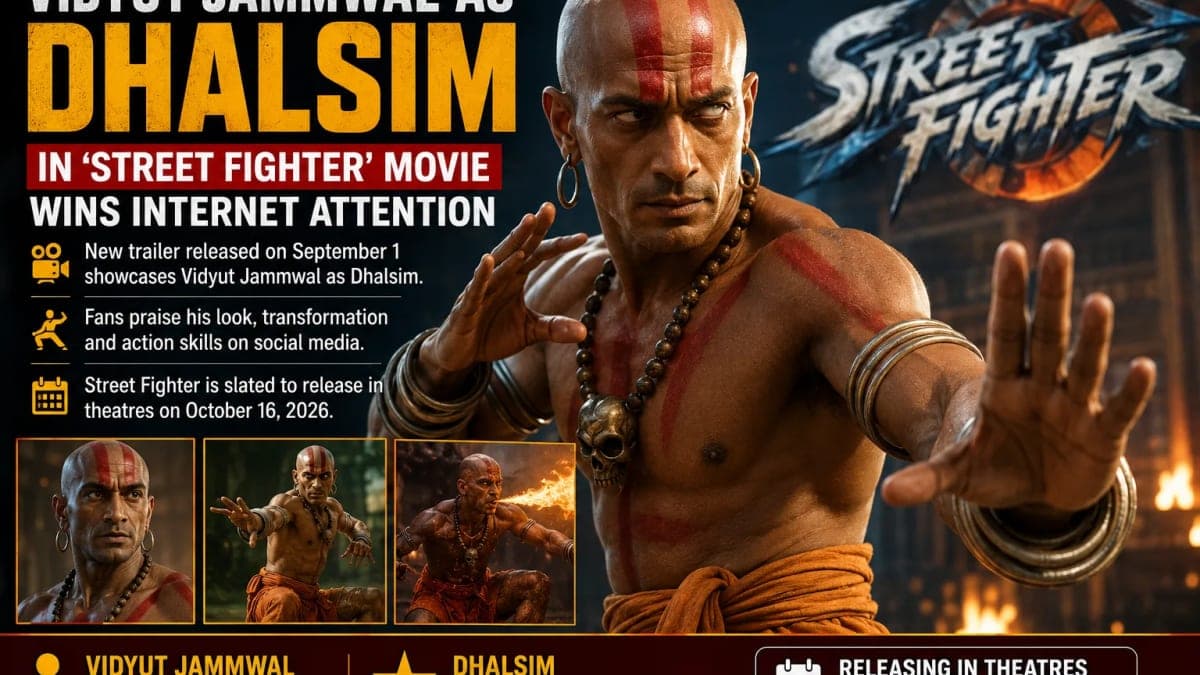
Indian action star Vidyut Jammwal is once again drawing attention for his striking transformation into Dhalsim in the upcoming Hollywood adaptation of Street Fighter.
The film’s latest trailer, released on September 1, 2026, provides a clearer look at Jammwal in action, with sequences highlighting the physicality and martial arts skills that have defined much of his screen career.
His casting had already generated discussion when the first character visuals were revealed in December 2025. The latest footage has now shifted some of that attention from his dramatic appearance to how he performs as Dhalsim in combat.
Social media users have been sharing clips and images from the trailer, with several fans praising Jammwal’s action sequences and expressing excitement about seeing an Indian action star join one of gaming’s best-known fighting franchises.
Vidyut Jammwal’s Dhalsim Transformation Stands Out
Jammwal looks dramatically different from his familiar screen appearances.
His Dhalsim transformation features a shaved head, distinctive red markings, a lean muscular physique, orange clothing, large metallic bangles and accessories inspired by the visual identity of the video-game character.
The appearance first became a major talking point when the film’s teaser and character poster were unveiled in December 2025.
At the time, reactions were mixed but intense. Many fans praised the physical transformation and considered Jammwal well suited to the martial-arts-oriented character, while others were surprised by the actor’s bald appearance and said they missed his familiar hairstyle.
The new trailer has added another dimension to the conversation by showing more of Jammwal performing as Dhalsim rather than simply presenting his visual transformation.
New Trailer Highlights Jammwal’s Martial Arts Background
One reason Jammwal’s casting has attracted particular interest is his established reputation as an action performer.
The actor has trained extensively in Kalaripayattu, the Indian martial art, and has built much of his career around physically demanding action roles.
In the new Street Fighter footage, that background becomes particularly relevant. Jammwal can be seen performing combat movements in the fighting arena, giving audiences a closer look at how his real-world action abilities could be incorporated into Dhalsim’s distinctive fighting style.
Fans reacting online have highlighted this aspect of his casting, with several expressing enthusiasm about seeing his martial arts abilities presented to an international audience.
One social-media reaction cited in coverage of the trailer said the film would give the world an opportunity to see Jammwal’s abilities as an action star and martial artist.
While individual online reactions do not necessarily represent the wider audience, the volume of posts sharing his scenes indicates that his appearance has become one of the talking points surrounding the new trailer.
Who Is Dhalsim in Street Fighter?
Dhalsim is one of the most recognisable characters in Capcom’s Street Fighter universe.
The character made his video-game debut in Street Fighter II in 1991 and is traditionally portrayed as an Indian yogi who is fundamentally peaceful but fights when circumstances require it.
His fighting style is among the franchise’s most distinctive, combining yoga-inspired movements with exaggerated abilities including stretching limbs and fire-based attacks.
That unusual combination of spirituality, flexibility and combat has made Dhalsim instantly recognisable among generations of Street Fighter players.
For a live-action adaptation, however, recreating such a character presents an obvious challenge: filmmakers must translate deliberately exaggerated video-game movements into sequences that work with real performers.
Jammwal’s flexibility, martial arts training and experience performing action sequences therefore give the filmmakers a practical foundation for approaching the character.
‘Street Fighter’ Marks Vidyut Jammwal’s Hollywood Debut
The film represents an important career milestone for Jammwal as it marks his Hollywood debut.
The actor has previously established himself in Indian cinema through action-oriented films including Force, the Commando franchise, Sanak and Crakk.
His move into Street Fighter places him inside a globally recognised entertainment property rather than simply another standalone action production.
That distinction could significantly expand his international visibility, particularly because Street Fighter has an established audience spanning video games, films, animation and competitive gaming.
How large Dhalsim’s role ultimately proves to be will only become clear when the finished movie arrives in theatres, but the promotional material has already positioned Jammwal as part of the film’s central ensemble.
A Major Ensemble Brings Street Fighter Characters to Life
Jammwal is part of a large international cast assembled to recreate Capcom’s famous roster of fighters.
Andrew Koji plays Ryu, while Noah Centineo portrays Ken Masters and Callina Liang appears as Chun-Li.
Other prominent casting includes Joe “Roman Reigns” Anoa’i as Akuma, David Dastmalchian as M. Bison, Cody Rhodes as Guile and Andrew Schulz as Dan Hibiki.
The ensemble also includes Curtis “50 Cent” Jackson, Jason Momoa, Orville Peck, Olivier Richters, Hirooki Goto, Rayna Vallandingham, Alexander Volkanovski, Kyle Mooney and Mel Jarnson.
The film is directed by Kitao Sakurai, known for Bad Trip.
Bringing together actors, professional wrestlers, combat-sports athletes and established action performers suggests that physical performance is intended to be an important element of the adaptation.
From 1987 Arcade Game to Another Hollywood Adaptation
The Street Fighter franchise began in 1987, when Capcom released the original fighting game.
Its popularity exploded after Street Fighter II arrived in 1991, helping establish many of the characters that remain closely associated with the franchise today.
Over the decades, Street Fighter developed into one of gaming’s most recognisable fighting properties.
The franchise has also had a complicated relationship with live-action cinema. Previous attempts to translate the games to film received mixed responses, meaning the latest adaptation arrives with both a large built-in audience and considerable expectations.
For longtime players, the challenge will be whether the movie can preserve the personalities, fighting styles and exaggerated visual identity of the games while constructing a convincing live-action story.
Why Vidyut Jammwal’s Casting Matters
Jammwal’s casting is notable beyond the dramatic Dhalsim makeover.
Hollywood adaptations of globally popular entertainment properties can offer Indian performers exposure to audiences who may have had limited familiarity with their previous work.
In Jammwal’s case, the role also aligns closely with his established strength: physical action.
Rather than entering Hollywood through a conventional dramatic or supporting character, he is portraying a martial artist in a franchise built almost entirely around distinctive fighting styles.
That makes Dhalsim a potentially natural showcase for the skills Jammwal has spent years displaying in Indian action cinema.
At the same time, the character comes with considerable expectations. Dhalsim has a highly recognisable appearance and fighting style, and longtime Street Fighter players are likely to closely examine how faithfully those characteristics have been translated to live action.
When Will Street Fighter Release?
Street Fighter is officially scheduled to hit theatres on October 16, 2026.
With the latest trailer now showcasing more of its characters and combat sequences, promotional activity around the film is likely to intensify as the release date approaches.
For Indian audiences, Vidyut Jammwal’s presence adds another point of interest to an already internationally recognised franchise.
His dramatic Dhalsim transformation may have started the conversation, but the latest footage suggests that his martial arts performance could ultimately determine how memorable his Hollywood debut becomes.