RBI Gives LIC Room to Expand Its HDFC Bank Investment
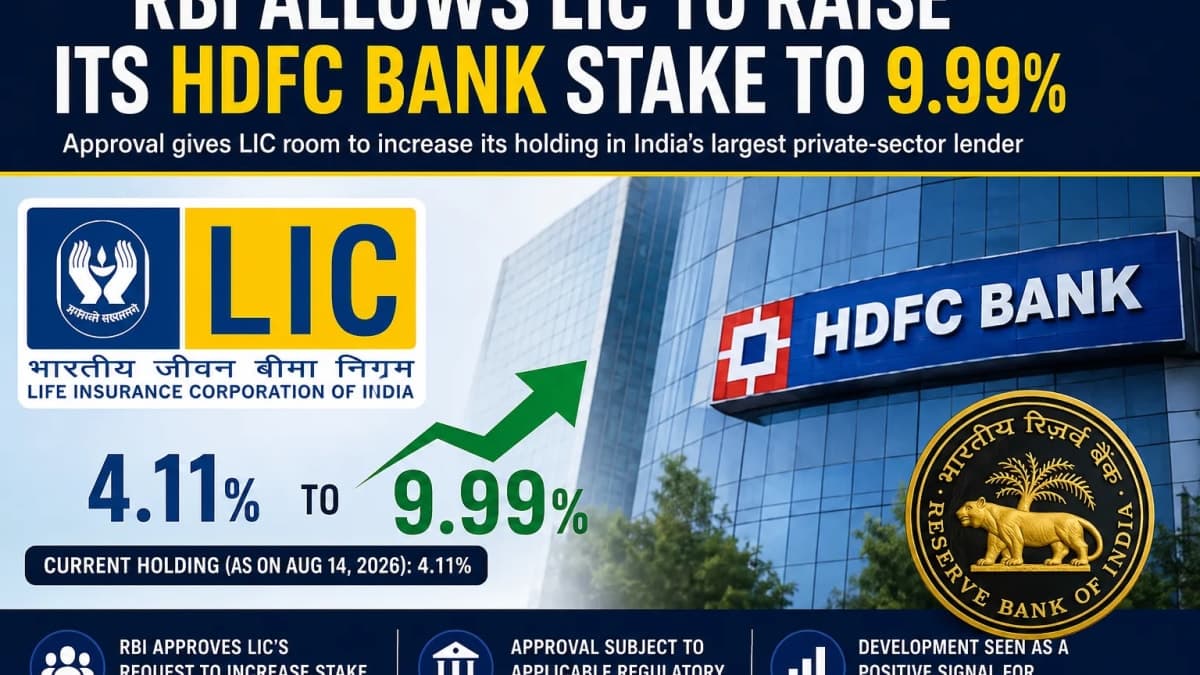
The Reserve Bank of India (RBI) has given Life Insurance Corporation of India (LIC) regulatory clearance to potentially raise its stake in HDFC Bank to 9.99%, creating room for one of India's biggest institutional investors to deepen its exposure to the country's largest private-sector bank.
HDFC Bank disclosed the approval in a regulatory filing. According to the disclosure, RBI granted its approval through a letter dated August 19, 2026, following an application submitted by LIC. The permission covers an aggregate holding of up to 9.99% of HDFC Bank's paid-up share capital or voting rights.
LIC Currently Holds 4.11% in HDFC Bank
As of August 14, 2026, LIC held 4.11% of HDFC Bank's total share capital. That means the regulatory ceiling potentially provides room for LIC to increase its holding by roughly another 5.88 percentage points, subject to the relevant rules and conditions.
The distinction between permission and an actual purchase is important. RBI's approval does not require LIC to increase its stake all the way to 9.99%, nor does it establish that such purchases will happen immediately.
Instead, the clearance gives LIC regulatory flexibility to acquire additional HDFC Bank shares while remaining within the approved ceiling and complying with applicable rules.
Why RBI Approval Matters
Banks operate under tighter ownership regulations than most listed companies because significant shareholders can potentially influence institutions that handle deposits and play an important role in the wider financial system.
The approval is therefore subject to applicable banking, securities and other regulatory requirements, including provisions of the Banking Regulation Act and relevant RBI directions and SEBI regulations.
For LIC, the approval increases the flexibility available when managing its large investment portfolio. As one of India's most influential domestic institutional investors, changes in LIC's holdings in major listed companies can attract considerable attention from market participants.
What It Means for HDFC Bank
The development is significant for HDFC Bank because it potentially allows a major long-term domestic institution to become a substantially larger shareholder.
Investors initially responded positively to the announcement. HDFC Bank shares gained more than 1% in early trading on August 20, with the stock around ₹727.60 during early deals. The move also came during a broader recovery in the Indian equity market, so the entire rise cannot necessarily be attributed to the LIC development alone.
A higher LIC holding could be interpreted by some investors as a sign of institutional confidence. However, regulatory permission by itself should not be treated as confirmation that LIC has decided to purchase the maximum permitted stake.
Why the 9.99% Level Is Important
The headline figure may suggest that LIC is immediately becoming a near-10% shareholder, but the actual situation is more nuanced.
LIC currently owns 4.11%. RBI has effectively provided a regulatory ceiling under which the insurer can increase that investment. The timing, quantity and price of any additional purchases will determine how much LIC's actual holding ultimately changes.
That difference is particularly important for investors evaluating the potential impact on HDFC Bank shares. Permission to buy creates the possibility of additional institutional demand, but it does not guarantee that the full amount of buying will materialise.
HDFC Bank's Recent Financial Performance
The development comes as investors continue to assess HDFC Bank's financial performance. For the April-June quarter of FY27, the lender reported standalone net profit of about ₹19,059.72 crore, representing year-on-year growth of roughly 5%.
Net interest income increased 6.7% year-on-year to approximately ₹33,535.95 crore. The bank reported a net interest margin of 3.26% on total assets and 3.40% based on interest-earning assets.
These operating indicators remain important because LIC's potential investment should ultimately be considered alongside the bank's earnings, margins, asset quality, growth trajectory and valuation rather than viewed solely through the regulatory announcement.
Balanced Analysis: Positive Signal, But Not a Guaranteed Catalyst
RBI's decision gives LIC significantly more flexibility to invest in HDFC Bank and could strengthen perceptions of long-term institutional interest in the lender.
There is nevertheless a major difference between receiving permission and deploying capital.
LIC may choose to increase its holding gradually, stop well below 9.99%, or make investment decisions according to market conditions and its broader portfolio strategy. Investors therefore should not interpret the regulatory approval as evidence that an immediate purchase of the entire additional stake is certain.
From HDFC Bank's perspective, the development is supportive from an institutional-ownership standpoint, but its longer-term share performance will continue to depend primarily on business fundamentals, earnings growth, margins, asset quality, credit growth and broader market conditions.
Why This Development Matters
The RBI approval brings together three major institutions in India's financial system: the country's banking regulator, its largest life insurer and one of its largest private-sector banks.
The immediate story is about LIC receiving greater investment flexibility. The bigger question for markets is whether LIC actually uses that flexibility—and, if it does, how quickly and to what extent.
Until additional purchases are disclosed, the 9.99% figure should be understood as a maximum permitted holding rather than LIC's new actual stake.
This article is based on reporting published by Business Standard.