Sunil Gavaskar Demands Penalties as India’s No-Ball Problems Come Under Scrutiny
Introduction
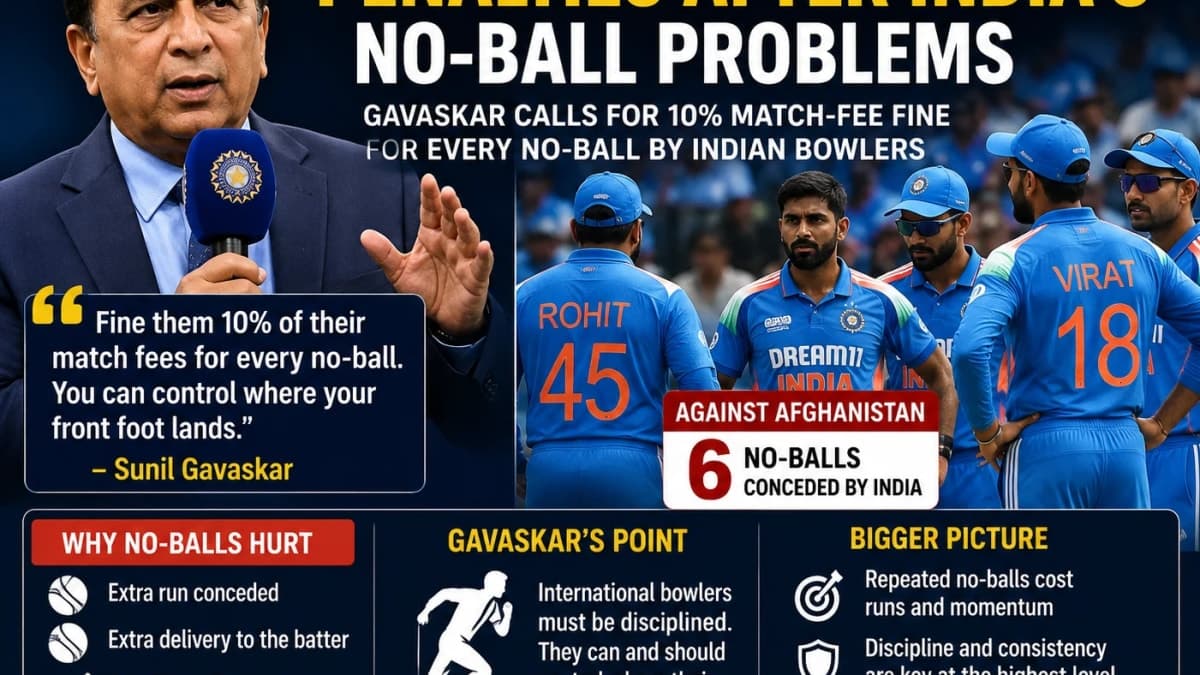
Former India captain Sunil Gavaskar has called for tougher action against bowlers who repeatedly deliver front-foot no-balls, suggesting financial penalties after India's overstepping problems attracted attention during the team's match against Afghanistan.
Gavaskar was critical of the frequency with which Indian bowlers crossed the popping crease and argued that no-balls at international level should carry consequences beyond the immediate on-field penalty.
His comments came after India conceded six no-balls during Afghanistan's innings, adding unnecessary pressure on the bowling attack and giving the opposition additional deliveries.
The former opener believes financial consequences could provide bowlers with a stronger incentive to eliminate an error he considers avoidable.
India’s Six No-Balls Draw Gavaskar’s Attention
India's bowling discipline became a major talking point after the team conceded six no-balls against Afghanistan.
While wides and other extras can result from attempts to produce difficult deliveries or respond to a batter's movement, Gavaskar argued that front-foot no-balls are fundamentally different because bowlers have control over where they land.
Speaking during the broadcast, Gavaskar proposed introducing an internal financial penalty.
“Fine them 10% of their match fees for every no-ball,” he said.
The suggestion would make repeated overstepping increasingly expensive for a bowler and, in Gavaskar's view, create a direct incentive to correct the problem.
‘You Can Control Where Your Front Foot Lands’
Gavaskar's criticism centered on the idea of controllability.
“You can control where your front foot lands,” he said.
That distinction is central to his argument.
A fast bowler operating at full pace naturally attempts to get as close to the popping crease as possible because doing so reduces the distance the ball travels before reaching the batter.
But pushing that limit too aggressively creates the risk of overstepping.
Gavaskar's position is effectively that international bowlers should leave themselves a sufficient margin behind the line rather than repeatedly trying to gain a few extra centimetres.
Gavaskar Suggests 10% Match-Fee Fine
The most striking part of Gavaskar's proposal is the size of the penalty.
A 10% match-fee fine for every no-ball could quickly become significant.
Under such a system, two no-balls could theoretically cost a player 20% of the match fee, while repeated violations would produce progressively larger consequences.
Gavaskar's suggestion should be understood as his proposed disciplinary measure rather than an existing ICC or BCCI regulation.
There is currently no general rule automatically deducting 10% of an international player's match fee for every front-foot no-ball.
His comments therefore amount to a call for stronger internal accountability rather than a description of current policy.
Why No-Balls Are So Costly in Limited-Overs Cricket
The impact of a no-ball extends well beyond conceding a single extra run.
In limited-overs cricket, a front-foot no-ball can also result in a free hit on the following delivery, substantially increasing the potential cost of the mistake.
The illegal delivery also does not count as one of the six legal balls in the over.
That means a no-ball can create three separate disadvantages:
an automatic extra run;
an additional delivery;
and, under applicable limited-overs rules, a free hit for the batter.
For bowlers operating against aggressive international batters, that combination can transform a minor technical mistake into a potentially expensive sequence.
The Hidden Tactical Cost of Repeated No-Balls
The scoreboard does not always capture the full impact.
Repeated no-balls can disrupt a bowler's rhythm and force captains to reconsider their field placements and bowling plans.
A bowler worried about overstepping may adjust the run-up or release position during a spell, potentially affecting pace, line or length.
Free hits can also force defensive field settings and give batters an opportunity to attack without the normal risk of most forms of dismissal.
In a close international contest, those marginal disadvantages can become decisive.
That is why Gavaskar's criticism focuses on discipline rather than simply the number of extras conceded.
Why Fast Bowlers Push the Crease
There is nevertheless a technical reason bowlers operate close to the line.
Delivering from farther forward effectively shortens the distance between the release point and the batter.
Fast bowlers therefore try to maximise the legal use of the crease.
The challenge is finding a repeatable run-up that allows the front foot to land close to—but safely behind—the popping crease.
Fatigue can complicate that process.
As a spell progresses, small changes in stride length, momentum or run-up rhythm can shift a bowler's landing position.
But at international level, Gavaskar's argument is that bowlers and coaching staffs should be capable of making the technical adjustments necessary to prevent repeated violations.
Is a Financial Penalty the Right Solution?
Gavaskar's proposal raises a broader debate about how teams should address controllable errors.
One argument in favour of financial penalties is straightforward: they create an immediate and personal consequence.
If technical reminders and coaching interventions have failed to solve a recurring problem, a financial penalty might sharpen concentration.
The opposing argument would be that professional athletes are already punished competitively.
A no-ball costs the team runs, creates an extra delivery and can produce a free hit. Bowlers are also judged on their performances, meaning repeated mistakes can eventually affect selection.
There is therefore room to debate whether an additional financial sanction is necessary.
Gavaskar has clearly taken the stricter position.
Coaching May Be as Important as Punishment
Financial penalties alone would not necessarily address the technical cause of overstepping.
Coaching staffs can use training footage and run-up markers to identify where a bowler's stride pattern begins to change.
Practice sessions can also recreate match intensity so bowlers learn to maintain a consistent landing position while operating at full pace.
For fast bowlers, even moving the starting point of the run-up backwards by a small distance can sometimes create an additional safety margin.
The most effective response may therefore combine accountability with technical correction.
Punishment can discourage the mistake; coaching is required to prevent it.
Gavaskar’s Comments Put Bowling Discipline in Spotlight
Gavaskar has long been known for demanding high technical and professional standards from international cricketers.
His latest criticism reflects that philosophy.
Rather than treating front-foot no-balls as unavoidable accidents, he views them as preventable errors that should be eliminated through greater discipline.
The six no-balls against Afghanistan provided a particularly visible example of why the issue matters.
India possesses a bowling attack capable of creating pressure through pace, movement and variation. Giving opponents extra runs and additional deliveries can undermine that advantage without the batter having to earn them.
Bigger Lesson for India
Whether or not Gavaskar's proposed 10% fine is ever adopted, his comments highlight a straightforward area for improvement.
At the highest level, matches are increasingly decided by small margins.
Fielding errors, dropped catches, unnecessary extras and no-balls can all shift momentum.
Unlike an outstanding shot from a batter or an unpredictable deflection, a front-foot no-ball is largely within the bowler's control.
That makes repeated overstepping particularly frustrating from a coaching perspective.
For India, reducing those errors would amount to an improvement that does not require a new tactical system or major personnel change—only greater consistency at the crease.
Conclusion
Sunil Gavaskar's proposal to fine bowlers 10% of their match fees for every no-ball is deliberately severe, but the underlying message is simple: international bowlers should be held accountable for errors they can control.
India's six no-balls against Afghanistan gave the former captain a clear example to make his case.
Whether financial punishment is the answer remains open to debate. Technical coaching, run-up adjustments and practice under match-like pressure may provide less punitive solutions.
But in modern limited-overs cricket, where a single no-ball can mean an extra run, an extra delivery and a free hit, Gavaskar's broader point is difficult to ignore.
For India, fixing the problem could prevent avoidable runs—and potentially avoidable defeats.