New Delhi, September 1, 2026: Bihar and Jharkhand have brought a decades-old inter-state water dispute to an end by signing a Memorandum of Understanding (MoU) governing the sharing of Sone River water.
The agreement, signed on August 31 in New Delhi, settles an issue that had remained unresolved since Jharkhand was carved out of Bihar in 2000. It establishes how the Sone water originally allocated to undivided Bihar under the 1973 Bansagar Agreement will be divided between the two successor states.
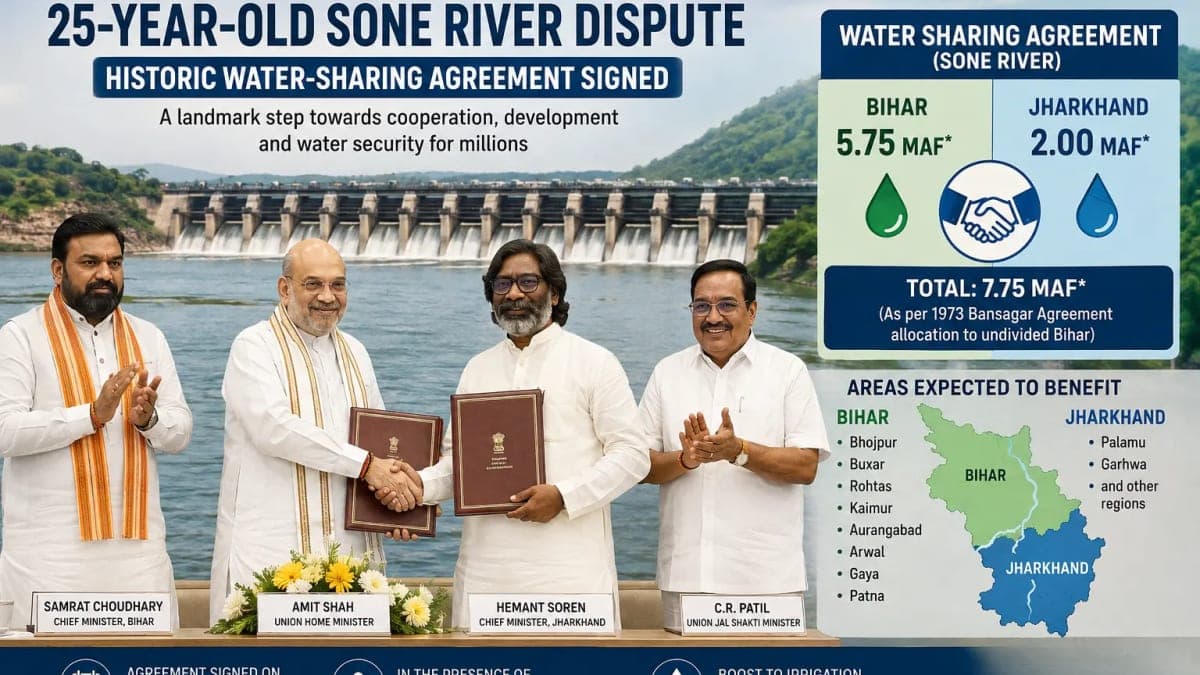
Under the agreed arrangement, Bihar will receive 5.75 million acre-feet (MAF) of Sone River water, while Jharkhand will receive 2.0 MAF, together accounting for the 7.75 MAF originally allocated to undivided Bihar.
The agreement is significant not only because it closes a long-running inter-state dispute, but also because it could support irrigation, drinking-water supply and future water infrastructure development across drought-prone and agricultural regions of both states.
What Bihar and Jharkhand Agreed
The dispute has its roots in the 1973 Bansagar Agreement, which was concluded among Madhya Pradesh, Uttar Pradesh and the then-undivided Bihar.
Under that arrangement, the available Sone River water was divided among the three states. Undivided Bihar received 7.75 MAF.
The situation became complicated after Jharkhand was created as a separate state in November 2000. While the earlier interstate framework remained in place, Bihar and Jharkhand had yet to formally settle how the 7.75 MAF allocated to the former unified state should be divided.
The new agreement resolves that question:
Bihar: 5.75 MAF
Jharkhand: 2.00 MAF
Total: 7.75 MAF
The allocation follows technical and inter-governmental deliberations, including work by a committee constituted by the Centre under the chairmanship of the Central Water Commission.
Agreement Signed in Presence of Amit Shah
The MoU was signed in New Delhi in the presence of Union Home Minister Amit Shah, Jharkhand Chief Minister Hemant Soren, Bihar Chief Minister Samrat Choudhary and Union Jal Shakti Minister C.R. Patil, along with senior officials from the Centre and the two state governments.
Calling the settlement an example of cooperative federalism, Shah said the agreement had resolved a long-awaited water dispute in eastern India.
He said the arrangement would help provide irrigation water to lakhs of farmers across large rural areas of Bihar and Jharkhand while also improving access to drinking water.
Shah described the settlement as an example of Prime Minister Narendra Modi's “Team Bharat” vision and argued that long-running disputes between states can be addressed through dialogue and cooperation.
Which Areas Could Benefit?
The agreement has practical implications for several districts where agriculture and water availability are closely linked to the Sone River system.
In Bihar, the Centre said improved water availability is expected to benefit areas including:
Bhojpur
Buxar
Rohtas
Kaimur
Aurangabad
Arwal
Gaya
Patna
In Jharkhand, Palamu, Garhwa and other regions are expected to gain from improved availability of water for irrigation and drinking purposes.
The impact could be particularly important in drought-prone and plateau regions where dependable irrigation remains essential for agricultural productivity.
Why the Dispute Lasted for More Than Two Decades
The core issue was not whether undivided Bihar had a share of Sone River water — that had already been established under the Bansagar framework — but how that existing allocation should be divided after Bihar's bifurcation.
That unresolved question also had consequences beyond the allocation itself.
The proposed Indrapuri Reservoir Project, earlier known as the Kadwan dam project, became linked to the dispute.
According to information previously provided by the Union Jal Shakti Ministry, Bihar submitted a preliminary project report for the reservoir to the Central Water Commission in December 2018.
Jharkhand maintained that the division of the Sone River water allocated to undivided Bihar under the Bansagar Agreement needed to be settled first.
With the interstate issue unresolved, the Central Water Commission returned the project proposal to Bihar in March 2022 and asked the state to resubmit it with the necessary no-objection certificates from co-basin states.
The new water-sharing agreement therefore removes an important long-standing dispute associated with future development of the river system.
How the Breakthrough Was Reached
The final MoU followed years of negotiations involving the two states, the Central Water Commission and central ministries.
A significant political consensus emerged during the 27th meeting of the Eastern Zonal Council in Ranchi on July 10, 2025.
Technical discussions and approvals continued afterward, eventually allowing the states to formalise the settlement.
The Centre has presented the agreement as part of a broader effort to resolve long-standing interstate issues through dialogue under mechanisms including the Inter-State Council and zonal councils.
Why the Sone River Agreement Matters
The importance of the settlement extends beyond the numerical division of water.
For farmers, greater certainty over water allocation can help governments plan irrigation infrastructure more effectively. For communities in water-stressed areas, improved management of river resources could strengthen drinking-water security.
The agreement could also make it easier for Bihar and Jharkhand to coordinate future reservoirs, canals and related water-management projects.
However, the signing of the MoU is the institutional breakthrough; the eventual scale of benefits will depend on how effectively the agreed allocation is translated into infrastructure, water releases and projects on the ground.
A New Chapter in Bihar-Jharkhand Water Cooperation
Bihar Chief Minister Samrat Choudhary and Jharkhand Chief Minister Hemant Soren thanked Prime Minister Narendra Modi and Union Home Minister Amit Shah for helping facilitate the settlement.
For the two neighbouring states, the agreement closes one of the unresolved questions created by Bihar's bifurcation more than two decades ago.
More importantly, it provides a defined framework for sharing a critical natural resource.
With the allocation now formally settled, attention is likely to shift from negotiations over entitlement to implementation — including how the two governments use their respective shares to expand irrigation, strengthen drinking-water supplies and advance long-pending water infrastructure.