BJP puts drugs at the centre of its early campaign
The BJP is preparing to take its campaign against drug abuse across Punjab, choosing an issue that has shaped state politics for years as it begins building towards the 2027 Assembly election.
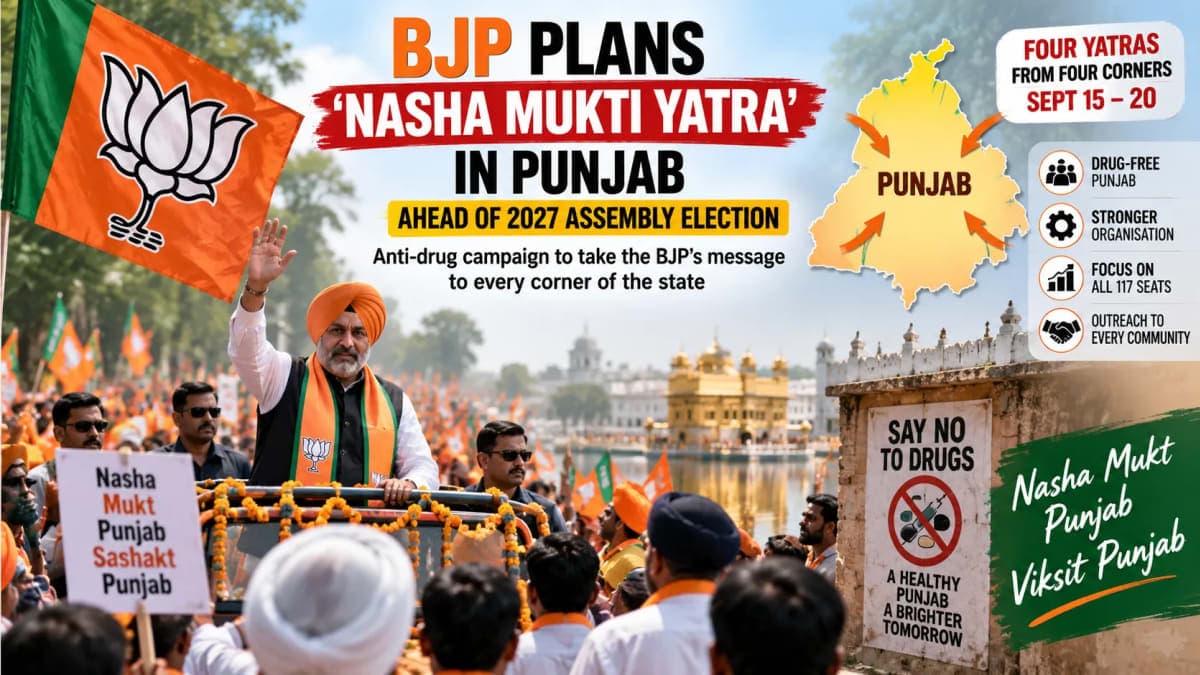
Punjab BJP president Kewal Singh Dhillon has said four “Nasha Mukti Yatras” are expected to start from different corners of the state between September 15 and 20. The journeys will give the party a platform to raise the drug issue while taking its political message directly into constituencies across Punjab.
The timing is significant. The election is still some distance away, but the BJP is trying to strengthen an organisation that for decades operated within the boundaries of its alliance with the Shiromani Akali Dal.
That makes the proposed yatras more than an anti-drug campaign. They are also an early test of whether the BJP can establish a sustained statewide presence on its own.
A familiar issue, but a different political contest
Drug addiction and trafficking are hardly new subjects in Punjab elections. Successive parties have campaigned on promises to dismantle supply networks, punish traffickers and improve rehabilitation.
The Aam Aadmi Party was no exception.
AAP used the issue while challenging earlier governments and, after its sweeping victory in 2022, the Bhagwant Mann administration launched its own measures against the drug trade.
The BJP will therefore have to make a more specific case than simply arguing that Punjab continues to face a drug problem. Its campaign will need to convince voters that the state government's response has fallen short and that the BJP has a credible alternative.
The four-yatra format gives the party time and geographical reach to develop that argument outside conventional election rallies.
Why four separate yatras matter
Rather than sending one procession through the state, the BJP plans to begin four journeys from different directions.
That approach allows the campaign to cover more constituencies while giving state and local leaders opportunities to organise meetings along separate routes. BJP leaders have studied campaign methods used by the party elsewhere, including its experience with political yatras in West Bengal.
Punjab, however, presents a distinct challenge.
For years, the BJP's electoral map in the state was shaped by its partnership with the Shiromani Akali Dal. Under the alliance, SAD contested most rural and Sikh-dominated constituencies while the BJP concentrated largely on urban seats.
The arrangement gave the BJP an established role in Punjab politics, but it also meant the party had less incentive to build its own machinery in large parts of the state.
That changed after the alliance collapsed in 2020 during the agitation against the Centre's three farm laws.
Preparing for all 117 Assembly constituencies
The BJP now says it is preparing to contest all 117 seats in Punjab.
Punjab in-charge Satish Poonia has publicly maintained that the party is building towards an independent contest in 2027. That position requires the BJP to develop an organisation capable of operating in areas where it previously depended heavily on an ally.
The scale of the effort is visible in its internal structure.
The party has planned five organisational circles for each Assembly constituency, with 622 circles and 6,425 sub-circles beneath more than 25,000 booth-level units.
It has also discussed setting up WhatsApp groups of roughly 250 people at the booth level.
The BJP wants the organisational structure completed by September 30 and fully operational by the end of October.
Those numbers may sound procedural, but they address one of the party's central problems in Punjab. A statewide campaign can attract attention; elections are ultimately fought through local workers who identify supporters, maintain voter contact and mobilise people at the booth level.
Nasha Mukti Yatra doubles as an organisational exercise
Seen in that context, the yatra serves two purposes.
Publicly, it allows the BJP to challenge the Mann government on drugs. Internally, it gives the newly expanded party network something around which to organise.
Workers can hold local meetings, recruit supporters and establish contact with communities well before the formal election campaign begins.
The BJP is also expected to use the outreach to promote welfare schemes associated with the Narendra Modi government, including Ayushman Bharat, PM-Kisan and the Pradhan Mantri Awas Yojana.
BJP national general secretary (organisation) B L Santhosh has been involved in discussions over the Punjab strategy, with booth strengthening and household outreach among the priorities.
The emerging campaign therefore combines criticism of the state government with an effort to sell the Centre's record.
The shadow of the old BJP-SAD alliance remains
There is one complication in the BJP's insistence that it is preparing independently: speculation about a possible rapprochement with the Shiromani Akali Dal has not disappeared.
The two parties were partners for more than two decades before splitting during the farm-law protests. They subsequently fought the 2022 Punjab Assembly election and the 2024 Lok Sabha election separately.
BJP leaders currently say their preparations cover all 117 seats, and that is the party's stated position.
At the same time, reports of contacts between figures in the BJP and SAD have kept questions about a possible future arrangement alive.
For organisational purposes, there is little disadvantage for the BJP in preparing independently. A stronger booth network would increase its electoral capacity whether it ultimately contests alone or enters some form of seat-sharing arrangement.
BJP is starting from a difficult electoral position
The party's expansion plans also need to be measured against its recent results.
The BJP won only two seats in the 2022 Punjab Assembly election. In the 2024 Lok Sabha election, it failed to win any of the state's 13 parliamentary constituencies.
Those results demonstrate the distance between building visibility and becoming a major contender for power.
Punjab's electoral landscape is also crowded. AAP will seek to defend the mandate it won under Bhagwant Mann in 2022, while Congress retains a substantial political base. SAD is trying to recover from a prolonged period of electoral decline, alongside competition from other Panthic political forces.
For the BJP, expanding in Punjab therefore requires more than consolidating its established urban vote. It needs to make inroads into constituencies and communities where the party historically operated through SAD rather than independently.
Drugs provide an opening, not a complete strategy
The Nasha Mukti Yatra gives the BJP an issue with statewide resonance, but the eventual election will be fought over a broader set of concerns.
Jobs, agriculture, industry, public finances, law and order and the performance of the Mann government are all likely to shape the 2027 contest.
The drug issue can nevertheless provide the BJP with an entry point.
It is personal for many Punjab families, politically familiar and difficult for any governing party to dismiss. By beginning its campaign there, the BJP can put pressure on AAP while simultaneously testing its own ability to organise beyond traditional strongholds.
That may be the more consequential part of the exercise.
The immediate measure of the yatras will be the crowds and political attention they generate. The longer-term measure will be whether the BJP can leave behind functioning local networks once the processions have moved on.
With the 2027 election still ahead, the party is using the anti-drug campaign to begin answering a larger question: whether it can turn years of being a junior alliance partner into a genuinely statewide organisation.