Census 2027 Population Count to Begin Early in Four Poll-Bound States From December 1
Introduction
The Centre has advanced the population enumeration phase of Census 2027 in four states headed for Assembly elections next year, separating the massive data-collection exercise from the expected election schedule.
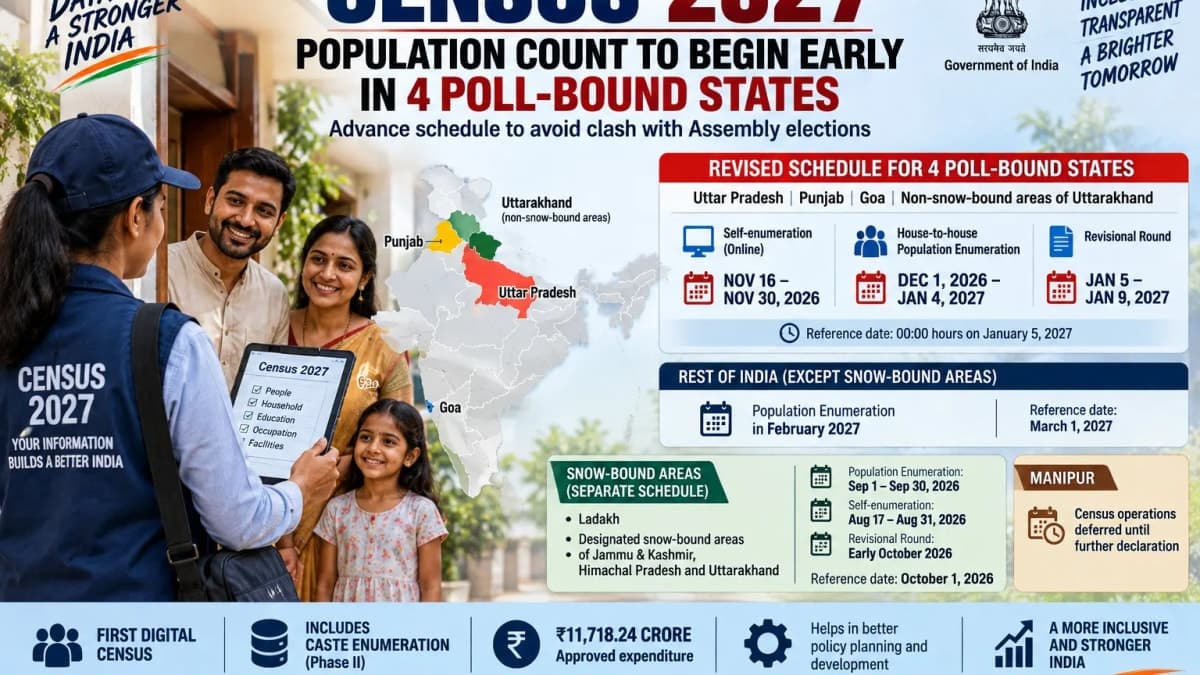
Population enumeration in Uttar Pradesh, Punjab, Goa and non-snow-bound areas of Uttarakhand will now take place from December 1, 2026 to January 4, 2027, according to a notification issued by the Office of the Registrar General of India.
A revisional round will follow from January 5 to January 9, while residents will be given an opportunity to complete self-enumeration between November 16 and November 30, 2026.
The rest of the country, apart from areas operating on a separate schedule because of snow conditions, is expected to undergo population enumeration in February 2027.
The revised timetable is significant because the four states are expected to hold Assembly elections in early 2027, creating the potential for the Census and electoral machinery to compete for many of the same government personnel.
Census Dates Advanced in Four States
Under the revised schedule, house-to-house population enumeration will begin on December 1 and continue through January 4.
The four areas covered are:
Uttar Pradesh
Punjab
Goa
Non-snow-bound areas of Uttarakhand
The reference date will be 00:00 hours on January 5, 2027.
The reference date is important because Census information is recorded with respect to a specific point in time, allowing the population count to represent a defined demographic snapshot rather than simply the number of people contacted during the weeks-long field exercise.
A revisional round from January 5 to January 9 will allow enumerators to account for relevant changes after their initial household visits.
Self-Enumeration Opens November 16
Residents of the four states will not necessarily have to wait for an enumerator to arrive at their homes.
The government has provided a 15-day self-enumeration window from November 16 to November 30.
Self-enumeration is part of the wider digital transformation of Census 2027. The exercise is India's first digital Census, although door-to-door enumeration remains an important part of the process.
Digital applications and the Census Management and Monitoring System have already been deployed as part of Census operations.
The combination of self-enumeration and enumerator-led data collection is intended to make an exercise covering India's enormous population easier to administer while preserving the ability to reach households that cannot or do not use the digital option.
Why Was the Census Schedule Changed?
The revised timetable comes ahead of Assembly elections expected in the four states in early 2027.
A major practical issue is manpower.
Teachers and other state government employees traditionally play an important role in Census enumeration. Many of those same personnel are also required for election-related duties.
Holding the population count and Assembly elections at roughly the same time could therefore put substantial pressure on state administrative machinery.
Advancing Census enumeration into December and early January creates greater separation between the two exercises.
The notification itself establishes the revised dates. Reports citing officials have linked the change specifically to avoiding manpower and logistical conflicts between Census and election duties.
Congress Questions Timing of the Decision
The change has also triggered a political dispute.
Congress general secretary Jairam Ramesh questioned why the adjustment was made now when the timing of the Assembly elections was already known.
He described the change as evidence of “shoddy planning” and alleged that “some nefarious political calculations” were behind the move.
That allegation is a political claim by the Congress, not an established reason contained in the Census notification.
Ramesh also raised objections to the design of the Census question dealing with caste and said suggestions previously made by Congress leaders Rahul Gandhi and Mallikarjun Kharge had not been accepted.
The government's operational explanation reported for advancing enumeration is the potential overlap between Census duties and the election process.
Rest of India Remains on February 2027 Timeline
The revised December schedule does not apply nationwide.
For most of India, the Population Enumeration phase remains scheduled for February 2027, with a reference date of March 1, 2027.
During this phase, enumerators will collect information covering demographic, socio-economic and cultural characteristics as well as migration and fertility-related details.
The government has also confirmed that caste enumeration will form part of the second phase of Census 2027.
That makes the forthcoming count particularly consequential. Census information influences research, policymaking, public administration and long-term assessments of demographic and social change.
Snow-Bound Regions Are Already on a Different Schedule
Census operations cannot follow the same timetable everywhere in India because severe winter conditions make some regions difficult to access.
Population enumeration in Ladakh and designated snow-bound non-synchronous areas of Jammu and Kashmir, Himachal Pradesh and Uttarakhand was scheduled from September 1 to September 30, 2026.
Those areas were given a self-enumeration period from August 17 to August 31, followed by a revisional round in early October.
Their Census reference date is October 1, 2026.
The separate timetable allows enumeration to be completed before winter conditions make access to some settlements significantly more difficult.
Census Operations Deferred in Manipur
Manipur presents a separate case.
The government has deferred Census operations in the state until a further declaration.
Manipur is also due for an Assembly election cycle in 2027, but unlike Uttar Pradesh, Punjab, Goa and Uttarakhand, the government has not simply moved its population enumeration to the December-January window.
That distinction means Manipur should not be included among the four states covered by the newly advanced population-enumeration schedule.
Census 2027 Comes Six Years After Original Schedule
India's latest Census carries unusual significance because the previous exercise was due to take place in 2021.
It was postponed following the COVID-19 pandemic.
As a result, Census 2027 will be conducted after a substantially longer gap than India's normal decennial Census cycle.
It will also be the eighth Census since Independence.
The Union Cabinet has approved an expenditure of ₹11,718.24 crore for the exercise.
Census 2027 Is Being Conducted in Two Phases
The nationwide operation is divided into two major stages.
The first is the Houselisting and Housing Census, which records information about buildings, housing conditions, household amenities and assets while establishing the framework needed for the population count.
The second is Population Enumeration, which records information about individuals living in households.
The government said in August that the first phase had already been completed in 31 states and Union Territories, with work in the remaining states and UTs scheduled for completion by September 2026.
Caste enumeration will take place during the second phase.
Why the December-January Window Matters
Moving population enumeration forward in the four poll-bound states is fundamentally an administrative scheduling decision, but its proximity to Assembly elections inevitably gives it political significance.
Uttar Pradesh in particular represents an enormous logistical undertaking for both the Census and the Election Commission because of its population and electorate.
Keeping the two operations apart reduces the possibility that teachers and other government personnel will be required for major Census and election assignments simultaneously.
The revised dates also provide residents with a clear sequence: self-enumeration from November 16, field enumeration from December 1, and the revisional exercise in early January.
For most Indians, however, the key date has not changed. Population enumeration across the remainder of the country is still scheduled for February 2027.