Reservation Row Puts Two NDA Allies on Opposite Sides
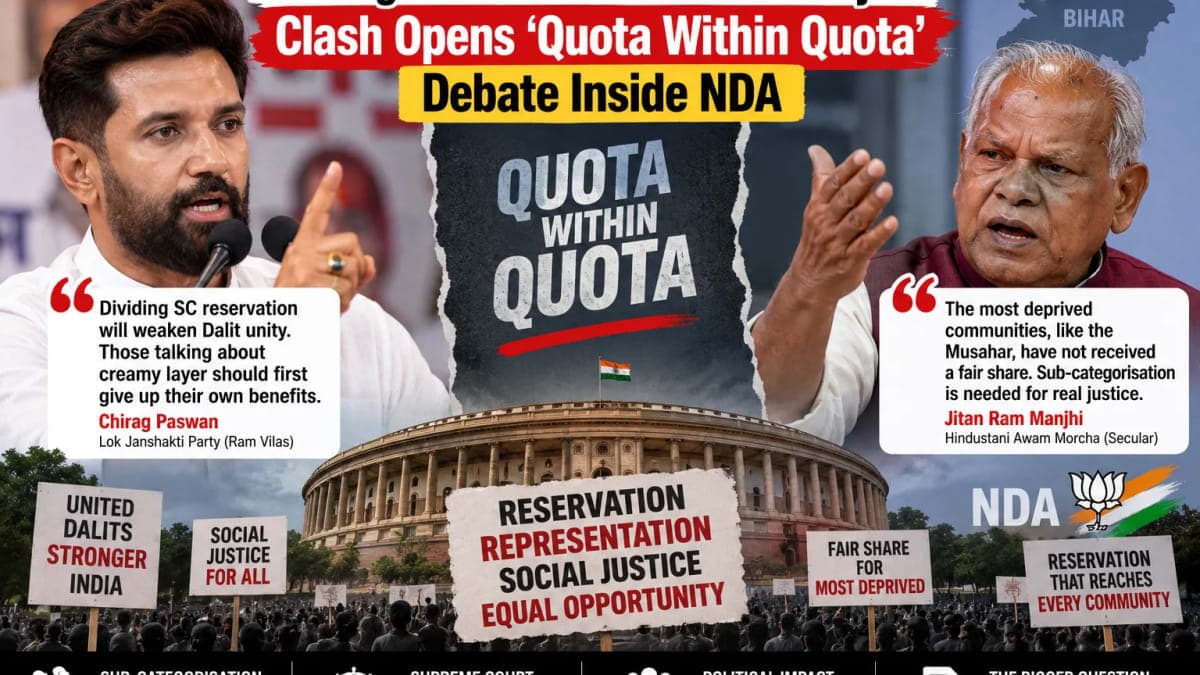
A politically sensitive debate over who benefits from reservation has opened a visible fault line within the National Democratic Alliance, with Union ministers Chirag Paswan and Jitan Ram Manjhi taking opposing positions on sub-categorisation within Scheduled Caste and Scheduled Tribe quotas.
The confrontation intensified after Santosh Kumar Suman, Manjhi's son and a Bihar minister, called for a review of reservation policy and backed sub-categorisation to examine whether historically disadvantaged groups within the SC and ST communities have received an adequate share of reservation benefits.
Paswan strongly opposed the proposal, while Manjhi defended the argument that communities that remain particularly deprived should receive greater access to reservation benefits.
The political exchange subsequently escalated, with Paswan and Manjhi calling for each other's resignation.
What Did Santosh Kumar Suman Propose?
Santosh Kumar Suman, president of the Hindustani Awam Morcha (Secular), argued that India's reservation system should be reviewed to determine which communities have benefited and which remain deprived.
Suman questioned whether the original objective of reservation had been fully achieved and pointed to disparities among different communities covered by existing quotas.
His argument is essentially for sub-categorisation—creating separate allocations within an existing reservation category so that communities considered particularly disadvantaged are not crowded out by groups that have secured a larger share of benefits.
HAM(S) has maintained that it is not demanding the abolition of reservation.
Instead, its stated position is that the system should become more effective at reaching groups that remain socially and economically disadvantaged.
Manjhi Camp Points to the Musahar Community
The political significance of the argument is closely connected with Bihar's complex caste landscape.
Jitan Ram Manjhi belongs to the Musahar community, which is regarded as one of the most disadvantaged Dalit communities in Bihar.
HAM(S) has argued that the benefits available under Scheduled Caste reservation have not been distributed equally among all communities.
Suman has cited the representation of Musahars in senior government positions as an example of this disparity, arguing that some Dalit groups remain severely underrepresented despite decades of reservation.
The Manjhi camp therefore sees sub-categorisation as a mechanism for distributing opportunities more evenly among communities already included within the Scheduled Caste framework.
Chirag Paswan Strongly Opposes the Proposal
Lok Janshakti Party (Ram Vilas) chief Chirag Paswan has taken the opposite position.
Paswan argues that Scheduled Caste reservation exists primarily because of historical social discrimination and untouchability, rather than economic disadvantage.
He has warned against applying an economic test or "creamy layer" principle to Scheduled Castes.
Paswan has also expressed concern that dividing existing Scheduled Caste reservation into smaller categories could weaken Dalit unity and undermine the broader purpose of social justice.
As the dispute intensified, Paswan said that those advocating a creamy-layer approach should first give up reservation benefits themselves.
He then demanded the resignations of Manjhi and Santosh Kumar Suman.
Manjhi Hits Back at Paswan
Manjhi rejected Paswan's criticism and defended the demand for greater representation for communities that have received fewer benefits from the existing system.
The disagreement soon moved beyond policy arguments into a direct political confrontation.
Manjhi accused Paswan of taking an improper position on the reservation question and also responded to calls for his resignation by questioning Paswan's own continuation in government.
What began as a disagreement over the distribution of reservation benefits had therefore become an unusually public clash between two Union ministers belonging to the same ruling coalition.
What Does ‘Quota Within Quota’ Actually Mean?
The phrase "quota within quota" generally refers to sub-classification within an existing reserved category.
Under such a system, the overall reservation available to a category does not necessarily disappear. Instead, part of that quota may be earmarked for communities identified as more disadvantaged within the larger group.
Supporters argue that this can prevent relatively better-represented communities from receiving a disproportionate share of reserved opportunities.
Opponents worry that such divisions could fragment historically disadvantaged communities and create new disputes over which groups should receive priority.
That distinction is central to the Paswan-Manjhi disagreement.
Supreme Court's 2024 Judgment Is Crucial to the Debate
The controversy also has an important legal background.
In August 2024, a seven-judge Constitution Bench of the Supreme Court, in a 6:1 majority ruling, held that states could sub-classify Scheduled Castes for reservation purposes, overturning the position taken in the 2004 E.V. Chinnaiah judgment.
The ruling opened the door for governments to identify differing levels of disadvantage within Scheduled Castes, provided such classification is supported by appropriate evidence.
The judgment did not simply create a nationwide "quota within quota" formula. Rather, it established constitutional room for sub-classification under specified conditions.
That legal distinction matters because the current political dispute is not merely about whether reservation should continue. It concerns how benefits within reserved categories should be distributed.
Sub-Categorisation and ‘Creamy Layer’ Are Not Exactly the Same
Another important distinction can easily get lost in the political debate.
Sub-categorisation and the creamy-layer principle are related to questions about the distribution of reservation benefits, but they are not identical concepts.
Sub-categorisation involves dividing a reserved category into sub-groups so that particular communities can receive an allocated share.
The creamy-layer concept, by contrast, generally concerns excluding relatively advanced individuals or families within a reserved category from reservation benefits.
The creamy-layer principle has long operated in the context of Other Backward Classes.
Applying such an exclusion to Scheduled Castes and Scheduled Tribes remains far more contentious.
The Centre has previously maintained before the Supreme Court that the creamy-layer concept applicable to OBC reservation cannot simply be extended to SCs and STs.
Why Bihar Makes the Debate Politically Important
The dispute carries particular weight because both Paswan and Manjhi are prominent Dalit leaders from Bihar and represent different political constituencies.
Paswan leads the Lok Janshakti Party (Ram Vilas), while Manjhi founded the Hindustani Awam Morcha (Secular). Both parties are part of the NDA.
Their disagreement therefore represents more than a personal political clash.
It exposes a fundamental question in Dalit politics: should Scheduled Caste communities continue to receive reservation largely as a unified constitutional category, or should policymakers account for differences in representation and deprivation among individual communities within that category?
For smaller and severely underrepresented communities, sub-categorisation can be presented as a question of equitable access.
For opponents, however, dividing the quota risks creating competition among groups that have historically faced caste discrimination.
Why the NDA Dispute Matters Beyond Bihar
The implications of the debate extend beyond the political rivalry between Paswan and Manjhi.
Any significant move toward sub-categorisation would require governments to confront difficult questions about evidence, representation and the distribution of limited reserved opportunities.
Which communities are the most deprived?
How should deprivation be measured?
How much of an existing quota should be allocated to individual sub-groups?
And how should governments ensure that attempts to improve representation do not produce arbitrary classifications?
Those are administrative and constitutional questions as much as political ones.
A Policy Debate With Larger Political Consequences
The Paswan-Manjhi confrontation has turned an internal disagreement among NDA allies into a wider debate about the future design of affirmative action.
At its heart are two competing interpretations of social justice.
The Manjhi camp argues that decades of reservation have not produced equal gains across all Dalit communities and that the most deprived groups require mechanisms guaranteeing them a meaningful share.
Paswan's position stresses that Scheduled Caste reservation originates from caste-based social discrimination and warns that internal divisions or economic criteria could dilute that principle.
The Supreme Court's 2024 judgment has given governments greater constitutional room to consider sub-classification, but the political challenge of implementing such a system remains considerable.
For the NDA, the dispute is therefore about more than managing two allies. It reflects a larger question likely to remain politically consequential: whether equality within reservation requires treating historically disadvantaged communities together—or recognising inequalities that persist within those categories themselves.