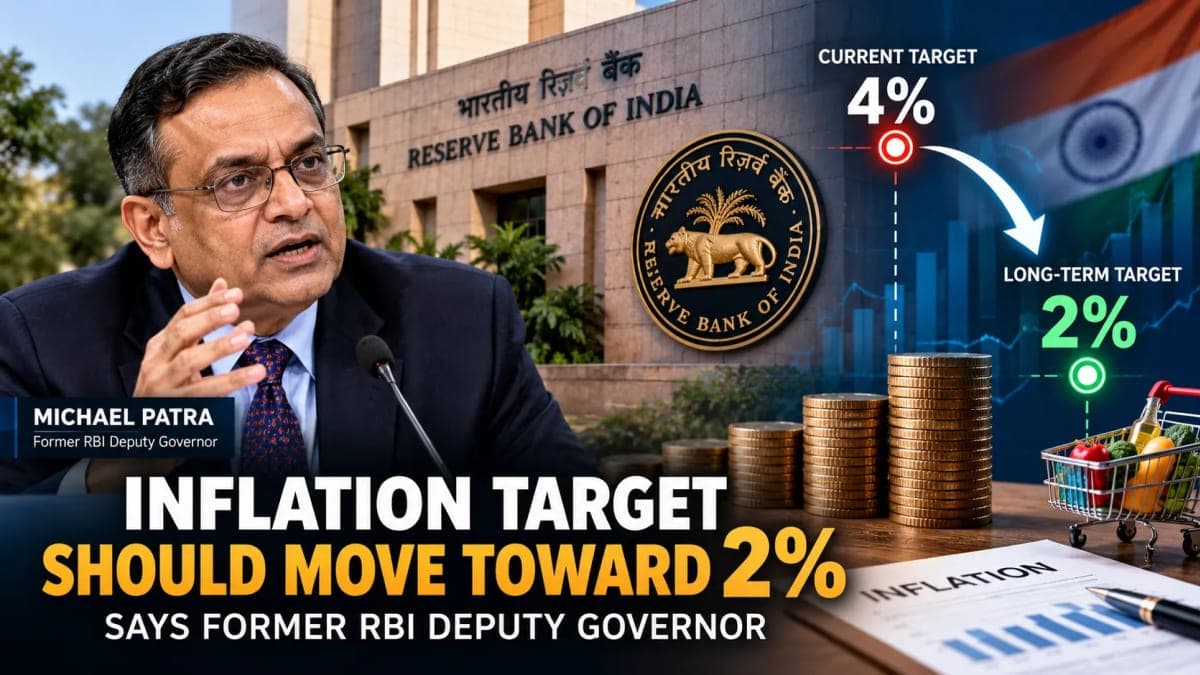
Patra Makes the Case for a Lower Long-Term Inflation Target
Former Reserve Bank of India Deputy Governor Michael Debabrata Patra has said India's inflation target should ultimately move closer to the 2% level prevalent across many advanced economies, as the structure of the Indian economy evolves.
Patra, who was a member of India's Monetary Policy Committee from 2016 to 2025 and served as RBI deputy governor in charge of monetary policy, made the argument in an interview with Business Standard published on October 2, 2026. He was also member-secretary of the Urjit Patel committee that helped shape India's inflation-targeting framework.
Importantly, Patra was discussing the long-term direction of the framework, not calling for the RBI to immediately cut its inflation target from 4% to 2%.
Why Patra Believes 2% Could Eventually Be Appropriate
Patra's argument rests on the idea that an appropriate inflation target should reflect an economy's underlying structural characteristics.
He said policymakers need to consider the economy's changing trend rate of inflation—the underlying inflation rate around which prices tend to move over time. Setting a target too high relative to that trend could make monetary policy unnecessarily restrictive, while setting it too low could produce overly accommodative policy and periodic inflation surges.
Patra said that if India eventually becomes an advanced economy, its inflation objective should align with the advanced-economy average, which he placed at around 2% today.
That makes his position more nuanced than simply arguing that "lower inflation is always better." The appropriate target, in his view, should evolve alongside India's economy.
India Currently Operates Around a 4% Inflation Target
India adopted its flexible inflation-targeting framework in 2016.
Under the framework, monetary policy has been centred on 4% headline Consumer Price Index inflation, with a tolerance band extending from 2% to 6%. The RBI has described price stability as the primary monetary-policy objective while also taking economic growth into consideration.
The tolerance range gives policymakers room to respond to shocks without being required to force inflation back to exactly 4% immediately.
This flexibility is particularly relevant to India because food and energy prices—which can be heavily affected by weather, supply disruptions and international commodity markets—have a major influence on headline inflation.
A Decade of Flexible Inflation Targeting
Patra argued that India's experience since 2016 provides evidence that the inflation-targeting framework has helped anchor price behaviour.
According to figures he cited, headline inflation averaged approximately 4.5% during the first five years of the framework and 4.9% during the following five years, despite major disruptions ranging from the Covid-19 pandemic to geopolitical conflicts and global commodity shocks.
He sees inflation repeatedly moving back toward the target after shocks as evidence that the framework itself has played a stabilising role.
That interpretation is Patra's assessment of India's inflation experience. Other economists can differ over how much of India's inflation performance should be attributed to monetary policy compared with fiscal measures, supply conditions, food-price management and global commodity cycles.
The 2022 Inflation Breach Remains an Important Lesson
India's inflation framework faced one of its biggest tests in 2022.
Under the system, the RBI is considered to have failed to meet its inflation mandate when headline inflation stays outside the 2%-6% tolerance band for three consecutive quarters.
Inflation remained above 6% for the required period in 2022, triggering the framework's formal accountability mechanism.
Patra said one lesson from that episode was the danger of assuming inflation caused initially by supply disruptions will necessarily remain temporary. Demand pressures can emerge later and make inflation more persistent, strengthening the case for earlier monetary-policy intervention.
Would a 2% Target Mean Higher Interest Rates?
Not automatically.
An inflation target is a medium-term objective, while interest rates are adjusted according to current and expected inflation, growth, financial conditions and other economic factors.
If policymakers attempted to lower inflation structurally from around 4% toward 2% while underlying inflation remained considerably higher, tighter monetary conditions could potentially be required during the transition.
But if India's structural inflation rate itself declined as productivity increased and the economy matured, the adjustment could look very different.
This distinction is central to Patra's argument: the target should reflect the economy's underlying inflation dynamics rather than being lowered mechanically.
AI Could Even Affect the Appropriate Inflation Target
Patra also pointed to artificial intelligence as an example of why the structural inflation rate can change.
If AI generates broad productivity improvements, businesses could potentially produce more efficiently, putting downward pressure on the economy's underlying inflation rate.
On the other hand, Patra noted that the huge investment requirements associated with AI and concentration of economic power could exert pressure in the opposite direction.
The example demonstrates why he believes policymakers must continually assess structural changes rather than assume today's optimal inflation target will remain appropriate indefinitely.
Not Everyone Agrees That India Should Move Away From 4%
There is an important counterpoint within the debate.
Former RBI Executive Director Janak Raj, writing in September 2025 during the review of India's inflation-targeting framework, argued for maintaining the existing 4% target with a ±2 percentage-point tolerance band. He said the framework had performed reasonably well despite major external shocks and that preserving the arrangement would support its credibility.
That illustrates the broader policy debate: one argument is that India's development and structural transformation could eventually justify a lower inflation target; another is that maintaining a stable, well-understood target provides credibility and avoids unnecessarily disrupting monetary policy.
Why a Lower Inflation Target Would Matter
Changing the inflation target would have consequences extending beyond the headline CPI number.
Inflation expectations influence interest rates, bond yields, borrowing costs, wages, household savings, investment decisions and business planning.
A sustainably lower inflation environment can protect purchasing power and make long-term financial planning easier. But aggressively pursuing a target that is inconsistent with the economy's underlying inflation dynamics could impose costs through tighter monetary conditions and weaker demand.
The policy question, therefore, is not simply whether 2% is better than 4%. It is whether India's economic structure eventually makes a lower target both credible and sustainable.
Patra Says Price Stability Supports Growth
Patra rejects the idea that inflation control and economic growth must always work against each other.
His argument is that keeping inflation stable helps an economy remain close to its productive potential. Persistently excessive demand can create inflation and eventually undermine growth, while weak demand and very low inflation can require monetary support.
He pointed to India's post-pandemic growth performance as evidence supporting his assessment that flexible inflation targeting has not prevented strong economic expansion.
Ultimately, Patra's 2% argument is best understood as a long-term policy proposition tied to India's economic development, rather than a recommendation for an immediate shift in the RBI's current operating framework.