India’s Q2 GDP Growth Nowcast Stands at 7.3%
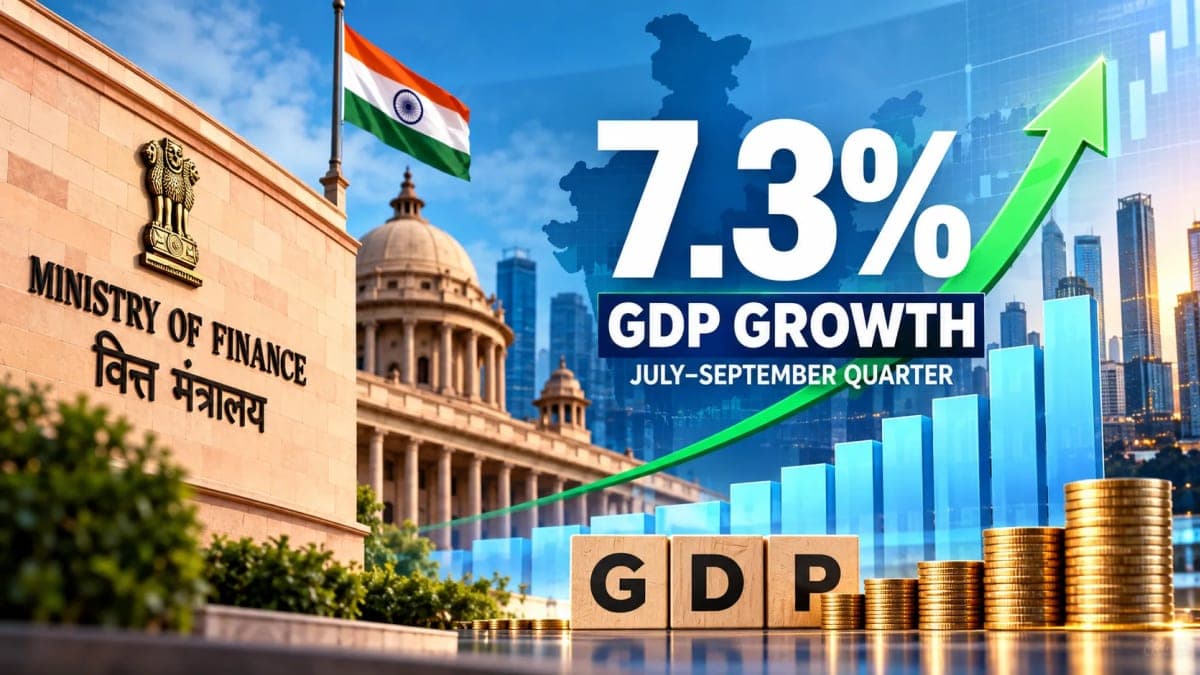
India’s economy is estimated to have expanded by 7.3% in real terms during the July–September quarter of FY2026-27, according to the Finance Ministry’s nowcasting model.
The projection was highlighted in the ministry’s September Monthly Economic Review, which indicated that economic momentum carried into the second quarter, but at a more moderate pace compared with the beginning of the financial year.
The figure is a nowcast, not the official Q2 GDP estimate. Official quarterly GDP statistics are released by the Ministry of Statistics and Programme Implementation (MoSPI).
Growth Expected to Ease From 7.8% in April–June
The latest projection follows a strong start to FY2026-27.
Official MoSPI data showed that real GDP grew 7.8% year-on-year during the April–June 2026 quarter. Nominal GDP expanded by 10.3% during the same period.
If the Finance Ministry’s 7.3% Q2 nowcast is broadly reflected in the eventual official figures, it would indicate that India maintained relatively strong economic expansion during the first half of FY27, while experiencing some moderation from the previous quarter.
That distinction matters: a decline from 7.8% to an estimated 7.3% would represent slower growth in year-on-year terms, rather than an economic contraction.
High-Frequency Indicators Point to Continued Expansion
The Finance Ministry’s assessment draws on high-frequency economic indicators to estimate activity before official quarterly GDP figures become available.
According to reporting on the September review, the Index of Industrial Production (IIP) increased 6.7% year-on-year in July, while the Index of Eight Core Industries grew 4.8%.
The manufacturing Purchasing Managers’ Index stood at 52.8 in August, remaining above the 50 level that separates expansion from contraction.
Services activity also provided support, with the ministry pointing to stronger new business and employment during August.
However, some indicators, including e-way bill generation and manufacturing activity, showed signs of moderating compared with the strong momentum seen earlier.
Why the 7.3% Estimate Matters
GDP growth is one of the broadest indicators of economic activity, covering production across manufacturing, services, agriculture, construction and other parts of the economy.
A Q2 growth rate around the Finance Ministry’s estimate would suggest that domestic economic activity remained resilient despite a challenging international environment.
It could also provide policymakers with a clearer picture of whether domestic consumption, investment and industrial activity are strong enough to cushion India from weaker or more volatile external conditions.
However, GDP growth alone does not capture every aspect of economic well-being. Employment conditions, household income growth, inflation, private investment and the distribution of economic gains remain important when assessing the broader strength of the economy.
Global Risks Could Complicate India’s Growth Outlook
While the Finance Ministry’s nowcast signals continued expansion, its broader assessment is cautious.
The ministry has highlighted geopolitical tensions, higher crude oil prices, global interest rates, trade uncertainty and volatile capital flows as potential risks.
Oil prices are particularly important for India because the country depends heavily on imported crude. Sustained increases in global energy costs can raise import expenses and contribute to domestic inflation.
The external environment could also affect the rupee and foreign capital flows as investors respond to changing interest rates and risk conditions across global markets.
At the same time, uncertainty surrounding international trade relationships could affect exporters and investment decisions.
Inflation Adds Another Layer of Uncertainty
The Finance Ministry has also flagged inflationary risks arising from global energy-market pressures, weather conditions and certain commodity prices.
Inflation matters for growth because persistently higher prices can reduce household purchasing power and influence monetary-policy decisions.
The interaction between growth and inflation will therefore remain important in determining the direction of India's economy over the coming quarters.
7.3% Is a Projection — Official Q2 Data Still Awaited
The Finance Ministry’s estimate should not be confused with an official GDP release.
MoSPI has scheduled the release of the official GDP estimates for the July–September quarter of FY2026-27 for November 30, 2026.
Until those statistics are published, the 7.3% number represents the Finance Ministry’s model-based assessment of economic activity rather than a final measurement.
The official release will provide a more detailed picture of sectoral performance and show how closely the actual outcome corresponds with the ministry’s nowcast.
What to Watch Next
The coming months will show whether India can maintain its domestic growth momentum while navigating a more difficult global environment.
Industrial production, private consumption, investment, exports, inflation and government expenditure will be among the important indicators to watch.
For now, the Finance Ministry’s 7.3% Q2 nowcast suggests continued expansion but also points to some moderation after the 7.8% growth recorded in April–June.
The larger question is whether that momentum can remain resilient if external pressures from energy prices, trade uncertainty and global financial conditions intensify.