India Ends Q2 on a Firm Economic Footing
India’s economy entered the festive season with several high-frequency indicators showing renewed strength at the end of the second quarter of FY2026-27.
September data showed stronger manufacturing activity, higher Goods and Services Tax collections and record levels of daily Unified Payments Interface transactions. Industrial production had also accelerated sharply in August, providing additional evidence of stronger activity during the quarter.
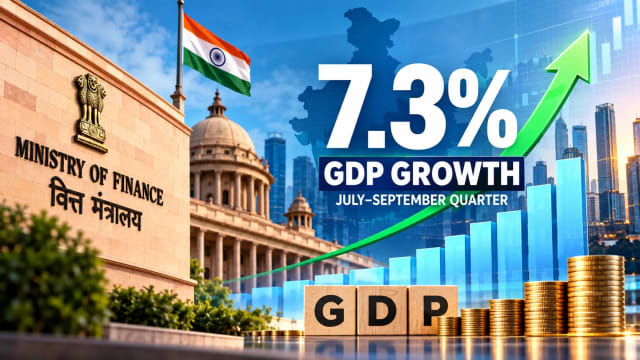
The figures do not yet constitute an official Q2 GDP reading, but together they provide an early indication that economic activity remained resilient during July-September.
Industrial Production Rises 8% in August
One of the clearest signals came from industrial production.
According to India's Ministry of Statistics and Programme Implementation, the Index of Industrial Production grew 8.0% year-on-year in August 2026.
Manufacturing output increased 9.0%, while electricity and gas supply recorded growth of 12.3%. The government data also showed manufacturing growing by at least 8% for three consecutive months.
The industrial numbers matter because manufacturing accounts for an important part of India's production economy and can provide an indication of underlying demand, investment and business activity.
Manufacturing PMI Reaches Seven-Month High
The September manufacturing survey provided another positive signal.
India's factory activity expanded at its fastest pace in seven months as domestic and overseas demand strengthened, according to the HSBC India Manufacturing Purchasing Managers' Index compiled by S&P Global.
The headline PMI increased to 55.1 in September from 52.8 in August, with new orders and production strengthening and manufacturers returning to hiring.
A PMI reading above 50 indicates expansion, while a reading below 50 signals contraction.
The September improvement is particularly notable because manufacturing momentum had weakened during the preceding months.
GST Collections Climb 14.7%
Tax collections also ended the quarter strongly.
India's gross GST revenue reached approximately ₹2.04 lakh crore in September, representing a 14.7% year-on-year increase, according to government data reported on October 1.
Domestic transaction revenues increased 10.1% to around ₹1.38 lakh crore.
Strong GST collections can reflect increased taxable economic activity, but the headline figure should not be treated as a direct measure of household consumption alone. Import-related tax receipts also contribute to total collections.
That distinction is particularly relevant because import-related GST was an important contributor to revenue growth during the first half of FY27.
UPI Transactions Cross 800 Million Per Day
India's digital economy provided another record.
Average UPI transactions reached approximately 802.3 million per day in September, up from 790.6 million in August and 654.3 million a year earlier.
Average daily transaction value also increased to roughly ₹97,900 crore.
The numbers demonstrate the continuing expansion of digital payments across India's economy. However, transaction volumes should not be interpreted as a direct proxy for GDP because UPI includes payments of widely differing values and purposes.
Automobile Market Shows Strength — But Also a Divide
The automobile sector presented a more mixed picture.
Passenger vehicle sales at several major manufacturers recorded strong increases in September. Maruti Suzuki reported total sales of around 2.36 lakh vehicles, up 24% year-on-year, while its domestic passenger vehicle sales rose 37%.
Mahindra & Mahindra reported passenger vehicle sales growth of 14%, while Hyundai Motor India's total sales increased 10.8%.
But rural-facing categories were weaker.
Mahindra's tractor sales declined 21% year-on-year, while Escorts Kubota recorded a 16.7% decline. Bajaj Auto's domestic two-wheeler sales were also down 12%, even as exports helped its overall volumes.
This divergence suggests that the consumption recovery cannot yet be described as uniform across households and regions.
Festive Season Could Provide the Next Demand Test
The timing of the stronger indicators is significant because India's festive period typically generates increased spending across automobiles, electronics, apparel, consumer goods and other discretionary categories.
Consumer-facing industries had already reported stronger demand during the July-September quarter, including double-digit or near-double-digit growth across several appliance, FMCG and branded apparel categories.
The coming weeks will therefore provide a clearer test of whether Q2's momentum translates into sustained household spending rather than a temporary pre-festival acceleration.
Inflation Remains an Important Risk
The economic picture is not without pressure.
India's Consumer Price Index inflation reached 4.82% year-on-year in August, up from 4.45% in July. Food inflation stood higher at 5.95%, according to official government statistics.
Higher food, commodity and energy costs can reduce households' disposable income and potentially limit discretionary purchases.
External conditions also remain uncertain. India's Finance Ministry has flagged geopolitical tensions, high crude-oil prices and tighter global financial conditions as risks that could increase imported inflation and affect financial markets.
What the Q2 Indicators Actually Tell Us
Taken together, the latest figures suggest that India finished the July-September quarter with substantial economic activity.
Industrial output accelerated, manufacturing surveys improved, GST collections remained above ₹2 lakh crore and digital payment activity reached new highs.
But the data also contain reasons for caution.
Some rural-linked vehicle categories remain weak, consumer inflation has increased, and higher energy and commodity prices could pressure household budgets and corporate costs.
The strongest conclusion at this stage is therefore that India entered the festive season with encouraging economic momentum, but the durability and breadth of that momentum still need to be tested.
Official Q2 GDP Data Still Awaited
High-frequency indicators can provide early clues about economic performance, but they should not be confused with India's official GDP estimates.
MoSPI has scheduled the release of India's official July-September FY2026-27 quarterly GDP estimates for November 30, 2026.
Until then, manufacturing surveys, industrial production, GST revenue, payments and sector-specific sales data provide useful—but incomplete—signals about the quarter's performance.