India’s Growth Momentum Expected to Continue in Q2
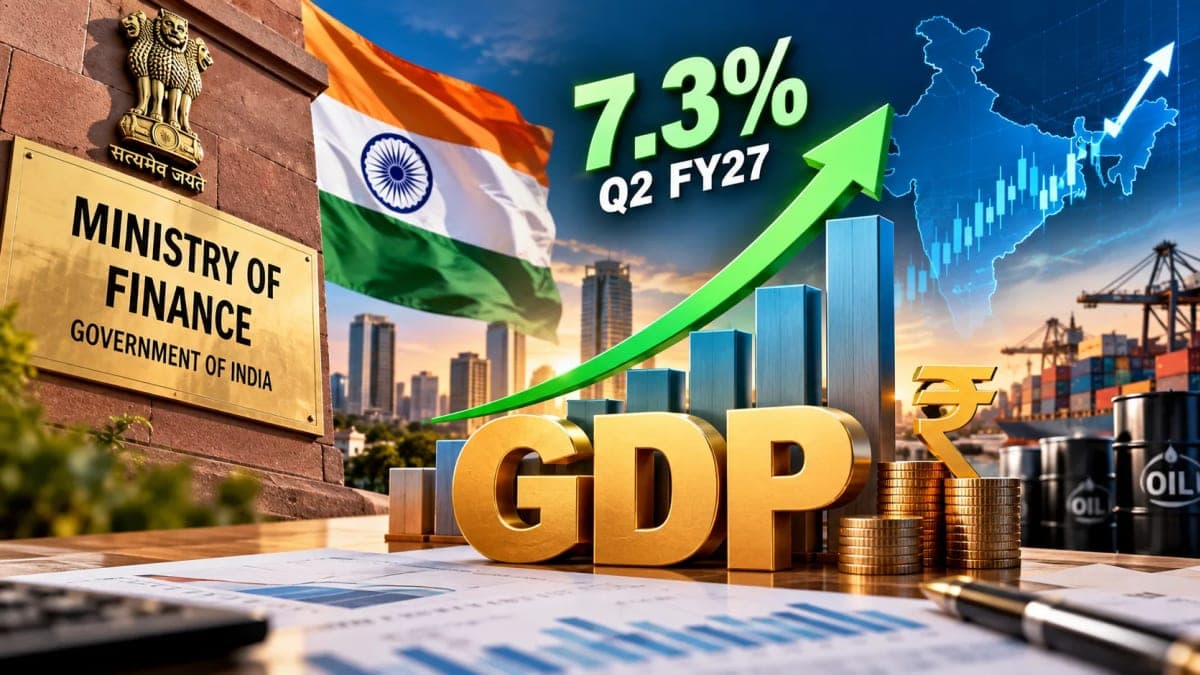
India’s economy could expand by 7.3% in real terms during the second quarter of FY27, according to the Finance Ministry’s latest assessment, suggesting that economic momentum remained relatively strong through the July–September period.
The projection appears in the Finance Ministry’s Monthly Economic Review for September 2026. The ministry’s nowcasting model, introduced in the Economic Survey earlier this year, produced the 7.3% estimate for the fiscal second quarter.
The Department of Economic Affairs has published the September 2026 Monthly Economic Review on its official portal.
Q1 Growth Provides a Strong Starting Point
The latest assessment follows a strong opening quarter for FY27.
India recorded 7.8% real GDP growth in Q1 FY27, giving the economy considerable momentum entering the July–September quarter. The Finance Ministry nevertheless indicated that the pace probably moderated somewhat during Q2.
A 7.3% outcome would therefore represent slower year-on-year growth than Q1, but would still indicate substantial expansion in economic activity.
Finance Ministry Estimate Is Above RBI Projection
One of the most significant features of the ministry’s assessment is the difference from the Reserve Bank of India’s projection.
The Finance Ministry’s 7.3% Q2 estimate compares with the RBI’s 6.4% forecast for the same quarter, according to reports on the September review.
That gap does not mean either figure is an official GDP result. They are projections produced before the government releases the actual national accounts data.
The eventual Q2 GDP release will therefore show whether activity tracked closer to the stronger momentum suggested by the Finance Ministry’s nowcasting model or the more moderate pace anticipated by the central bank.
Domestic Demand and Investment Support the Economy
The Finance Ministry’s assessment points to resilient domestic demand and investment as important supports for economic activity.
Economic indicators during the quarter have also offered signs of continued business momentum. Manufacturing activity, for example, strengthened in September, with the HSBC India Manufacturing PMI reported at 55.1, up from 52.8 in August.
These indicators help explain why the ministry sees continued expansion despite a more uncertain international environment.
Oil Prices and Global Financial Conditions Remain Risks
The positive domestic picture comes with significant external risks.
The Finance Ministry identified higher crude-oil prices, tighter global financial conditions and trade uncertainty as factors capable of affecting India's growth and investment outlook.
Oil prices are particularly important for India because the country depends heavily on imported energy. A sustained increase in crude prices can raise the import bill, create inflationary pressure and increase costs for businesses and consumers.
Tighter international financial conditions can meanwhile influence foreign investment flows, borrowing costs and the rupee.
Trade Uncertainty Could Affect Investment
The ministry also highlighted uncertainty surrounding India's trade relationship with the United States and broader tariff pressures.
According to its assessment, emerging economies face increasing competition for international capital at a time when geopolitical and geoeconomic uncertainty is making investors more selective.
That creates a different challenge from simply generating strong domestic growth: India must also remain attractive to global investors while international trade and capital flows become less predictable.
AI Investment Emerges as Another Economic Consideration
The September review also raised an increasingly important issue: India's position in the global artificial-intelligence investment cycle.
The ministry referred to the limited “India angle” in major global AI-related developments as one factor potentially influencing the country's relative investment attractiveness.
The observation matters because enormous amounts of global capital are being directed toward AI infrastructure, computing capacity, data centres and associated technology.
India’s ability to capture a larger share of such investment could therefore become increasingly relevant to its longer-term productivity and investment story.
Why the 7.3% Estimate Matters
If the Finance Ministry’s estimate is borne out by the official data, a 7.3% Q2 expansion would indicate that India's economy retained considerable momentum after its 7.8% Q1 performance.
But the ministry itself has cautioned against assuming that recent growth will automatically continue. Its September assessment argues that India cannot simply rely on its post-pandemic growth record amid a more difficult global environment.
That makes the composition and durability of growth as important as the headline GDP number.
Balanced Analysis: Strong Domestic Economy Faces External Test
The 7.3% estimate presents an encouraging picture of domestic economic activity, particularly when considered alongside the strong Q1 performance.
At the same time, it remains a nowcast rather than the official Q2 GDP figure.
Several external variables could influence India's trajectory in the coming quarters. Energy prices can affect inflation and the current account, trade disputes can weigh on exports and investment decisions, and tighter global financial conditions can reduce capital flows into emerging markets.
The contrast between the Finance Ministry’s 7.3% estimate and the RBI’s 6.4% projection also illustrates the uncertainty surrounding economic forecasting.
The official GDP figures will ultimately provide the more authoritative measure of how India's economy actually performed during July–September.
What to Watch Next
Attention will now turn to the official Q2 FY27 GDP data and whether it confirms the strong momentum suggested by the Finance Ministry.
Beyond the headline growth figure, investors and policymakers will be watching private consumption, manufacturing, investment and external trade for evidence about the breadth of the expansion.
Crude-oil prices, global interest rates and India's trade environment will also remain important variables for the second half of FY27.