Indian Stock Market Extends Historic Losing Run
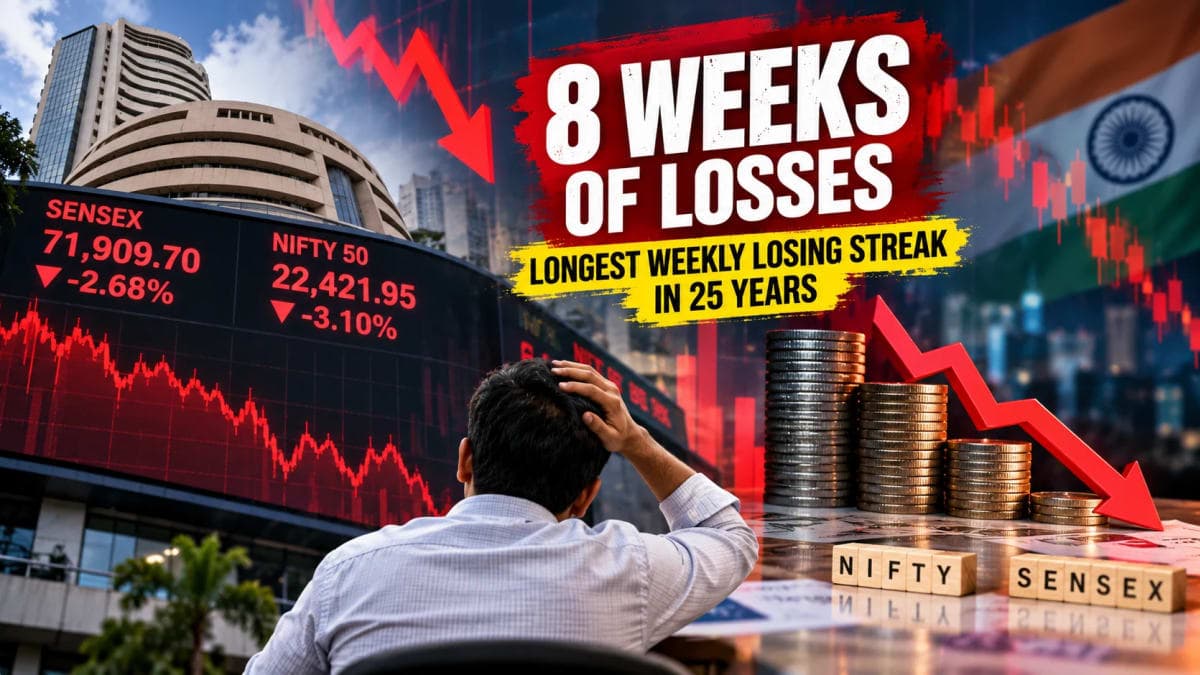
Indian benchmark indices ended another difficult week with the Nifty 50 and BSE Sensex declining for an eighth consecutive week, marking their longest weekly losing streak in roughly a quarter of a century.
The holiday-shortened trading week ended on Thursday, October 1, as Indian exchanges remained closed on Friday for Gandhi Jayanti.
For the week, the Sensex dropped 1,986.04 points, or 2.68%, to 71,909.70, while the Nifty 50 lost 718.55 points, or 3.10%, to finish at 22,421.95.
Over the entire eight-week decline, Reuters reported that the Nifty has fallen approximately 8.7%, while the Sensex has declined around 8.4%.
Thursday's Sell-Off Deepens the Pressure
The final trading session of the week underlined the fragile mood on Dalal Street.
On Thursday, the Sensex fell as much as roughly 1.5% intraday before recovering part of its losses. It eventually closed 570.59 points, or 0.8%, lower at 71,909.70. The Nifty finished around 0.9% lower at 22,421.95.
Volatility also increased sharply. The India VIX, a commonly watched gauge of expected market volatility, climbed about 7% during Thursday's session to reach its highest level in more than three months.
The weakness was not confined to India's biggest companies. The Nifty Midcap 100 declined 3.5% for the week, while the Nifty Smallcap 100 lost 3.3%. Both broader indices extended their weekly declines to four consecutive weeks.
Foreign Investors Continue to Pull Money From Indian Equities
Persistent foreign selling has emerged as one of the biggest pressures on Indian stocks.
Foreign institutional investors sold approximately ₹34,966 crore of Indian equities during the week, extending their selling streak to six weeks, according to market data cited by Moneycontrol. Domestic institutional investors provided a significant counterweight, purchasing approximately ₹33,455 crore during the same period.
Reuters reported that foreign investor outflows from Indian equities have reached a record $27.8 billion in 2026.
One major reason is the sharp rise in US government bond yields. When yields on comparatively low-risk US assets increase, emerging-market equities can become less attractive to global investors, encouraging capital to move away from markets such as India.
The US 10-year Treasury yield recently climbed above 5%, reaching levels not seen in more than two decades.
Crude Oil Near $100 Adds Another Challenge
High crude oil prices are creating an additional concern for Indian markets.
Oil has traded around the $100-per-barrel level amid continuing geopolitical uncertainty in West Asia.
That matters particularly for India because the country imports a substantial share of its crude requirements. Sustained increases in global oil prices can raise India's import bill, contribute to inflationary pressure and weigh on the rupee.
Investors therefore face a difficult combination: expensive energy, elevated global interest rates and continued foreign capital outflows.
Rupee Weakness Adds to Investor Concerns
Currency pressure has developed alongside falling equities.
The Indian rupee weakened 50 paise during the week to close at 96.32 against the US dollar, compared with 95.82 on September 25. During the week it traded between 95.74 and 96.32.
A weaker rupee can further complicate conditions because imported commodities priced in dollars—including crude oil—become more expensive in domestic currency terms.
For foreign investors, currency depreciation can also reduce dollar-denominated returns from Indian assets.
Auto and Consumer Stocks Lead Weekly Declines
Selling was widespread across sectors.
The Nifty Consumer Durables index fell 6%, making it the week's weakest major sectoral index, while the Nifty Auto index dropped 5.8%.
Metal, FMCG and PSU banking indices each lost more than 4%, while real estate, healthcare, infrastructure and oil-and-gas indices declined more than 3%.
Automobile shares faced additional pressure after September vehicle-sales figures disappointed market expectations. During Thursday's session, Bajaj Auto dropped sharply, while Mahindra & Mahindra and Maruti Suzuki also suffered significant losses.
IT Emerges as the Rare Bright Spot
Technology shares provided one of the few areas of relative strength.
The Nifty IT index gained approximately 0.5% over the week, making it the only sectoral index to finish higher, according to market data.
IT shares benefited partly from softer-than-expected US inflation data, which provided some support to technology stocks despite the broader risk-off environment.
The divergence illustrates that the sell-off has not affected every industry equally, even though overall market breadth has remained weak.
Nearly ₹15 Lakh Crore in Market Value Erased During the Week
The magnitude of the decline can also be seen in overall market capitalisation.
The combined market value of companies listed on the BSE fell by nearly ₹15 lakh crore during the week, according to Moneycontrol. Major companies including Reliance Industries, Titan, Bajaj Finance and Bharti Airtel contributed significantly to the decline.
Across the entire eight-week correction, estimates cited by The Economic Times indicate that approximately ₹26 lakh crore of market capitalisation has been erased.
Market-capitalisation losses represent changes in the quoted value of listed shares rather than an equivalent amount of cash physically leaving the market.
Why an Eight-Week Losing Streak Matters
An eight-week sequence of declines is unusual for India's benchmark indices.
The duration makes the current correction historically notable, but the number of consecutive losing weeks alone does not determine what happens next.
What makes the current period more significant is the combination of several pressures occurring simultaneously: foreign capital outflows, high oil prices, rising international bond yields, rupee weakness and concerns about domestic inflation.
Those forces can affect both equity valuations and corporate earnings expectations.
RBI Policy Decision Becomes the Next Major Trigger
Investors will now focus closely on the Reserve Bank of India's next monetary-policy decision.
A Reuters poll cited in market reporting showed expectations that the RBI could raise the repo rate by 25 basis points to 5.50% as policymakers respond to inflation risks.
A rate increase could help address inflationary pressures, but higher borrowing costs can also affect economic activity, corporate financing and equity valuations.
The market will therefore be watching both the RBI's decision and its commentary about inflation, oil prices and economic growth.
What Investors Will Watch Next
The direction of US Treasury yields, crude oil prices, foreign institutional flows and the rupee is likely to remain central to market sentiment when trading resumes.
Corporate earnings will also become increasingly important as investors assess whether individual companies can justify their valuations despite a more difficult macroeconomic environment.
Any meaningful decline in oil prices or global bond yields could ease some of the pressure on Indian assets. Conversely, further increases could prolong volatility.
Balanced Analysis: Historic Streak Does Not Automatically Mean a Market Crisis
Eight consecutive weekly declines make the current sell-off historically unusual, but the comparison with past market crises requires care.
A long losing streak measures duration, not necessarily the severity of the decline. The Nifty has fallen about 8.7% across the eight weeks, according to Reuters, which is substantial but different in character from the sudden collapses seen during major financial shocks.
There are also counterweights. Domestic institutional investors have continued buying equities aggressively, helping absorb much of the foreign selling during the latest week.
At the same time, the combination of elevated oil prices, global yields and currency weakness means a durable recovery may depend on more than India's domestic economic fundamentals alone.
The next few weeks could therefore be determined less by the historic eight-week statistic itself and more by whether the external pressures responsible for it begin to ease.