India's property insurance market is beginning to turn more expensive after severe floods in Gujarat generated substantial claims and added pressure to insurers already dealing with losses from natural catastrophes and industrial incidents.
Industry estimates put insurance losses from the Gujarat floods at around ₹5,000 crore, with property-related claims accounting for a significant portion of the damage. The losses are now contributing to a reassessment of how insurers price fire and natural-catastrophe risks, particularly for large industrial assets.
According to Bajaj General Insurance, property insurance premium rates are hardening by nearly 25–30%. Crucially, however, this does not mean base natural-catastrophe rates themselves have increased by that amount.
Instead, insurers are reducing the steep discounts that had previously kept effective premiums low.
Property Insurance Rates Harden by Nearly 25–30%
Gurdeep Singh Batra, head of commercial underwriting at Bajaj General Insurance, said the combination of Gujarat flood claims and increasing risk in the Himalayan region was influencing pricing.
“In view of the losses and flood claims in Gujarat and the rising risk in the Himalayan region, the rates in property insurance are hardening mainly with reduction in discounts.”
Batra said premiums were hardening by nearly 25–30%, while underlying NATCAT—or natural-catastrophe—base rates remained unchanged.
This distinction is important for businesses buying property insurance.
The market isn't necessarily experiencing a uniform 25–30% increase in published base rates. Instead, customers that previously received very large discounts may now be offered smaller concessions, resulting in higher final premiums.
Gujarat Flood Claims Estimated at Around ₹5,000 Crore
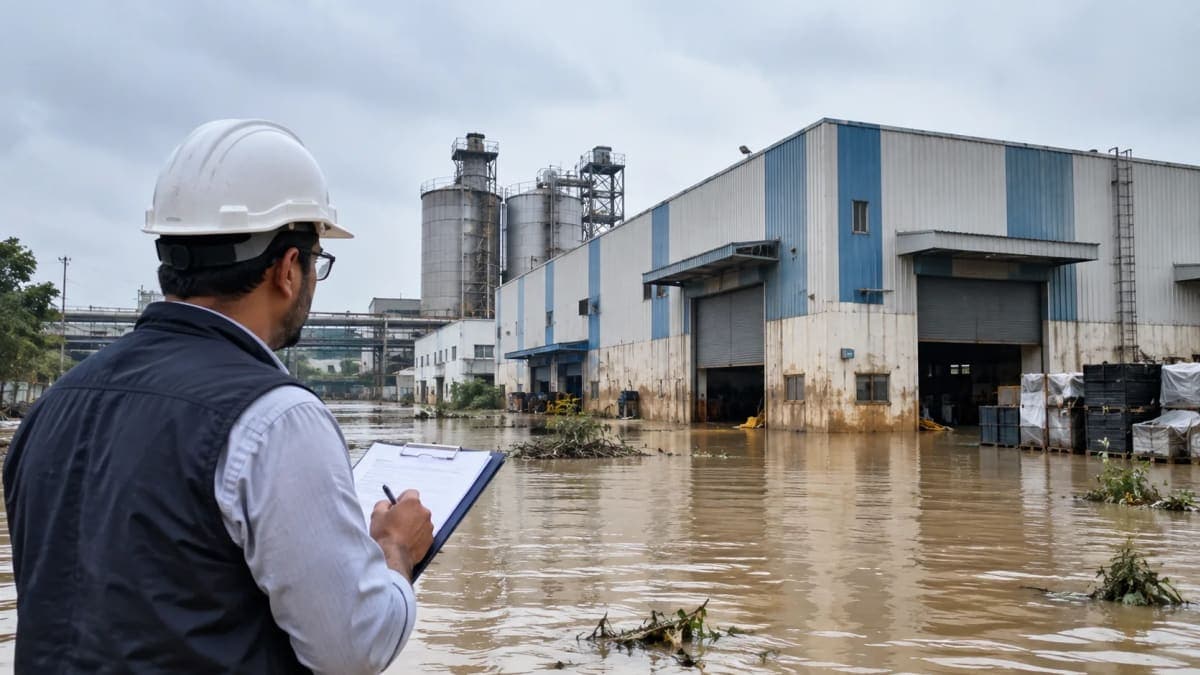
The shift follows extensive flooding and waterlogging in Gujarat.
Earlier industry estimates indicated that insurers could face approximately ₹5,000 crore in claims, with property insurance expected to account for most of the losses and motor claims following.
Among the major industrial losses is Welspun Living's Vapi facility.
Operations at the plant were disrupted from July 23, and the company's assets and materials were insured. People familiar with the matter told The Economic Times that Welspun had filed a potential insurance claim of approximately ₹1,000 crore.
According to that report, HDFC ERGO is the lead insurer, accounting for around 30% of the insured limit. The claim figure was attributed to people familiar with the matter and should therefore be understood as a reported potential claim rather than a confirmed final insurance payout.
Why Insurers Are Cutting Discounts
The Gujarat floods arrived after an extended period of intense price competition in India's property insurance market.
Insurers had been offering substantial discounts, particularly when competing for large industrial accounts.
The Insurance Regulatory and Development Authority of India (IRDAI) had previously warned general insurers about aggressive pricing in the fire-insurance market after complaints that discounts on some large industrial risks had reached as high as 99%.
The regulator's concern was that excessive discounting could undermine underwriting discipline and insurers' financial health.
Recent catastrophe losses are now making that pricing strategy more difficult to sustain.
Natural-Catastrophe Cover Is Seeing Greater Pressure
The price adjustment isn't necessarily uniform across every component of property insurance.
Industry experts say the increase is currently more pronounced for NATCAT coverage, which protects against natural catastrophes, than for FLEXA coverage, which covers fire, lightning, explosion or implosion, and aircraft-related risks.
Some non-life insurers have also established minimum pricing for the natural-catastrophe component of fire insurance amid concerns about previous levels of discounting.
The implication is that businesses with greater exposure to floods and other natural hazards could face greater pricing pressure than relatively lower-risk properties.
Location Could Become More Important in Insurance Pricing
One consequence of the Gujarat losses could be greater emphasis on where an insured property is located.
Industry participants told The Economic Times that the losses strengthened the argument for differentiating premiums according to location and catastrophe exposure rather than allowing competition to revolve predominantly around discounts.
That could matter particularly for industrial facilities located in areas with substantial exposure to floods and other natural hazards.
Two factories with similar replacement values may present very different risks if one is located in a flood-prone industrial zone while another has considerably lower catastrophe exposure.
A shift toward more granular risk-based pricing could therefore create wider differences between premiums charged for otherwise comparable industrial properties.
Why Rates Stayed Low Until Now
The property insurance market had been under pricing pressure for roughly a year.
One reason was the absence of a sufficiently large loss event that would force insurers to reconsider aggressive discounting.
Another was abundant insurance and reinsurance capacity.
More reinsurers have entered the Indian market through GIFT City, adding to capacity supplied by the state-owned reinsurer, foreign reinsurance branches and domestic reinsurers.
More capacity generally increases competition for insurance business, which can push premiums downward.
But catastrophe losses change that calculation.
Insurers have recently faced floods in Gujarat, Assam and Odisha, along with accidents at manufacturing facilities. Those events are now contributing to reduced discounts in fire and property insurance.
The Market's View Changed Between August and September
The timing of the shift is particularly noteworthy.
In early August, when the Gujarat losses were initially being assessed, industry participants did not expect the estimated ₹5,000 crore claims to produce higher property insurance premiums.
The market was considered too competitive and heavily discounted for one event to immediately trigger a pricing correction.
By September, however, the picture had changed.
Additional catastrophe and large-loss events increased pressure on insurers, and the market began reducing discounts.
That progression helps explain why the current increase cannot be attributed exclusively to Gujarat.
The Gujarat floods were an important catalyst, but they occurred within a broader environment of rising catastrophe losses and pressure on insurers' underwriting results.
Insurers Are Already Facing Underwriting Pressure
The pricing correction also comes as India's general insurance industry faces substantial underwriting losses.
General insurers collectively reported underwriting losses of ₹45,279 crore in FY26, compared with ₹31,043 crore in FY25, according to recent industry data reported by Financial Express. Gross direct premium income increased 9% to ₹3.36 lakh crore during the period, but underwriting profitability remained under pressure.
An underwriting loss essentially means that claims and associated operating expenses exceed the premiums earned from the underlying insurance business, before investment income and other factors are considered.
Large catastrophe claims can add further pressure, particularly when risks were originally priced at heavily discounted levels.
Reinsurers Could Influence What Happens Next
Reinsurance will be an important factor in determining whether the current pricing correction persists.
Reinsurers effectively insure insurance companies by taking on portions of large risks. Their capacity is particularly important for high-value industrial properties where potential losses can be enormous.
Industry participants say global reinsurers' response to recent catastrophe losses could therefore influence the eventual scale of the pricing adjustment for major industrial accounts.
If reinsurers demand higher prices or tighter terms for catastrophe exposure, direct insurers may ultimately pass some of that additional cost on to corporate policyholders.
Not Every Property Will See the Same Increase
Businesses should not interpret the reported 25–30% hardening as an automatic premium increase applying to every property policy in India.
India operates under a free-pricing regime for these risks, meaning there is no single fixed market rate.
Hanmant Dudle, senior director and head of property, construction and surety practice at Lockton India, said the size of any increase would vary from one risk to another.
Pricing can depend on factors including the type and value of the property, its location, catastrophe exposure, claims history, safety measures, policy limits and the amount of insurance and reinsurance capacity available.
That means a flood-exposed industrial facility seeking a large NATCAT limit could experience a very different renewal outcome from a lower-risk commercial property.
What This Means for Indian Businesses
For companies, the most significant development isn't simply that insurance is becoming more expensive.
It is that insurers appear to be moving away from a period of extreme discount-driven competition toward more risk-sensitive pricing.
Large manufacturers, infrastructure operators and businesses with assets exposed to floods and other natural catastrophes may consequently face closer scrutiny during policy renewals.
Companies seeking larger insurance limits for catastrophe-prone assets could also find that insurers pay greater attention to location, flood exposure and risk-mitigation measures.
The Gujarat floods have therefore become an important test for India's property insurance market. With claims estimated around ₹5,000 crore and other catastrophe losses adding to underwriting pressure, insurers are beginning to price risk more cautiously—even if the adjustment is currently happening primarily by taking away discounts rather than dramatically rewriting base rates.