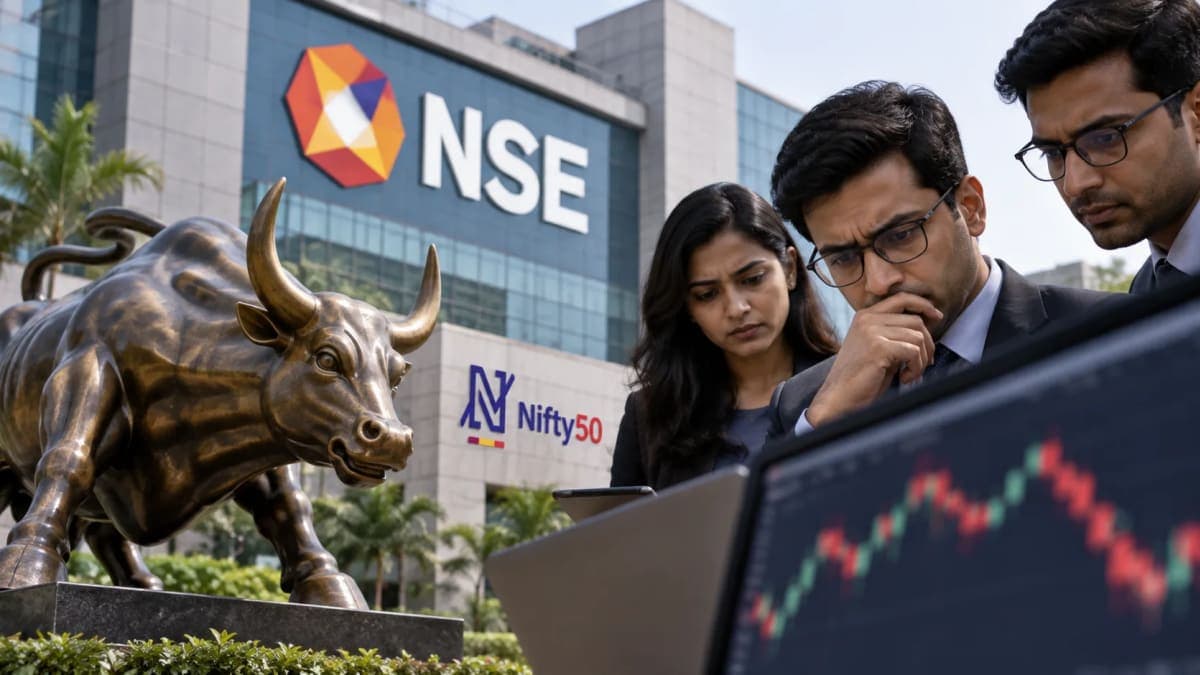
The National Stock Exchange of India (NSE) IPO was subscribed 43% on its opening day on September 17, 2026, a relatively measured start for one of the biggest public issues India has seen.
By the end of Day 1, investors had placed bids for about 3.84 crore shares against roughly 8.86 crore shares available for public bidding, according to subscription data reported after the close. Non-institutional investors showed the strongest early participation, while qualified institutional buyers were much slower to enter.
The headline number, however, needs context. Institutional investors often place large IPO orders later in the bidding window, and NSE still has two bidding days remaining. The issue closes on September 21. Reuters cited Fident Asset Management founder Aishvarya Dadheech as cautioning against drawing conclusions from first-day numbers because institutions typically participate closer to the end of an IPO.
What makes the next two sessions particularly interesting is the contrast between the relatively modest public-book response and the substantial demand NSE received before the IPO even opened.
NSE IPO Day 1: how each category responded
The overall public book ended Day 1 at 0.43 times subscription. Qualified institutional buyers, excluding anchor investors, subscribed 0.19 times their allocated portion. Non-institutional investors reached 0.72 times, while the retail portion was subscribed 0.44 times. The employee category was close to fully subscribed at 0.98 times, according to data compiled by The Economic Times.
Within the non-institutional segment, demand was stronger among smaller NII applications. Financial Express reported that the ₹2 lakh-₹10 lakh category reached about 94% subscription, while larger applications were at roughly 62%.
That distribution makes the first-day result more nuanced than the 43% headline suggests.
Retail and non-institutional investors participated reasonably actively, while the biggest gap was in the QIB book. Whether institutions significantly increase their bids on the remaining days will therefore have a major influence on the final subscription multiple.
A ₹22,562 crore IPO with no fresh capital for NSE
NSE's IPO is unusual not just because of its size.
The public offering consists entirely of an offer for sale (OFS) of up to 126,436,650 equity shares by existing shareholders. NSE itself is not issuing fresh shares to raise growth capital from the transaction.
At the upper end of the price band, the issue is worth about ₹22,561.57 crore, making it the second-largest IPO in Indian market history after Hyundai Motor India's 2024 offering.
The price band has been set at ₹1,700-₹1,785 per share, with a face value of ₹1. Retail investors can bid for a minimum lot of eight shares, which means a minimum investment of ₹14,280 at the upper price band.
Eligible employees receive a discount of ₹170 per share.
The IPO opened on September 17 and closes on September 21. NSE's issue-information page says QIB and NII bidding on the final day closes at 4 pm, while the retail and employee window continues until 7 pm.
The anchor book tells a different story
One reason Day 1 shouldn't be viewed in isolation is what happened before public bidding started.
NSE raised approximately ₹6,746 crore from anchor investors, with more than 150 investors participating in the anchor book. The investor group included major domestic and international institutions.
Reported participants included Life Insurance Corporation of India, Fidelity, Abu Dhabi Investment Authority, Norges Bank and other institutional investors.
That doesn't guarantee similar demand from the remaining QIB book. Anchor allocation and the public institutional book are separate portions of an IPO.
It does, however, show that the issue had already attracted substantial institutional capital before Day 1.
This makes the 19% QIB subscription on the opening day less straightforward than it might appear. The more meaningful test will be where institutional demand stands when bidding closes on September 21.
NSE's scale is the attraction — but also part of the valuation debate
For investors, NSE isn't a conventional IPO story about a company raising money to build factories, acquire customers or reduce debt.
It is an opportunity to own part of the market infrastructure through which a large share of India's securities trading takes place.
NSE's own offer documents identify its market leadership, operating scale, technology infrastructure, profitability and cash generation among its strengths. At the same time, the Red Herring Prospectus flags dependence on trading activity and regulatory developments among material risks.
That combination matters because an exchange's economics are closely tied to market activity.
Higher trading volumes can support transaction revenue and related businesses. But regulatory changes that alter derivatives trading, transaction economics or market structure can affect volumes and therefore revenue.
Reuters reported that NSE is seeking a valuation of up to roughly $46 billion, with the pricing coming against a backdrop of lower options-trading activity and increasing competition from BSE.
So investors aren't simply deciding whether NSE is an important company. Its importance to India's capital markets is well established. The question in the IPO is what investors are willing to pay for that business under the current regulatory and competitive environment.
Why derivatives regulation matters to the IPO
The timing of the listing adds another layer to the investment case.
Indian regulators have introduced measures affecting equity derivatives as they seek to address risks surrounding highly speculative retail participation. For an exchange with substantial exposure to derivatives activity, changes in contract structures, trading frequency or volumes can affect transaction-linked revenue.
NSE's RHP itself highlights regulatory change as a risk rather than treating future trading volumes as guaranteed.
Competition is another variable.
BSE has been trying to expand its position in equity derivatives, creating a more competitive market than the one NSE operated in when its dominance was even stronger. Reuters identified both competition from BSE and reduced options activity as factors investors are weighing around NSE's valuation.
None of this means the first-day subscription figure can be attributed to one particular concern. Public bidding data shows how much investors applied for; it does not reveal why individual investors chose to bid or stay away.
Claims that the 43% subscription was specifically caused by valuation, regulation or competition should therefore be treated as interpretation rather than established fact.
NSE's IPO also closes a long chapter
The listing has been years in the making.
NSE's IPO ambitions were delayed amid regulatory proceedings connected with issues including its colocation and dark-fibre cases. NSE's FY2025-26 disclosures show that the company had previously filed settlement applications relating to the colocation and dark-fibre matters.
In March 2026, it submitted revised settlement terms involving a cumulative amount of ₹1,491.21 crore, according to NSE's own financial disclosure.
The exchange subsequently moved ahead with the listing process. Its investor-relations records show the Red Herring Prospectus filing on September 10 and the price-band announcement on September 11. NSE's offer-document repository also records a SEBI observation letter dated September 4, 2026 and an in-principle listing approval from BSE dated July 20.
That history helps explain why the IPO is attracting attention beyond its ₹22,562 crore size.
What happens after Day 1?
The issue remains open on September 18 and September 21, so the first-day figure is only an early snapshot.
The biggest number to watch is the QIB book.
Institutions had subscribed only 19% of the non-anchor portion by the end of Thursday. If institutional orders arrive later in the process, the overall subscription multiple can change considerably because of the size of that category. Conversely, Day 1 alone cannot establish what final institutional demand will look like.
The retail book also deserves attention. At 44%, retail participation was ahead of QIB demand but still below full subscription after the first session. NII demand, at 72%, was the strongest of the three main public categories.
The scheduled listing date is September 24, 2026, according to the current IPO timetable reported by The Economic Times and Reuters.
For now, the cleanest reading of Day 1 is also the simplest: NSE's much-awaited IPO did not fill its public book immediately, but early bidding was uneven rather than absent. Non-institutional and retail investors provided much of the demand, while institutions largely stayed on the sidelines after a sizeable anchor allocation.
The final two bidding sessions will show whether that was merely normal IPO timing or a sign that investors are taking more time to assess NSE's valuation and regulatory risks.
Claims and figures requiring caution
The 43% overall Day 1 subscription, 19% QIB, 72% NII and 44% retail figures are supported by reported end-of-day subscription data. Minor differences exist in some reports — Reuters, for example, reported 42% overall, 42% retail and 70% NII based on an earlier data snapshot — while later figures show 43%, 44% and 72%, respectively.


