Technology Meets Tradition at Ujjain Shop Opening
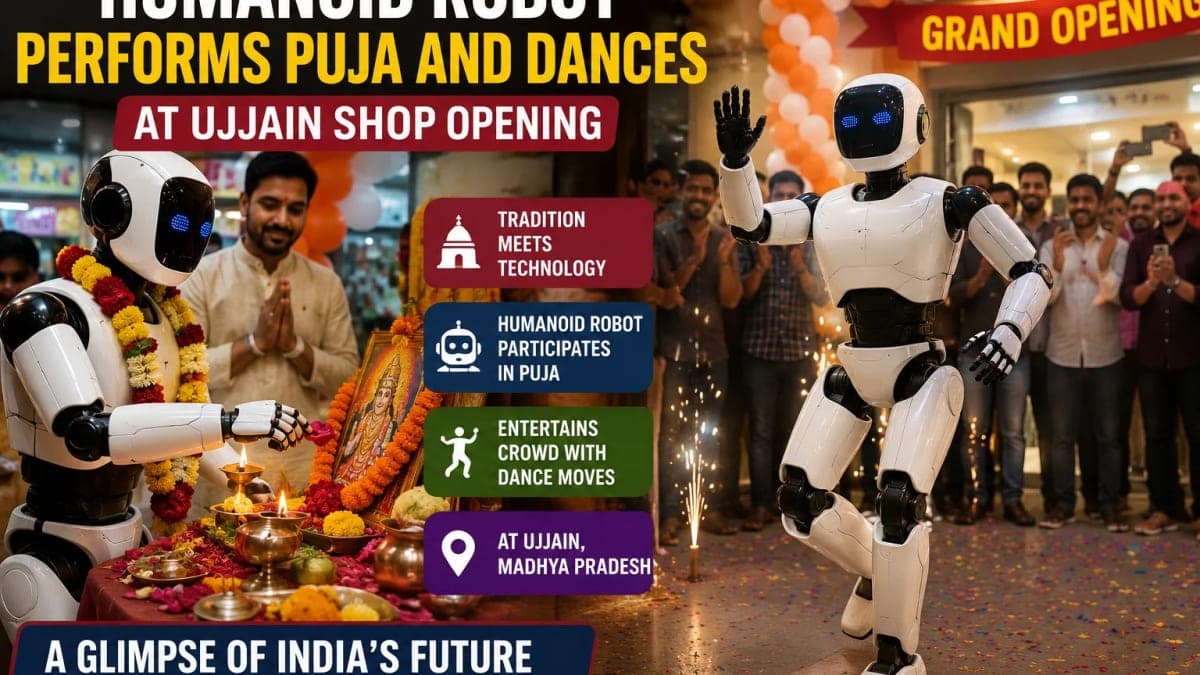
A routine commercial inauguration in Ujjain turned into an unusual technology showcase when a humanoid robot became part of the opening celebrations.
Instead of being displayed simply as a technology exhibit, the robot participated in activities associated with the ceremony. It performed actions during the puja and later entertained those present with dance movements.
The combination of a futuristic-looking machine and a traditional Indian ceremony made the inauguration stand out from a conventional shop opening.
Humanoid Robot Participates in Puja
Puja ceremonies are commonly organised when new shops, offices and businesses are inaugurated in India, with owners seeking an auspicious beginning for their ventures.
What made the Ujjain event different was the involvement of the humanoid robot.
The machine's participation offered a striking visual contrast: a technology associated with robotics and automation appearing alongside a centuries-old cultural tradition.
Rather than replacing the ceremony itself, the robot appears to have been incorporated as a distinctive attraction within the inauguration.
Robot's Dance Adds Entertainment to the Event
The robot's role was not limited to the ceremonial activity.
It also demonstrated dance-like movements, turning the inauguration into a technology and entertainment showcase for people attending the event.
Humanoid robots are designed to resemble aspects of human appearance or movement. Depending on their capabilities, such machines can walk, move their arms, interact with people or execute programmed sequences.
Public demonstrations are therefore becoming an effective way of introducing robotics to people who might otherwise encounter such technologies only through online videos or technology exhibitions.
Why the Ujjain Robot Event Matters
On its own, a robot appearing at a shop inauguration is a relatively small local event. Its broader significance comes from what it represents about changing public interaction with emerging technologies.
Robotics was once associated primarily with factories, research institutions and highly specialised engineering applications. Advances in sensors, computing, artificial intelligence and robotic hardware are gradually expanding potential applications into hospitality, education, customer engagement and entertainment.
Events such as the one in Ujjain also show how businesses can use emerging technologies as attention-grabbing promotional tools.
For a newly opened shop, an unusual robot demonstration can generate curiosity among visitors while creating visually distinctive material for social media.
Robots Are Becoming More Visible in Public Spaces
Industrial robots have been used in manufacturing for decades, but humanoid machines represent a different challenge.
They are designed to operate in environments created primarily for humans, which requires machines to deal with movement, balance, object handling and human interaction.
Recent advances in artificial intelligence have further increased interest in combining humanoid robotic hardware with systems capable of understanding language and interpreting their surroundings.
However, the impressive movements seen during demonstrations should not automatically be interpreted as evidence that robots possess human-like understanding.
Some public performances may involve predefined routines, remote operation or carefully programmed sequences.
Tradition and Technology Can Coexist — but Context Matters
The robot's participation in a religious ceremony is likely to generate different interpretations.
Some viewers may see the event simply as a creative demonstration showing how technology can be incorporated into traditional celebrations. Others may consider the religious setting significant and believe that technological novelty should remain separate from rituals carrying spiritual meaning.
Both reactions underline an important question that is likely to become more common as sophisticated machines enter everyday environments: where should society draw the line between technological participation, entertainment and culturally meaningful human activities?
The Ujjain inauguration does not settle that debate, but it provides an interesting example of how quickly those questions are moving from science-fiction scenarios into real-world situations.
Balanced Analysis: Spectacle Today, Practical Applications Tomorrow?
The robot's appearance at the Ujjain shop opening primarily demonstrates the public appeal of humanoid technology.
For businesses, robots can provide novelty, attract visitors and generate social-media attention. They can also make complex technology feel more accessible to ordinary consumers.
At the same time, a ceremonial performance should be distinguished from practical autonomous robotics.
Dancing or completing predetermined gestures in a controlled environment is considerably different from performing complex tasks reliably in unpredictable workplaces.
The real test for humanoid robotics will therefore be whether these machines can progress beyond demonstrations and become safe, affordable and genuinely useful in areas such as manufacturing, logistics, healthcare support, hospitality and customer service.
For now, the Ujjain shop opening offers a striking glimpse of something increasingly visible in India and around the world: technology entering spaces where tradition, commerce and everyday social life intersect.
This article is based on reporting published by India Today.