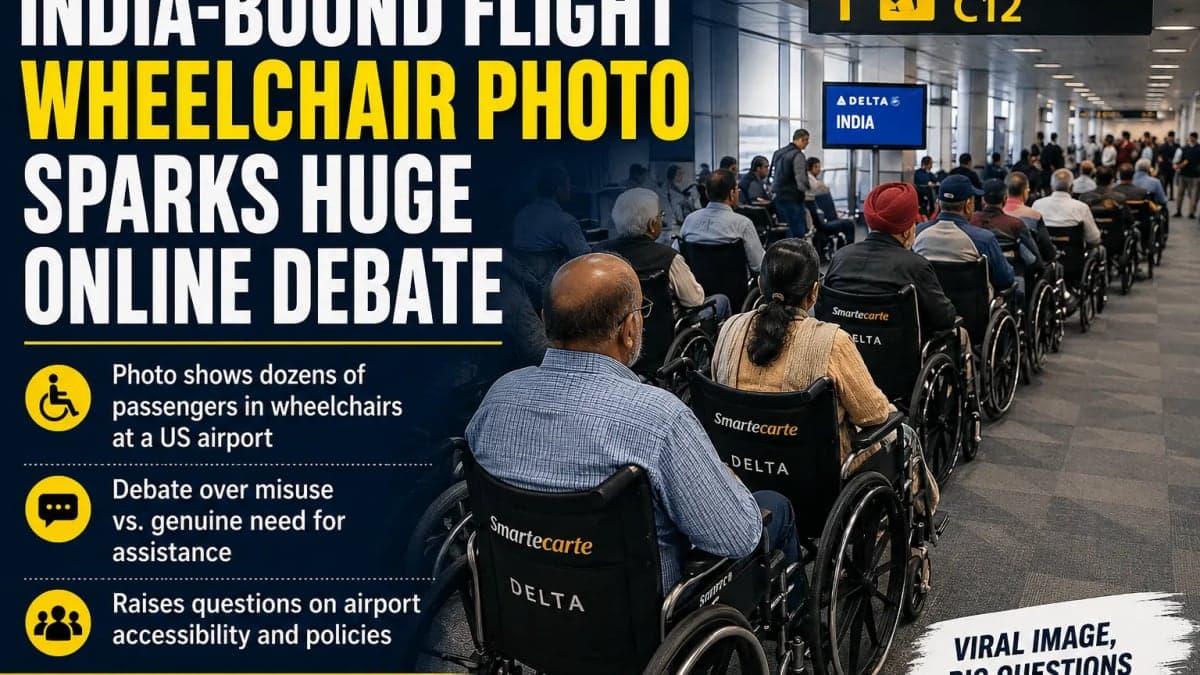
Viral Wheelchair Photo Puts Airport Assistance Under Spotlight
A striking airport photograph has become the centre of an online argument over accessibility, passenger behaviour and the challenges airlines face in providing mobility assistance.
The image, which circulated widely on social media on August 21, shows rows of passengers sitting in wheelchairs in what appears to be a departure area at a US airport. They were reportedly waiting to board an India-bound flight. The photograph accumulated hundreds of thousands of views as users debated why such a large number of travellers appeared to require mobility support.
Some social-media users interpreted the scene as evidence that passengers were taking advantage of a free service. Others pushed back, arguing that drawing conclusions about a person's physical condition from a single photograph risks unfairly targeting elderly and disabled travellers.
The controversy has therefore developed into a broader question: How should airlines protect accessibility services from possible misuse without making genuine passengers prove that they deserve assistance?
Why India-Bound Flights May See High Wheelchair Demand
One important factor is the passenger profile on long-distance routes connecting the United States and India.
These flights can carry significant numbers of older travellers, including parents visiting children and relatives abroad. Large international airports can also require passengers to cover considerable distances between check-in, security, immigration and departure gates.
Being able to stand or walk a short distance does not necessarily mean someone can comfortably navigate an entire airport.
An elderly passenger with arthritis or reduced stamina, for example, may still need assistance across a large terminal. Similarly, conditions involving the heart, joints, recovery from surgery or other health limitations may not be visible to other passengers.
That distinction is important because a photograph alone cannot establish why any individual is using a wheelchair.
Why Critics Believe the System Can Be Misused
At the same time, concerns about misuse of wheelchair assistance are not entirely new.
Airport and airline workers have previously raised questions about travellers requesting wheelchairs despite being capable of navigating terminals independently. Under US air-travel accessibility rules, passengers generally cannot be required to provide medical documentation simply to obtain wheelchair assistance, and the service is provided without a separate charge.
Wheelchair assistance can also involve more than transportation through a terminal. Depending on the airport and circumstances, passengers may receive staff escorts and priority-related assistance during parts of their journey.
Critics argue that these conveniences can encourage some passengers who do not genuinely require mobility assistance to request the service.
If that happens on a significant scale, it could stretch airport staffing and potentially reduce the availability or speed of assistance for passengers who genuinely depend on it.
A Viral Photograph Cannot Diagnose Disability
The strongest limitation of the viral image is also the simplest: viewers know very little about the people pictured.
A traveller may appear physically fit while experiencing chronic pain, cardiovascular problems, neurological conditions, limited endurance or another non-visible disability.
Similarly, an older passenger might be able to walk from a wheelchair to an aircraft seat but still be unable to comfortably cover the much longer distances inside a major international terminal.
For this reason, the ability to stand or walk briefly should not automatically be treated as evidence that wheelchair assistance was unnecessary.
The viral photograph therefore raises legitimate questions about airport systems, but it does not provide enough evidence to determine whether any specific passenger was abusing them.
Should Airlines Charge for Wheelchair Assistance?
One solution proposed in online discussions is introducing a fee to discourage people from requesting wheelchairs simply for convenience.
The idea has an obvious attraction: passengers who do not genuinely need assistance may be less likely to request it if there is a significant cost attached.
However, such a policy could create a different accessibility problem.
Charging everyone could penalise elderly passengers, people with disabilities and travellers with legitimate but difficult-to-document medical limitations. Requiring medical certificates could also add another hurdle to travel for passengers who need support.
The policy challenge is therefore more complicated than simply making wheelchair assistance expensive.
Previous Incidents Show Why Accessibility Matters
The debate also comes against the backdrop of serious incidents involving passengers who did not receive expected mobility assistance.
In February 2024, an 80-year-old passenger at Mumbai airport reportedly had to walk after wheelchair assistance was unavailable. He later collapsed while heading toward immigration and died. India's Directorate General of Civil Aviation subsequently imposed a ₹30 lakh penalty on Air India.
That episode demonstrates why wheelchair services cannot be treated merely as an airport convenience. For vulnerable travellers, timely mobility assistance can be a genuine safety requirement.
Why This Debate Matters
The controversy highlights a difficult balancing act facing airlines and airports worldwide.
Accessibility systems are deliberately designed to avoid forcing disabled passengers to repeatedly justify their conditions. Making assistance difficult to obtain could discourage vulnerable travellers from requesting the help they genuinely require.
But systems based largely on passenger requests can also become strained if people use them primarily for convenience.
Airlines therefore have to pursue two goals simultaneously: maintain easy and dignified access for passengers who need assistance while managing staffing and procedures in ways that discourage deliberate misuse.
Technology, better pre-booking systems, improved staffing forecasts and clearer distinctions between different kinds of mobility and airport-navigation assistance could potentially help without turning every wheelchair request into a medical investigation.
Balanced Analysis
The viral photograph is powerful precisely because dozens of wheelchairs gathered in one place look unusual. But unusual does not automatically mean fraudulent.
There may indeed be passengers who request airport wheelchairs mainly because they make a difficult international journey easier. That possibility deserves attention, particularly when excessive demand could affect passengers with serious mobility limitations.
At the same time, judging individuals solely by whether they appear capable of walking risks misunderstanding disability and age-related mobility problems.
The more useful debate is therefore not about deciding from a photograph who is "genuinely disabled." It is about designing an airport-assistance system that is difficult to exploit but easy to access when help is genuinely needed.
This article is based on reporting published by Moneycontrol.