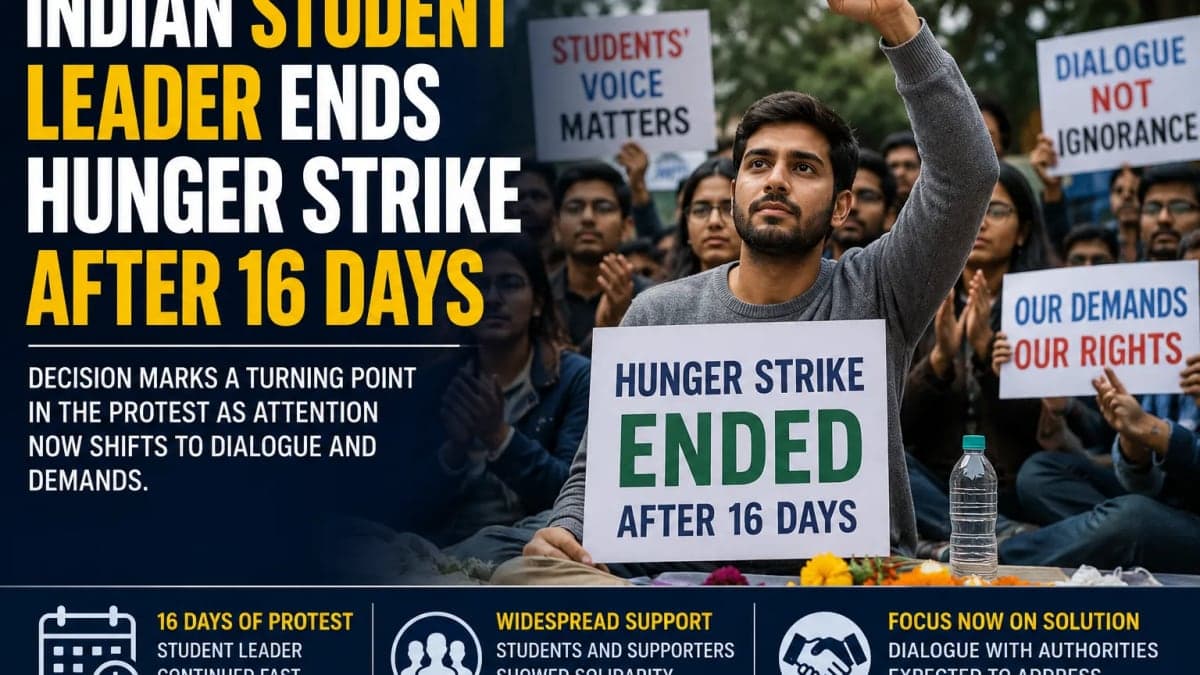
Student Leader Ends 16-Day Hunger Strike
An Indian student leader has ended a hunger strike after continuing the protest for 16 days, concluding a prolonged form of demonstration that had placed sustained attention on the issues behind the agitation.
The end of the fast represents an important moment in the protest. A hunger strike lasting more than two weeks carries both symbolic significance and serious physical consequences, making the decision to conclude such an action noteworthy regardless of the dispute that triggered it.
However, ending a hunger strike does not necessarily mean that the wider disagreement has been resolved. Much depends on what led the student leader to stop the fast and whether there have been assurances, negotiations or other developments concerning the protesters' demands.
Why Hunger Strikes Carry Political Significance in India
Hunger strikes have a long history in Indian political and social movements.
Rather than relying on physical confrontation, protesters using this method place their own health at risk to increase moral and public pressure on authorities. The tactic has been employed in movements involving students, workers, activists and political leaders.
For student movements in particular, prolonged fasting can transform an issue that initially concerns a university or local administration into a subject attracting much broader attention.
A 16-day hunger strike therefore represents a considerable escalation beyond routine demonstrations, marches or sit-ins.
Health Becomes a Major Concern During Prolonged Fasts
The duration of the protest also raises an important health dimension.
Extended periods without adequate nutrition can result in weakness, dehydration, electrolyte disturbances and other complications. The severity of the effects depends on factors including fluid intake, medical supervision and an individual's health.
As a hunger strike continues, concern about the protester's physical condition can become an increasingly important factor in negotiations.
For that reason, the conclusion of a 16-day fast can be significant not only politically but also from a health and safety perspective.
Ending the Fast Does Not Automatically End the Dispute
The most important question following the development is what happens next.
A hunger strike is a protest method rather than the underlying cause of a movement. Ending it therefore does not automatically indicate that every demand has been accepted or that disagreements between students and authorities have disappeared.
The next stage could depend on whether dialogue continues and whether any commitments made during negotiations are implemented.
This distinction is important because protest movements often shift strategies. Demonstrators can end a hunger strike while continuing their campaign through meetings, representations, demonstrations or other peaceful methods.
Student Movements and Institutional Accountability
Student protests have historically played a visible role in debates over education and public policy in India.
Depending on the circumstances, such movements can involve issues ranging from campus administration and academic policies to fees, examinations, recruitment, representation and broader political questions.
At the same time, institutions and governments can face competing considerations. Administrators may argue that decisions must follow established regulations and procedures, while protesters may contend that formal mechanisms have failed to adequately address their concerns.
Constructive dialogue becomes especially important when disagreements reach the stage of an indefinite or prolonged hunger strike.
Why the 16-Day Mark Matters
Sixteen days is a substantial period for any hunger strike.
The length of the protest indicates the determination involved in maintaining the demonstration and explains why its conclusion represents a turning point.
But the success or failure of the protest cannot be judged simply by its duration.
A more meaningful assessment would require knowing whether the concerns that triggered the strike were addressed, whether concrete commitments were secured and whether those commitments are subsequently implemented.
Balanced Analysis: Attention Now Shifts From Protest to Outcome
The end of the hunger strike can reduce immediate concern surrounding the student leader's physical well-being, but attention will now shift toward the outcome of the dispute.
From the protesters' perspective, a 16-day fast may have succeeded in drawing greater attention to their concerns. From the perspective of authorities or administrators, resolving the disagreement may require balancing those demands against legal, institutional or practical constraints.
Without confirmed details about the specific dispute or the terms under which the hunger strike ended, it would be premature to describe the development as either a complete victory for protesters or a resolution for authorities.
What can be established is that a demanding 16-day phase of the protest has concluded. Whether that moment leads to a lasting settlement will depend on what follows.