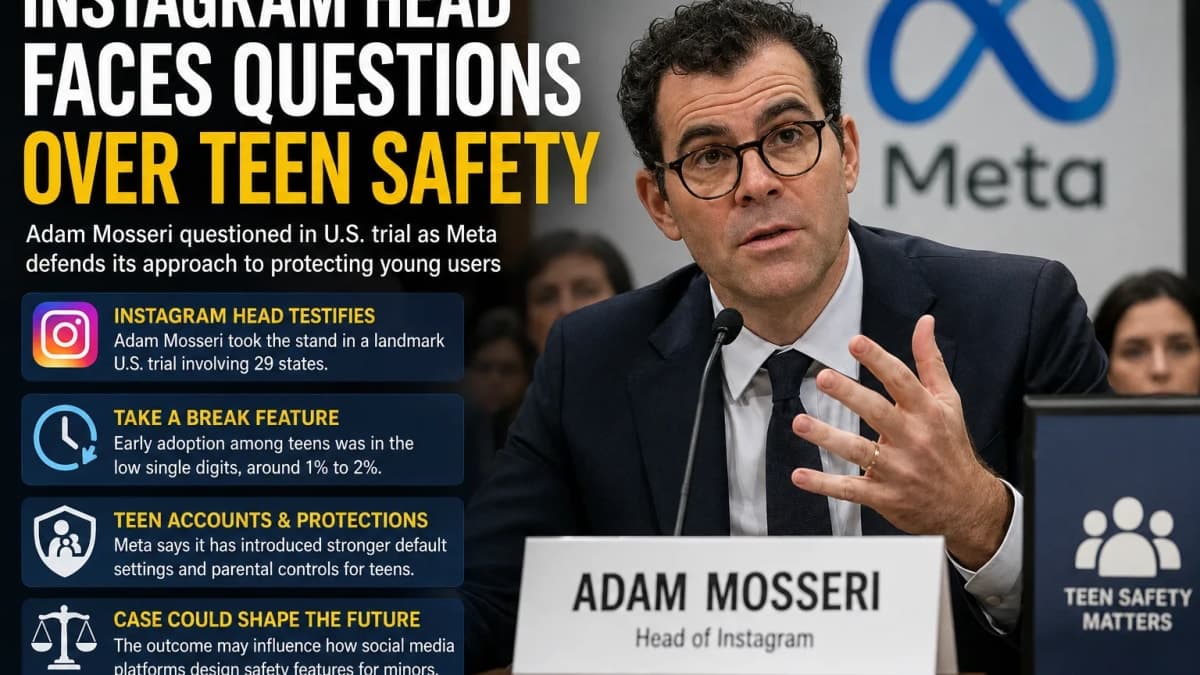
Instagram Head Faces Questions Over Teen Safety as Meta Defends Its Record in Court
Instagram head Adam Mosseri has been questioned about the platform’s approach to protecting teenagers as Meta faces a landmark U.S. trial over allegations that Instagram and Facebook were designed in ways that encouraged excessive use among young people.
Mosseri, who has led Instagram since 2018, took the witness stand in federal court in Oakland, California, on August 25. A major focus of the questioning was Instagram’s “Take a Break” feature, which was created to encourage users to step away from the app after spending a certain amount of time scrolling.
The testimony is significant because the case could influence how social media companies design products for children and teenagers in the United States.
What Is the Case Against Meta?
The broader legal action involves 29 U.S. states, which have accused Meta of designing Instagram and Facebook in ways that could encourage compulsive use among younger users.
Four states — California, Colorado, Kentucky and New Jersey — are at the center of the current trial. They allege Meta's products contributed to harms affecting young users while the company failed to adequately communicate risks associated with its platforms.
The broader coalition also alleges Meta improperly collected and used data belonging to children under 13, raising questions under federal children's privacy law. Meta disputes the allegations.
Instagram’s “Take a Break” Feature Comes Under Scrutiny
One of the most closely examined issues during Mosseri’s testimony was how teenagers interacted with Instagram's “Take a Break” feature.
The feature was introduced in 2021 and encourages users to leave Instagram temporarily after spending a selected amount of time on the service.
But before Instagram eventually made the feature a default for teenage accounts, only a small percentage of teens were using it.
During questioning, Mosseri acknowledged that adoption had been in the low single digits. Reports from the proceedings indicate early adoption was around 1% to 2% of teen accounts.
That figure became important because Instagram had previously highlighted another statistic: more than 90% of teenagers who activated reminders continued to keep them enabled.
The distinction is significant. A high percentage of users keeping a feature enabled does not necessarily mean a large percentage of Instagram's overall teenage audience was actually using it.
Why Was the Feature Not Enabled by Default Earlier?
Another major question concerned timing.
Instagram launched Take a Break in 2021, but the feature did not become a default setting for teenagers until September 2024, when Meta was rolling out its broader Teen Accounts initiative.
Mosseri rejected suggestions that Instagram intentionally delayed making the feature a default.
He explained that many teenagers did not initially want to use the tool, while Instagram ultimately decided to move forward with stronger default protections anyway.
That explanation highlights one of the central dilemmas facing social media platforms: whether safety tools should depend on teenagers voluntarily activating them or whether companies should impose stronger protections automatically.
Questions Over How Meta Presented the Safety Tool
The courtroom questioning also focused on how Instagram publicly described its teen-safety initiatives.
Ahead of Mosseri's December 2021 appearance before the U.S. Senate, Instagram published information promoting new protections for younger users.
Mosseri acknowledged during the current trial that Meta had not disclosed the very low overall adoption rate associated with Take a Break when discussing the feature publicly.
However, he pushed back against the broader suggestion that the company was trying to conceal information, arguing that the feature later became part of a substantially stronger system of protections for teenagers.
Meta Points to Teen Accounts and New Protections
Meta's defense extends beyond Take a Break.
The company has introduced Teen Accounts, which automatically apply stronger protections to younger users. These accounts include restrictions and parental-control features designed to give teenagers a more protected Instagram experience.
Mosseri argued that focusing on the early performance of a single safety feature does not provide a complete picture of the company's evolving youth-safety efforts.
Meta also disputes the broader allegations that its platforms were intentionally designed to addict children and maintains that research does not establish the straightforward causal relationship between social media use and adolescent harm alleged by its critics.
Why This Trial Matters Beyond Instagram
The importance of the case extends far beyond one Instagram feature.
For years, governments, parents, researchers and technology companies have debated how social media affects younger users.
The central regulatory question is increasingly shifting from whether companies should provide safety features to how those protections should work by default.
If an important protection requires teenagers to discover it, activate it and configure it themselves, regulators may question whether it provides meaningful protection at scale.
Default safety settings, by contrast, can potentially reach far more users without requiring them to take additional action.
The outcome of the Meta case could therefore influence future expectations for age verification, parental controls, notifications, recommendation systems and time-management tools across the wider social-media industry.
The Business Model Is Also Under Examination
Underlying the debate is the economics of social media.
Platforms such as Instagram compete heavily for users' attention because engagement can support advertising revenue. Critics argue this creates an inherent tension between maximizing time spent on a platform and encouraging users to disconnect.
Meta argues that this framing oversimplifies how its products work and ignores investments the company has made in safety, privacy and parental-control systems.
Determining where commercial incentives end and corporate responsibility begins is one of the larger issues surrounding the trial.
Balanced Analysis: Safety Features Are Only Part of the Question
Instagram's decision to eventually make stronger protections automatic represents an important evolution in its approach to younger users.
At the same time, the courtroom testimony raises a legitimate question about whether optional safety tools can be considered effective when only a small proportion of their intended audience activates them.
There is also an important distinction between acknowledging risks and proving legal responsibility.
Concerns about young people's mental health and excessive social-media use are serious, but establishing that specific platform-design decisions directly caused particular harms is a more complex legal and scientific question.
That is why the current trial could become particularly consequential.
Rather than simply debating whether social media can affect teenagers, the proceedings are examining what technology companies knew, what actions they took and whether those actions were sufficient.
What Happens Next?
The trial is expected to continue for several weeks, with testimony from additional current and former Meta executives and employees.
Mosseri's appearance puts one of Instagram's most senior decision-makers directly at the center of the debate.
Whatever the eventual verdict, the case is already highlighting a major shift in expectations surrounding social platforms.
For companies serving millions of teenagers, simply offering safety controls may no longer be enough. Regulators, parents and courts are increasingly asking whether those protections are effective, enabled by default and built deeply enough into the product to make a measurable difference.
This article is based on reporting published by Exchange4media.