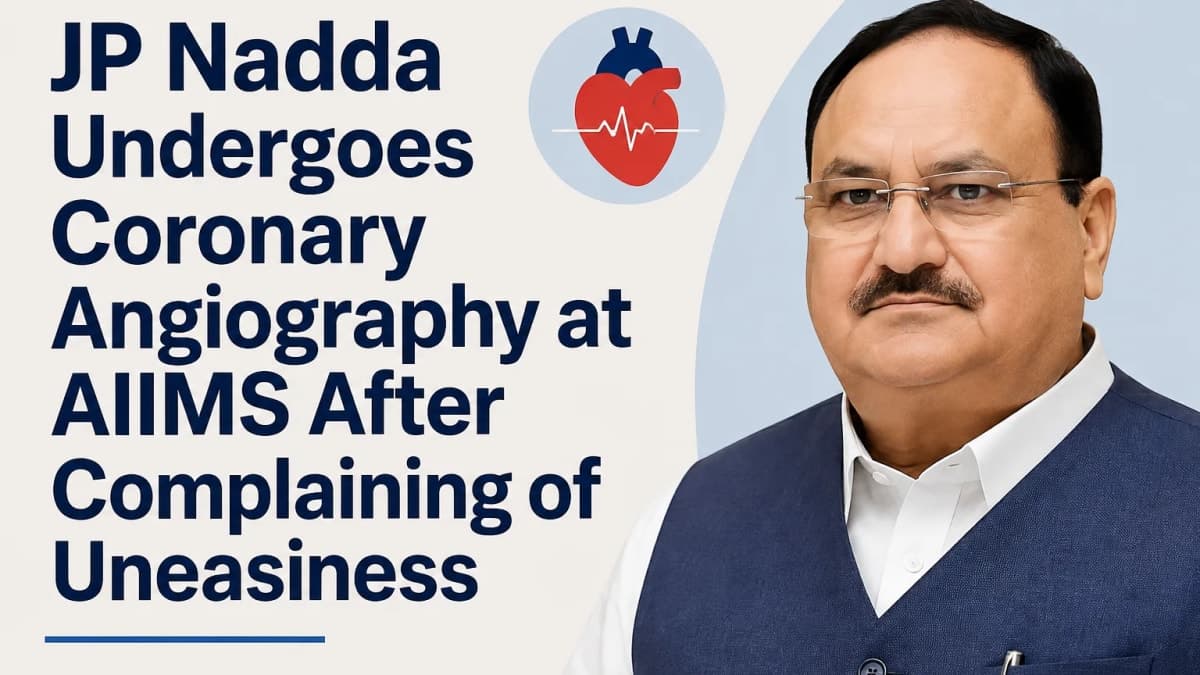
JP Nadda Admitted to AIIMS After Feeling Uneasy
Union Health and Family Welfare Minister JP Nadda was evaluated at the All India Institute of Medical Sciences (AIIMS), New Delhi, after complaining of uneasiness on Thursday evening.
As part of his medical assessment, doctors conducted several tests, including a coronary angiography on August 13, 2026. According to information released by AIIMS, Nadda is currently stable and has been kept under observation in the Department of Cardiology.
The hospital has not publicly disclosed the precise cause of his discomfort or detailed findings from the angiography.
What Is Coronary Angiography?
Coronary angiography is a diagnostic procedure doctors use to examine the blood vessels supplying the heart. It can help identify narrowing or blockages in the coronary arteries and provide doctors with information needed to determine whether further treatment is necessary.
Undergoing the procedure does not by itself establish that a patient has suffered a heart attack or has a particular cardiovascular condition. In Nadda's case, the publicly available hospital statement confirms the test and his stable condition but does not announce a specific diagnosis.
Nadda Remains Under Medical Observation
AIIMS said Nadda remains admitted to its cardiology department for observation. Keeping a patient under observation allows doctors to monitor vital parameters and assess whether additional investigation or treatment is necessary.
For now, the most significant official update is that the Union minister is stable. Further conclusions about his health would be premature unless AIIMS or his representatives release additional medical information.
Why the Health Update Matters
Nadda holds a significant position in the Union government as Minister of Health and Family Welfare. He has also been closely involved with India's healthcare policy and the expansion and functioning of the AIIMS network.
Earlier in 2026, Nadda addressed a leadership conclave involving presidents and executive directors of new AIIMS institutions, where he emphasised patient-centred care, teaching, research and institutional standards.
His admission to AIIMS therefore attracts both political and public attention because of his senior government responsibilities and his direct oversight of the country's health portfolio.
Balanced Analysis
The decision to conduct coronary angiography indicates that doctors considered a detailed cardiovascular assessment appropriate after Nadda reported uneasiness. However, the procedure alone should not be interpreted as evidence of a serious cardiac diagnosis.
The information released so far is limited but reassuring on one important point: AIIMS has described his condition as stable. Until doctors provide further findings, speculation about the underlying cause of his symptoms should be avoided.
The episode also highlights the importance of prompt medical evaluation when unexplained discomfort raises possible cardiovascular concerns. In the case of a senior public official, transparent but medically appropriate updates can help prevent misinformation while respecting patient privacy.
This article is based on reporting published by Moneycontrol News.