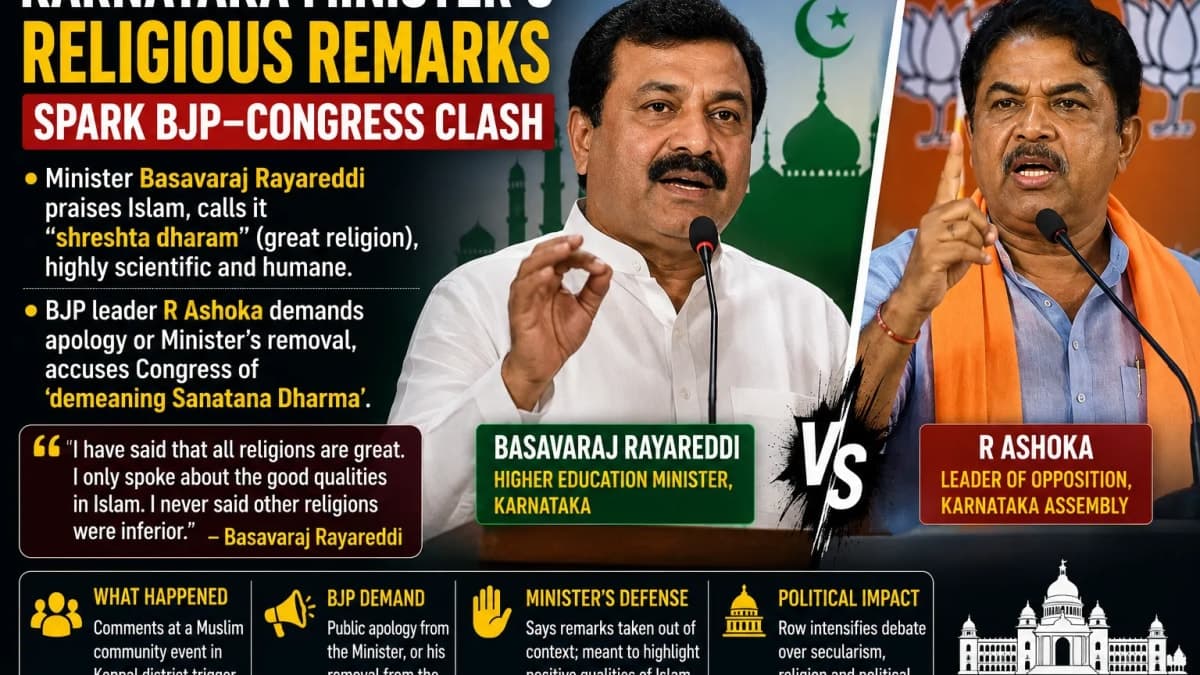
A fresh political confrontation has erupted in Karnataka after Higher Education Minister Basavaraj Rayareddi made remarks praising Islam at a Muslim community mass marriage programme in Kuknoor in Koppal district, prompting the opposition BJP to accuse the Congress government of disrespecting Hindu beliefs.
Rayareddi described Islam in strongly positive terms, referring to it as disciplined, scientific and humane. He also spoke about his interest in studying religions and expressed a desire to visit Mecca.
The remarks quickly became politically contentious after BJP leader and Leader of the Opposition in the Karnataka Assembly R Ashoka accused the minister of portraying Sanatana Dharma as inferior.
Ashoka has demanded that Rayareddi withdraw his comments and apologise. He said Chief Minister D K Shivakumar should remove the minister from the Cabinet if he refuses.
Rayareddi has subsequently defended himself, maintaining that his intention was to highlight what he sees as the positive qualities of Islam rather than diminish any other religion.
What Did Basavaraj Rayareddi Say?
The controversy originated from Rayareddi's address at the mass marriage programme organised by the Muslim community in Kuknoor.
During his speech, Rayareddi said:
“I would like to say that Islam is shreshta dharam (great religion) than other dharmas....”
He went on to say that he had attempted to study the Quran as well as other religions and their histories.
Rayareddi also described Islam as highly disciplined, highly scientific and humane.
However, his speech contained a broader appeal for religious tolerance as well.
“Read it, understand, and don't become bigots, don't become casteists,” he said, before arguing that people should respect different religions and learn from their positive teachings.
The minister also said there were good and bad people across religions and argued that faith should ultimately contribute to human welfare.
Minister Expresses Desire to Visit Mecca
Another part of Rayareddi's remarks that attracted attention concerned his desire to visit Mecca.
He said he had thought about travelling there but believed he could not do so as a non-Muslim.
The minister used the broader discussion to praise Islamic teachings while encouraging people to understand religion beyond ritual practices.
His remarks were subsequently circulated widely and became the focus of political criticism.
BJP Says Remarks Demeaned Sanatana Dharma
The BJP responded strongly, arguing that the minister's comments went beyond appreciating one religion and instead created a hierarchy between faiths.
R Ashoka accused Rayareddi of effectively portraying Sanatana Dharma as inferior.
Ashoka also targeted Chief Minister D K Shivakumar, questioning why the government had not acted against the minister.
The BJP leader demanded that Rayareddi withdraw his comments and apologise to Hindus across Karnataka.
If Rayareddi refuses to apologise, Ashoka said the Chief Minister should remove him from the Cabinet.
The BJP has also used the controversy to renew its broader allegation that the Congress government follows an “anti-Hindu” approach.
That description represents a political accusation by the opposition rather than an established fact.
BJP Turns Pressure Toward Chief Minister D K Shivakumar
The controversy has increasingly become a political test for the Chief Minister rather than remaining solely about Rayareddi's original speech.
Ashoka questioned Shivakumar's public temple visits while accusing his government of failing to respond when a Cabinet minister makes comments the BJP considers disrespectful toward Hindu beliefs.
The opposition is effectively asking the government to clarify whether Rayareddi's comments represent his personal opinion or have broader political acceptance within the administration.
That distinction could become important as the controversy develops.
A minister's personal comments about religion can quickly acquire wider political significance when opposition parties link them to the ideology or policies of the government in which that minister serves.
Rayareddi Says He Never Called Other Religions Inferior
As criticism intensified, Rayareddi offered an explanation of his remarks.
Speaking in Kalaburagi, he maintained that he had been discussing what he considered positive aspects of Islam and had not intended to diminish other religions.
“I have said that all religions are great. I only spoke about the good qualities in Islam. I never said other religions were inferior,” Rayareddi said.
His clarification is important because it differs from the interpretation advanced by the BJP.
The opposition argues that describing one religion as superior necessarily places others below it.
Rayareddi's defence is that his broader speech promoted respect for all faiths and opposed both religious bigotry and casteism.
The political dispute therefore concerns not only what words were spoken but also how those words should be interpreted within the wider context of his address.
Appreciation of Religion Becomes Political Flashpoint
The controversy illustrates the political sensitivity surrounding comparative statements about religion in India.
There is an important distinction between praising the teachings of a particular faith and declaring that faith superior to others.
Rayareddi's remarks have become contentious because the language attributed to him has been interpreted differently by the two sides.
The BJP is focusing on his use of “shreshta dharam” and other statements praising Islam.
Rayareddi, meanwhile, is emphasizing portions of his speech in which he encouraged people to respect all religions, reject bigotry and learn from the positive teachings found across different faiths.
That wider context does not erase the disputed language, but it helps explain why the minister rejects the BJP's characterization of his position.
BJP Raises Minority Appeasement Charge
The BJP has also linked the controversy to its longstanding accusation that the Congress engages in minority appeasement.
BJP spokesperson Ashok Gowda accused Rayareddi and the state government of making such statements to appeal to particular voters.
Again, this represents the BJP's political allegation rather than a demonstrated motive behind the minister's speech.
No evidence cited in the current reports establishes that Rayareddi's comments were made as part of an electoral strategy.
The controversy nevertheless gives the BJP an opportunity to push a familiar political argument about Congress's approach toward religious communities.
Why the Controversy Matters Beyond One Speech
Religious controversies involving serving ministers can become politically significant because Cabinet members speak from positions of public authority.
Even when comments represent an individual's personal beliefs, opposition parties can use them to question the wider government's position.
For Congress, the immediate challenge is therefore preventing Rayareddi's speech from developing into a broader debate over its approach toward Hindu and Muslim communities.
For the BJP, the controversy provides an opportunity to pressure the government on an issue with considerable emotional and political resonance.
The dispute also demonstrates how quickly comments made at a local community programme can become statewide political issues once video clips and quotations circulate through traditional and social media.
What Is Confirmed and What Is Political Claim?
Several distinctions are essential for understanding the controversy accurately.
It is confirmed that Rayareddi publicly praised Islam, described it using terms including scientific and humane, discussed his interest in religious study and expressed a desire to visit Mecca.
It is also confirmed that R Ashoka and other BJP leaders have criticised those remarks and demanded an apology or action against the minister.
Rayareddi has subsequently stated that he considers all religions great and did not intend to say that other religions were inferior.
By contrast, allegations that the remarks prove Congress is “anti-Hindu” or were motivated by minority appeasement are political claims made by BJP leaders. They should not be presented as established facts.
Similarly, Rayareddi's descriptions of the qualities of a particular religion are his personal assessments rather than objectively verifiable judgments about one religion relative to another.
Maintaining those distinctions is particularly important when reporting disputes involving religious belief.
Political Pressure Could Continue
The immediate question is whether Rayareddi's clarification will be enough to contain the controversy.
The BJP's demand goes further than seeking an explanation. It wants the minister to withdraw the disputed remarks and apologise, with removal from the Cabinet proposed as the alternative.
Rayareddi, meanwhile, has defended the broader intention behind his comments.
That leaves the government facing a political decision over whether additional clarification or action is necessary.
Until then, the controversy is likely to remain another flashpoint in Karnataka's increasingly sharp political contest between the ruling Congress and opposition BJP.
Conclusion
Basavaraj Rayareddi's remarks have evolved from a speech at a community marriage programme into a wider political dispute over religion, secularism and the responsibilities of public officials.
The BJP maintains that his comments demeaned Sanatana Dharma and has demanded an apology or his removal from the Cabinet.
Rayareddi rejects that interpretation, saying he was highlighting positive qualities he sees in Islam while maintaining that all religions are great.
The difference between those two interpretations now sits at the heart of the controversy.
As the BJP increases pressure on Chief Minister D K Shivakumar, the political impact of the episode will depend on whether Rayareddi's clarification ends the dispute—or gives the opposition further ammunition against the Congress government.