Kerala Left Alliance Faces Growing Dispute Over Deputy Opposition Leader Post
Introduction
A leadership dispute inside Kerala’s Left Democratic Front has escalated into an unusually public confrontation between its two principal constituents, the Communist Party of India (Marxist) and the Communist Party of India.
At the centre of the disagreement is the Deputy Leader of the Opposition post in the Kerala Legislative Assembly.
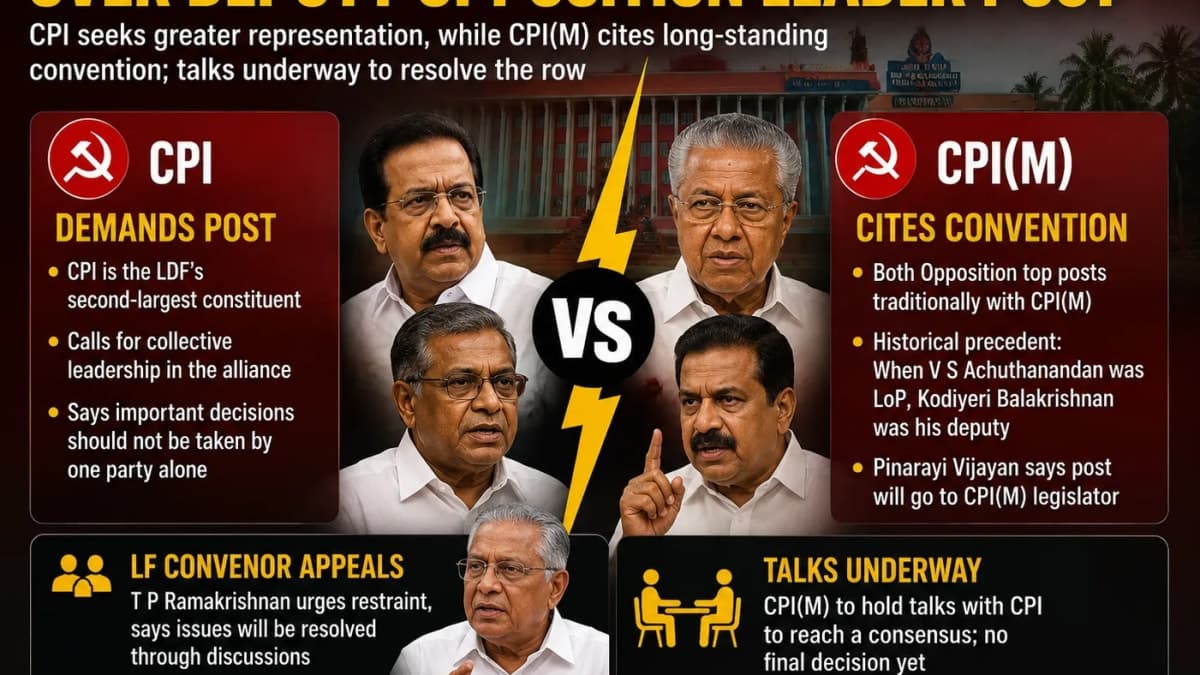
The CPI, the LDF’s second-largest constituent, is demanding the position as part of what it argues should be a more collective leadership arrangement following the alliance’s defeat in the 2026 Assembly election.
The CPI(M), however, has resisted the demand. Its leaders argue that both the Leader of the Opposition and deputy leader positions have traditionally remained with the CPI(M).
The disagreement has now moved beyond internal negotiations, spilling into party publications, social media and exchanges involving senior leaders and youth organisations.
Why CPI Wants the Deputy Opposition Leader Post
The CPI’s argument goes beyond simply seeking another Assembly position.
The party maintains that as the second-largest constituent of the LDF, it should have greater representation in the Opposition leadership structure.
Following the LDF’s election defeat, the alliance has also emphasised the importance of collective leadership — a principle the CPI believes should be reflected in the distribution of significant parliamentary responsibilities.
CPI state secretary Binoy Viswam has been among the prominent voices supporting the party’s position.
The CPI argues that coalition politics requires important decisions to be taken collectively rather than being determined by the dominant constituent alone.
That argument has transformed the dispute from a fight over an Assembly designation into a wider debate about how power should be shared within the LDF.
CPI(M) Cites Long-Standing Convention
The CPI(M) has taken a different position.
Its leaders argue that established Left parliamentary practice in Kerala supports keeping both the Leader of the Opposition and Deputy Leader positions with the CPI(M).
CPI(M) state secretary M V Govindan previously pointed to historical precedent, noting that when V S Achuthanandan served as Leader of the Opposition, Kodiyeri Balakrishnan served as his deputy.
The CPI(M)’s position is therefore that handing the deputy position to an alliance partner would depart from the arrangement traditionally followed by the Left.
Former chief minister and current Opposition Leader Pinarayi Vijayan has also maintained that the position should go to a CPI(M) legislator.
His comments intensified the disagreement rather than settling it.
Pinarayi Vijayan’s Comments Trigger CPI Criticism
The confrontation escalated after Vijayan publicly rejected the CPI’s claim.
He said the appointment of the Deputy Leader of the Opposition required him to send a letter to the Assembly Speaker and indicated that the name recommended would be that of a CPI(M) legislator.
The CPI reacted strongly.
Binoy Viswam criticised Vijayan’s remarks, while the party argued that a political decision involving the LDF should not effectively be made by one leader or one constituent.
CPI assistant secretary Sathyan Mokeri subsequently addressed the issue in an article in the party mouthpiece Janayugom, arguing for collective leadership within the alliance.
The dispute consequently moved from private coalition discussions into the public political arena.
Party Mouthpieces Join the Battle
The confrontation has increasingly been fought through the official publications associated with both communist parties.
Mokeri’s Janayugom article drew a response from CPI(M) state secretariat member C N Mohanan in Deshabhimani.
Mohanan defended the CPI(M)’s position and argued that the Opposition leader and deputy leader posts have historically remained with the CPI(M) under Kerala’s front system.
The increasingly public nature of the exchanges is significant.
Coalition disagreements are common, but Kerala’s Left parties have historically attempted to resolve many of their differences through internal front mechanisms.
The use of party publications to challenge each other indicates how difficult the Deputy Opposition Leader issue has become to contain.
‘Pressure Tactic’ and ‘Master-Servant’ Remarks Escalate Row
The language surrounding the disagreement has also become sharper.
C N Mohanan accused the CPI of employing a “pressure tactic” over its demand.
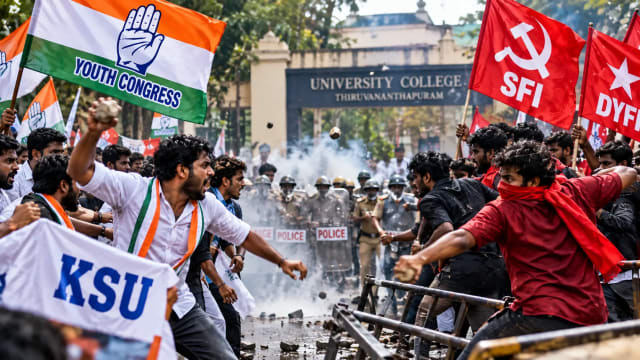
The dispute then expanded further as leaders associated with the youth wings of the two parties became involved.
AIYF state secretary T T Jismon and DYFI state secretary M Vijin joined the public exchanges.
The increasingly confrontational language has turned what could have remained an organisational negotiation into a test of relations between the CPI(M) and CPI.
LDF Convenor Calls for Restraint
With the argument becoming increasingly public, LDF convenor T P Ramakrishnan has attempted to lower tensions.
Ramakrishnan urged leaders within the alliance to exercise restraint in their public comments and said discussions were continuing to resolve the disagreement.
He said:
“Problems should be resolved through discussions and efforts in that direction are continuing.”
Ramakrishnan also emphasised that differences of opinion naturally arise within a political front and should ultimately be settled collectively.
His intervention signals that the LDF leadership recognises the political damage that could result if the disagreement continues escalating.
CPI(M) and CPI Expected to Hold Talks
Despite the increasingly heated exchanges, there are signs that the dispute could return to negotiations.
The CPI(M) has indicated that it will hold discussions with the CPI in an effort to settle the leadership issue.
That makes a negotiated compromise possible, although neither side has publicly abandoned its central position.
For the CPI, backing down after repeatedly demanding the post could create questions about its influence within the coalition.
For the CPI(M), conceding the position would require changing a convention that it has repeatedly cited as justification for retaining the post.
The challenge therefore involves finding a solution that allows both parties to claim that their larger political concerns have been respected.
The Dispute Began After LDF’s 2026 Election Defeat
The political context is crucial to understanding why the disagreement has become so sensitive.
The Congress-led United Democratic Front defeated the LDF in the 2026 Kerala Assembly election, ending the Left alliance’s decade-long period in government.
Pinarayi Vijayan subsequently became Leader of the Opposition.
The electoral defeat triggered wider discussions inside the Left about leadership, organisational weaknesses and the future direction of the alliance.
Against that backdrop, the CPI has argued for a more meaningful role in Opposition leadership.
The Deputy Leader dispute therefore comes at a moment when the LDF is already reassessing how it functions after losing power.
Why a Seemingly Small Post Has Become a Big Political Issue
The Deputy Leader of the Opposition position may appear relatively modest compared with the Leader of the Opposition post.
Politically, however, the dispute has become symbolic.
For the CPI, the question is whether the LDF’s second-largest party receives meaningful recognition within the alliance’s leadership structure.
For the CPI(M), the issue involves maintaining a long-established parliamentary convention and preserving the authority associated with being the dominant party within the coalition.
That turns the argument into something larger than deciding who receives a title.
It has become a debate about power-sharing, consultation and coalition management.
IUML Support Adds an Unexpected Dimension
The CPI has also received support from an unexpected quarter.
The Indian Union Muslim League (IUML), which belongs to the Congress-led UDF rather than the LDF, has backed the CPI’s argument for the Deputy Opposition Leader position.
That outside support does not determine how the LDF will settle its internal dispute, but it adds another political dimension to the controversy.
The ruling coalition can potentially use the disagreement to portray the Opposition as divided at a time when the LDF is trying to rebuild after its election defeat.
Dispute Risks Distracting LDF From Opposition Role
The prolonged confrontation creates a broader political challenge for the Left.
Following a decade in government, the LDF must adjust to its role as Kerala’s principal Opposition alliance and develop a coordinated strategy for challenging the new UDF government.
An extended internal battle over leadership positions risks distracting the alliance from that objective.
It can also complicate attempts to project unity inside the Assembly.
The disagreement has already affected coordination between the two Left parties. Earlier in the dispute, the CPI had declined to participate in an LDF legislature party meeting while its demand remained unresolved.
That demonstrates how an argument over one position can potentially influence the alliance’s wider functioning.
What Happens Next?
The immediate focus will be on negotiations between the CPI(M) and CPI.
LDF convenor T P Ramakrishnan has made clear that the alliance intends to address the disagreement through discussions, while CPI(M) leaders have also indicated that talks will take place.
Several outcomes remain possible.
The CPI(M) could retain the Deputy Opposition Leader position, the CPI could ultimately secure it, or the parties could devise another arrangement that gives the CPI greater representation while allowing the CPI(M) to preserve its position on parliamentary convention.
At present, however, no final settlement has been officially announced.
Any claim that either party has secured the position should therefore be treated cautiously until the LDF formally resolves the issue.
Why the Row Matters Beyond One Assembly Position
The biggest consequence of the dispute may ultimately have little to do with the Deputy Opposition Leader title itself.
The controversy is testing whether the LDF can translate its commitment to collective leadership into an arrangement acceptable to both its dominant party and its principal junior partner.
After losing the 2026 election, maintaining internal unity is particularly important for the Left.
The CPI(M) remains the dominant force within the coalition, but the CPI wants greater recognition of its role in shaping Opposition politics.
How the LDF resolves the disagreement could therefore provide an early indication of how power will be distributed inside the alliance during its period outside government.
For now, the dispute remains unresolved — and what began as a disagreement over an Assembly position has evolved into a broader test of unity, consultation and leadership within Kerala’s Left coalition.